dailynewsnblog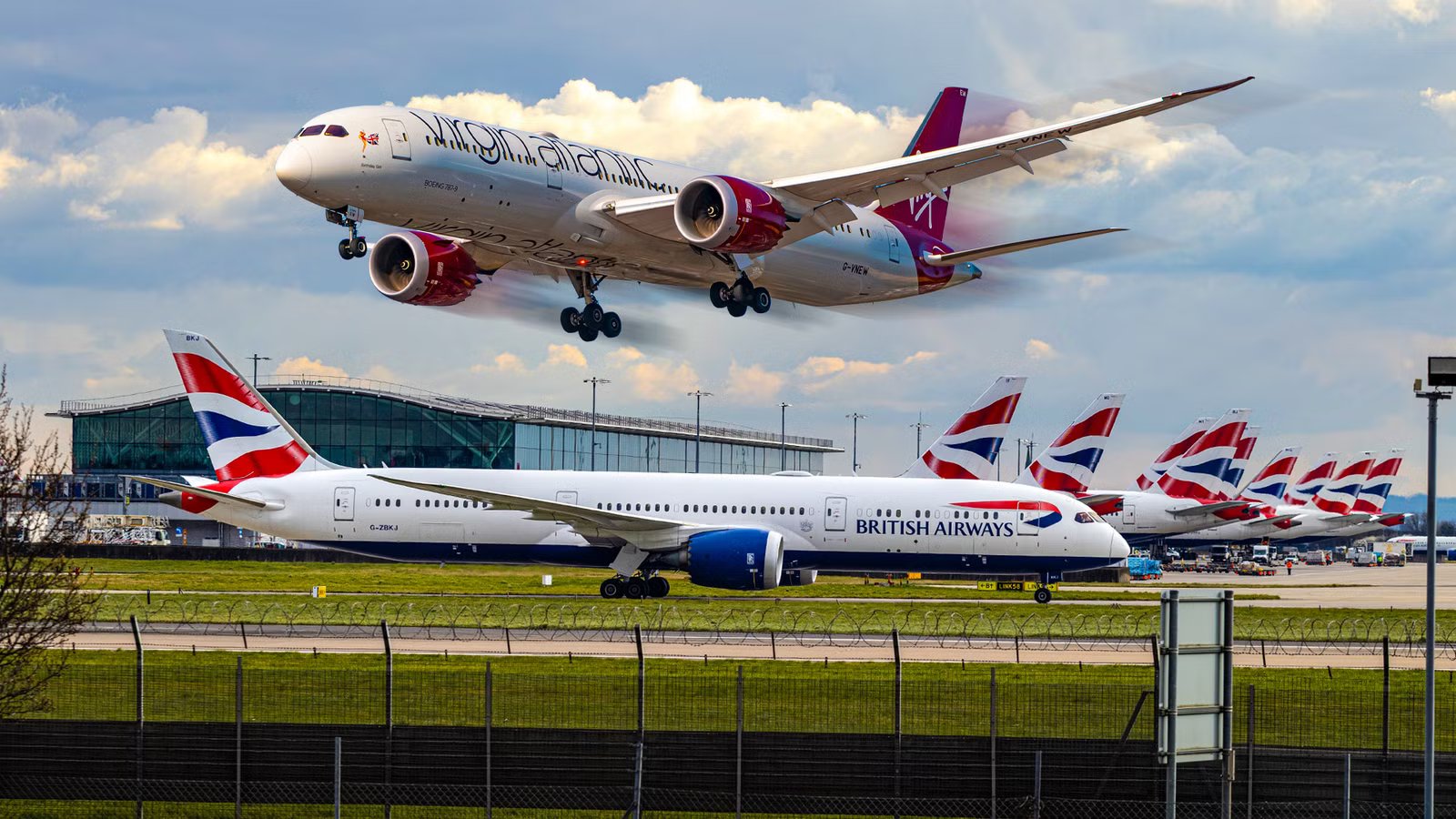
In Europe, there are dozens of different legacy carriers, some of which are among the world’s highest-rated airlines with the most extensive route networks. These carriers include the likes of  British Airways, Air France, Turkish Airlines (if you consider it a European airline, which geographically, it is), Lufthansa, and many more. These carriers all maintain membership in the largest global alliances, such as the SkyTeam and Star Alliance.
However, across the board, there is typically just one legacy carrier per nation, due to several factors related to the long-term development of the aviation industry, alongside extensive consolidation that has taken place over the years. This can be observed across the continent. Even in some of the largest European aviation markets, there is only one long-haul legacy airline. In Germany, there is just Lufthansa. In France, there is just Air France.
The United Kingdom is in a unique position

Sometimes, there may be a legacy carrier that serves as the flagship airline for multiple different countries, such as Scandinavian Airlines (SAS), which operates out of multiple different Scandinavian countries. There are other long-haul carriers, such as LEVEL, Condor and Norse Atlantic, but these are not full-service network airlines as they do not primarily cater to business travelers and operate premium services. Furthermore, these carriers do not have membership in large-scale airline industry alliances or have well-developed loyalty programs.
While most European nations have a single legacy carrier, there is one important exception to note. The United Kingdom, one of the continent’s largest air travel markets and most important hubs for business travelers, is home to two different massive legacy airlines, each of which has a pretty substantial global footprint. The first of these two is British Airways, the nation’s long-time flag carrier and member of the Oneworld alliance. The carrier’s origin story is relatively straightforward, as it emerged from a series of mergers as the nation’s largest and most important carrier.
Even today, British Airways, with its principal hub at London Heathrow Airport (LHR), remains the most important airline in the UK and operates the most services from the country. The carrier has a full network of short-haul flights around Europe and a massive long-haul network that connects points across the globe. In almost every other European nation, the legacy airline maintains near-complete market dominance, with relatively few competitors across the board.
In the United Kingdom, however, there is a second legacy carrier that plays an important role in the market. Virgin Atlantic, the largest and most successful airline to ever come out of Richard Branson’s Virgin Group, is one of the largest and most important long-haul airlines to emerge in Europe. The airline operates business-class cabins and has an extensive lounge network, all features that help it target business travelers. Furthermore, it is also a full member of the SkyTeam alliance, which it joined back in 2023, according to The Points Guy.
While it does not have a short-haul network, it does have partnership agreements with SkyTeam carriers from across the continent which enable it to provide it with short-haul connectivity to complement its impressive global network. The airline operates a fleet of widebody jets, which offer three-cabin configurations, all hallmarks of a legacy airline.
Therefore, all of this begs an interesting question: how was the UK market able to develop and support two different long-haul full-service airlines where nowhere else on the continent this can be observed? In this article, we will attempt to find an answer to this question.
A brief history of how Virgin Atlantic came to be

The story of Virgin Atlantic began in 1984 when the company was founded by Randolph Fields and Alan Hellary as British Atlantic Airways, an airline that was initially going to operate flights between London and the Falkland Islands. However, runway limitations at Port Stanley Airport (PSY) prevented large intercontinental aircraft from operating there. The airline then turned its eyes to the high-demand lucrative flight corridor between London and New York, but its initial applications to receive a license for flights between London Gatwick Airport (LGW) and New York’s John F. Kennedy International Airport (JFK) were rejected.
Staring down no financial pathway forward, Field and Hellary partnered with Richard Branson of the Virgin Group, who acquired a majority stake in the carrier and quickly rebranded the airline as Virgin Atlantic. The carrier soon launched flights, with the inaugural service taking place between Gatwick and Newark Liberty International Airport (EWR) on June 22nd, 1984, using a leased Boeing 747-200. The company was profitable within its first year, a rare achievement for a new commercial airline.
It was pretty clear from the beginning that Virgin Atlantic was going to be a major player in the UK aviation market. The carrier expanded quickly throughout the 1980s, with flights to Miami, Tokyo, Los Angeles, and multiple other major cities. After the UK’s bilateral air treaty restrictions were relaxed in the 1991 revision of the Second Bermuda Agreement, which governed flights between the US and London, Virgin Atlantic was finally able to start flying from Heathrow in 1991.
The airline competed fiercely with British Airways for market control

In response to Virgin’s decision to enter the Heathrow market, the airline was now poised to directly compete with British Airways for high-spending business travelers, something which was a cause for major concern. British Airways launched its infamous “dirty tricks” campaign in an attempt to tarnish Virgin’s reputation, something which resulted in a libel lawsuit that Virgin ultimately won. According to the Guardian, British Airways was required to pay around $5 million in total damages and legal fees, which Richard Branson donated to Virgin Atlantic staff.
Virgin Atlantic also attempted to challenge British Airways, by adopting slogans like “Now Way BA” and later rebranded itself as the UK’s flag carrier when British Airways made the interesting decision to remove the Union Jack from its aircraft liveries. Despite their competitive dynamics in the 80s and ’90s, the two allegedly collaborated to fix prices with British Airways and Cathay Pacific, a scandal that would undoubtedly tarnish Virgin’s reputation.
Today, the airline has rebounded from financial struggles that were induced by the COVID-19 pandemic and has since joined the SkyTeam alliance. The carrier secured a financial rescue package of over $1.3 billion to avoid bankruptcy following the pandemic and introduced cargo operations to its fleet to generate auxiliary revenue. Despite its struggles, the carrier today remains an influential legacy carrier in the UK market.
So how did Virgin Atlantic manage to survive as a full-service carrier?

This question is objectively a bit harder to answer. One of the biggest challenges that a new airline faces when attempting to enter the market as a legacy carrier is the extensive market presence, identity, and history that a flag carrier like British Airways already has.
Richard Branson, however, was able to effectively use his image and the Virgin Group’s reputation to help attract customers, and his company was not afraid to go toe to toe with British Airways. Collectively, these two carriers have created one of the longest-standing and most impressive airline rivalries in commercial aviation. At the end of the day, however, competition is good for the customer, and having more airlines in the market will ultimately result in lower fares and more options for customers.