dailynewsnblog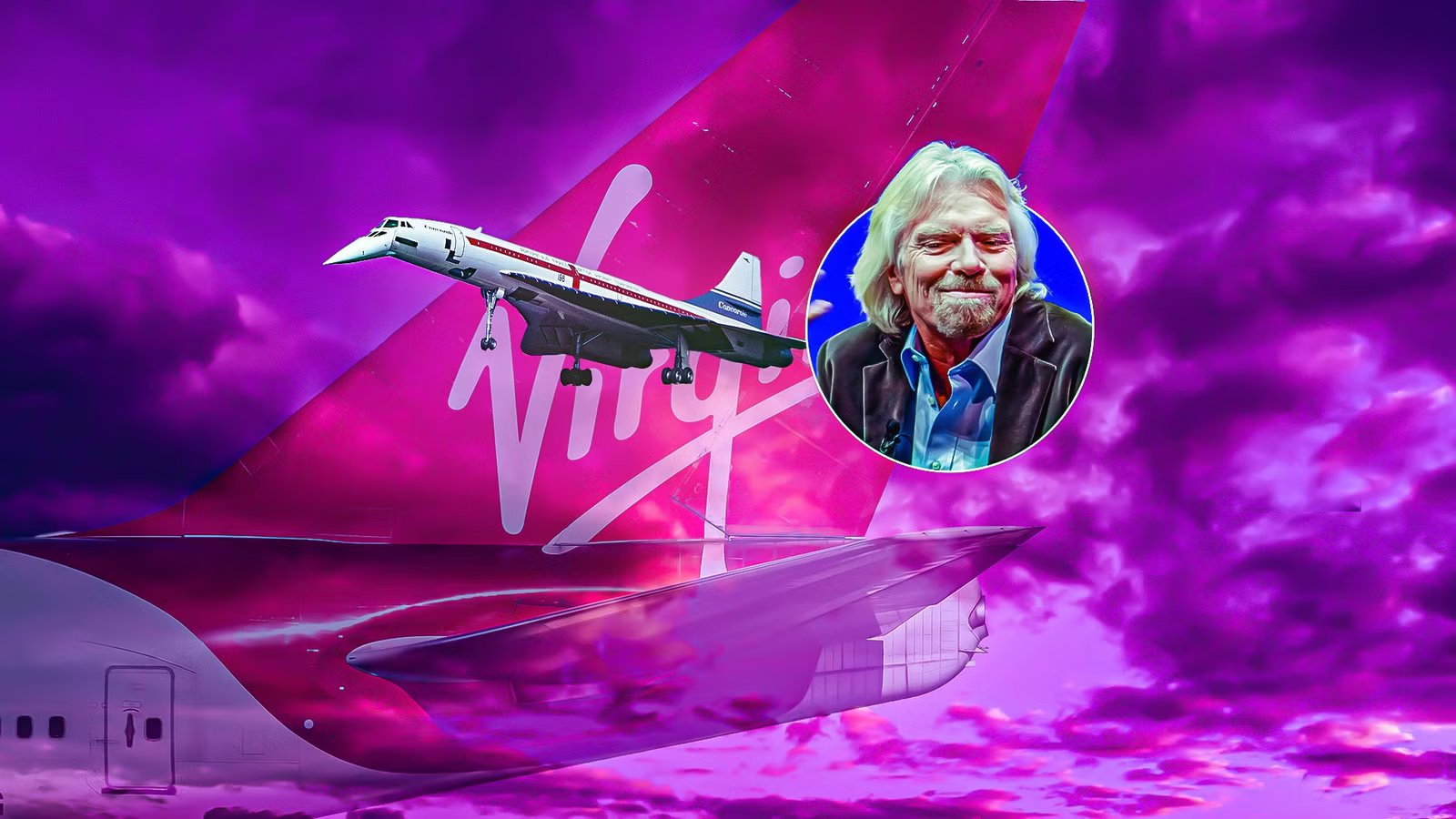
For decades, Sir Richard Branson has sought to restore supersonic airline travel after Concorde’s grounding in 2003. He first tried to purchase the handful of remaining examples from British Airways, seeking government support after unsuccessful initial attempts. Years later, Branson partnered with the startup Boom to develop a new aircraft to bring passengers from London to New York in 3.5 hours.
Let’s take a look back in time to see why Concorde stopped flying and how Britain’s most iconic billionaire attempted to get it back to the skies.
Concorde overview

First introduced in 1976, Concorde was a supersonic jetliner, manufactured through a partnership between Sud Aviation (later Aérospatiale) and the British Aircraft Corporation (BAC).
Despite breaking new ground in commercial aviation, Concorde never reached its predicted success. After 100 options from various major airlines had been received, analysts estimated a market of 350 aircraft. However, only 20 were built (six prototypes and 14 production examples), partially due to delays and cost overruns.
Operated by British Airways and Air France, Concorde flew a range of routes, including London–Bahrain, London–New York, London–Miami, and London–Barbados (with British Airways), and Paris–Dakar–Rio de Janeiro, Paris–Azores–Caracas, Paris–New York, and Paris–Washington (with Air France). Both airlines suffered from low profitability, and it wasn’t until British Airways repurposed Concorde as a super-premium service that it became genuinely profitable.
Concorde was also operated at a substantially smaller scale by Braniff International Airways as part of an interchange agreement with BA. This carrier flew the jet at subsonic speeds between Dulles International Airport and Dallas Fort Worth International Airport, from January 1979 until May 1980.
There was also a short-lived arrangement between Singapore Airlines and British Airways that lasted three flights during December 1977. Further flights ran via the Singapore Airlines-British Airways collaboration from January 1979 to November 1980.
Concorde flew commercially for 27 years (including a brief hiatus in the early 2000s), but it was retired in 2003. All but two are now preserved in museums across Europe and North America. Its specifications were as follows:
|
Capacity |
92-120 (128 in high-density layout) |
|---|---|
|
Wingspan |
84 ft (25.6 m) |
|
Empty weight |
172,504 lb (78,700 kg) |
|
Powerplant |
4 × Rolls-Royce/Snecma Olympus 593 Mk 610 turbojets, 31,000 lbf (140 kN) thrust each dry, 38,050 lbf (169.3 kN) with afterburner |
|
Cruising speed |
1,165 knots |
|
Ceiling |
60,000 ft (18,300 m) |
|
Runway requirement (with max load) |
11,800 ft (3,600 m) |
Why did Concorde stop flying?

Concorde’s final flight was on November 26, 2003, with the aircraft making the short hop from Heathrow Airport in London to Bristol. The aircraft stopped flying primarily because it had ceased to be commercially viable. Passenger numbers began to decline, particularly after Air France’s tragic crash in Paris in July 2000. The answer to questions about what caused the crash was answered by a piece of metal that had fallen off a Continental Airlines DC-10 minutes before flight 4590’s takeoff.
109 people aboard and four people on the ground died in the crash. Such a publicly visible disaster made many potential customers reluctant to fly on Concorde. Passenger numbers began to decline, and with an average Concorde flight consuming 6,771 gallons of fuel according to the National Air & Space Museum, it became impossible for operators to continue making money from supersonic airliners. The decline in international travel following the 9/11 attacks was the last straw to ground Concorde.
Moreover, Concorde faced challenges from the emerging environmental movement, who were opposed to noise and air pollution vastly higher than those of a conventional airliner. Following the final flight in November 2003, every Concorde was grounded, and the surviving examples were preserved primarily in museums.
Branson’s attempts to buy Concorde

The head of Virgin Group made an audacious bid to secure Concordes for Virgin Atlantic the day after British Airways and Air France announced they would be retiring on April 10, 2003. The Independent reported that he had offered just £1 for each Concorde, the same price British Airways paid for them.
Expectedly, this offer was rejected. Yet, Branson continued to escalate from his initial PR-driven bid, offering £1 million and then £5 million for each aircraft. They planned to fly the five most airworthy aircraft and use the two grounded for spare parts and repairs. Their fleet of five Concords would fly from the UK to Dubai, Washington, New York, and Barbados.
Even if no profitable outcome had been possible, Virgin intended to found a charitable heritage trust that would keep at least two supersonic jetliners flying, with Branson making an initial donation of £1 million. Despite this drastic increase and Virgin Group’s other commitments, Branson could still not purchase any Concordes.
Virgin Group called this refusal ‘industrial vandalism,’ and The Guardian reported that a spokesperson had said that “it is a disgrace to the airline industry, an industry which we all love. There is no reason why the aircraft cannot still fly in some form for the nation.”
Branson asks the UK Government to intervene

After British Airways refused to sell their Concordes to Virgin Group, Branson sought government help. He contacted the Labour Party’s Trade and Industry Secretary at the time, Patricia Hewitt, to outline the reasons he believed British Airways had to sell him the aircraft.
Branson cited a supposed clause in the 1980s deal to privatize British Airways, which the government had previously owned.
He claimed the clause stated that another airline must be allowed to operate the supersonic fleet if British Airways decided it was no longer viable. The alleged clause was in place to protect an asset that had been developed with billions in taxpayers’ money. Government officials found no trace of such a clause.
Branson then referred back to the terms of an Anglo-French treaty signed in 1962, which he claimed gave Airbus, the successor of Concorde’s French manufacturer, an obligation to maintain the fleet. Airbus replied that it would refuse to support Concorde beyond its retirement, as set by British Airways.
The BBC reported that Hewitt noted in her reply to Branson that “it is not for the government to decide on either the cessation of Concorde services or the disposal of the aircraft concerned.”
As a result, Hewitt refused to intervene. British Airways published a list of acceptable museums and private collectors to whom it was prepared to sell the surviving Concorde airframes, and soon, the remaining aircraft had been offloaded.
Boom Supersonic’s passenger aircraft

Having been unsuccessful in all efforts to purchase the world’s only supersonic jetliner, Branson and the Virgin Group went back to the drawing board. They decided to work with Denver-based startup Boom to create a prototype of a new supersonic passenger airliner in collaboration with Virgin Galactic in 2016. Branson told The Guardian:
“I have long been passionate about aerospace innovation and the development of high-speed commercial flights. As an innovator in the space, Virgin Galactic’s decision to work with Boom was an easy one. We’re excited to have an option on Boom’s first 10 airframes. Through Virgin Galactic’s manufacturing arm, the Spaceship Company, we will provide engineering and manufacturing services, along with flight test support and operations as part of our shared ambitions.”
Together, they aimed to develop a safe and reliable jet that could fly passengers from London to New York in 3.5 hours, charging a relatively affordable $5,000 return for the privilege. This represented a similar fare to a business-class ticket for the same journey.
The aircraft development occurred while Boeing and Lockheed Martin were developing similar aircraft. Named Overture, Boom Supersonic’s aircraft is set to travel at Mach 1.7. They have raised $150 million from investors to develop the aircraft and plan to raise a further $500 million for a manufacturing facility.
Had the London-New York trial been successful, 500 further routes would have been proposed within a supersonic flight market estimated to be worth $100 billion. Branson hoped that test flights of the aircraft could begin in Southern California in time for the first commercial departures in 2023, marking the 20th anniversary of Concorde’s decommissioning by British Airways and Air France.
Black Scholl, the CEO of Boom, told The Guardian why he thought his aircraft would succeed where Concorde had failed. He stated that “60 years after the dawn of the jet age, we’re still flying at 1960s speeds. Concorde’s designers didn’t have the technology for affordable supersonic travel, but now we do.”
Boom’s proposed aircraft did have some shortcomings that Concorde had not experienced, as the capacity would only have been 45-50 passengers, rather than Concorde’s 92-128.
The future of supersonic airline travel

Despite the great optimism in 2016 that we would soon see supersonic air travel, these flights are still yet to materialize. The agreement made between Boom and Virgin Galactic expired in August 2020. A Boom spokesperson told Simple Flying that this agreement had ended by mutual consent.
Losing the Virgin Galactic partnership is a substantial setback for Boom Supersonic, but it hopes that its flagship Overture aircraft, dubbed the ‘New Concorde’, will be in the skies by 2030.
The Virgin Group also remains interested in pursuing supersonic travel. The company has said that it is “interested in the development of high-speed, sustainable forms of air travel, and we continue to monitor developments in this area closely.” One almost certain thing is that we will never see Concordes in the sky again now that all remaining airframes have been in storage for over 20 years.