dailynewsnblog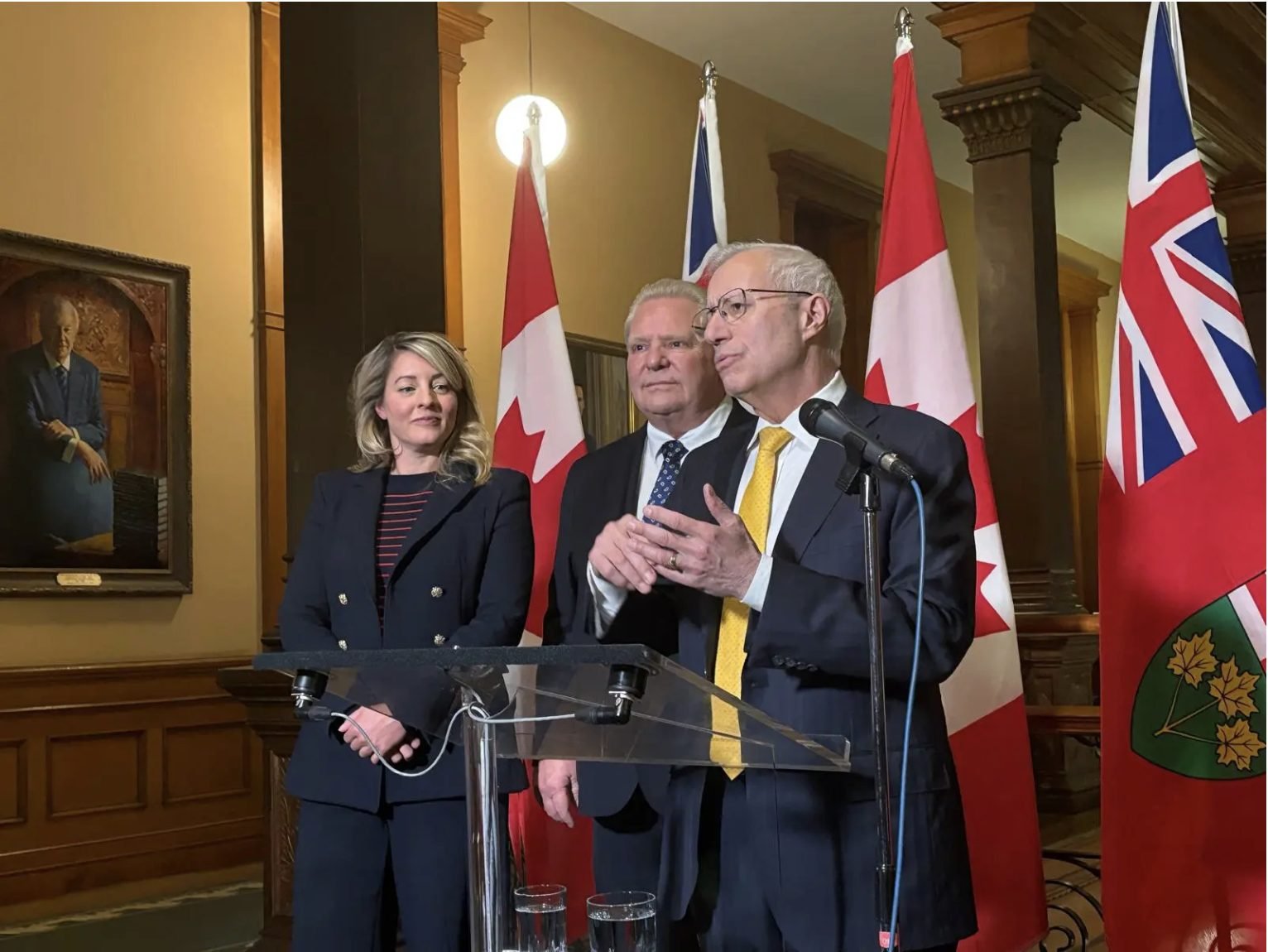
“We’re a big family across the country,” Ford told reporters.
Premier Doug Ford and federal Industry Minister Mélanie Joly emerged from a closed-door meeting Monday portraying a united front on the future of Canada’s auto sector.
“We’re a big family across the country,” Ford told reporters.
“Sometimes families disagree, but make no mistake about it, probably 98 per cent of the time, we agree.”
The meeting came amid growing concern in Ontario over Ottawa’s handling of trade with China, the expected arrival of tens of thousands of Chinese-made EVs beginning March 1, and the broader impact on Canada’s auto industry, which is heavily concentrated in southern Ontario.
Joly confirmed the federal and Ontario governments will establish a joint auto task force, aimed at coordinating strategy on investment, electrification, workforce protection, and supply chains.
“We decided to work together and to create an auto task force between Ontario and the federal government,” she said. “It’s about future strategic investments, protecting workers, particularly unionized ones, and making sure we maintain a strong industrial base here in Canada.”
She added that national security concerns, including the security of software in vehicles, will also be a key consideration.
“We will never compromise the security of Canadians,” Joly said.
The minister acknowledged that approximately 49,000 Chinese EVs are expected to begin entering the Canadian market in the coming weeks, and said conditions will be attached to those imports, though she offered few specifics.
“We will be able to inform you with more details in the coming weeks,” she said.
Ford, who has been openly critical of Ottawa’s China policy in recent weeks, reiterated that his primary concern is protecting Ontario auto workers.
“If a company wants to come in, whether from China, Europe or Asia, we have one request: build the vehicles here,” he said. “Protect the auto sector. Make sure we get the parts here. Make sure we get the technology here.”
Asked last week by QP Briefing/iPolitics about whether he would consider putting forward legislation to make sure Canadian workers and parts are used if a Chinese company does come to Canada, Ford said simply that “everything is on the table.”
When asked about whether he thinks the reason why Ontario was left out of the conversations with China had anything to do with his government anti-tariff ad featuring Ronald Reagan that derailed talks with the U.S., he dismissed the suggestion outright.
“That has absolutely nothing to do with that whatsoever,” he said. “That’s long, long past.”
Joly was also pressed on why Ontario, the home to the bulk of Canada’s auto manufacturing, was left out of negotiations with China.
She rejected the idea that Ontario had been excluded, saying the prime minister had work to do on the trade file but that provinces continue to be engaged.
“The prime minister and the premier had a really positive conversation today,” she said, adding they are expected to meet again later this week in Ottawa during the First Ministers Meeting. “We will always bring along Ontario. We will always bring along the different premiers.”
She didn’t specify why the federal government decided to not bring along to Beijing an Ontario representative.
Details of the auto task force are still to be unveiled, Joly said.