Why Some US Indian Reservations Prosper While Others Struggle


Our colleague Thomas Stratmann writes about the political economy of Indian reservations in his excellent Substack Rules and Results.

Across 123 tribal nations in the lower 48 states, median household income for Native American residents ranges from roughly $20,000 to over $130,000—a sixfold difference. Some reservations have household incomes comparable to middle-class America. Others face persistent poverty.

Why?

The common assumption: casino revenue. The data show otherwise. Gaming, natural resources, and location explain some variation. But they don’t explain most of it. What does? Institutional quality.

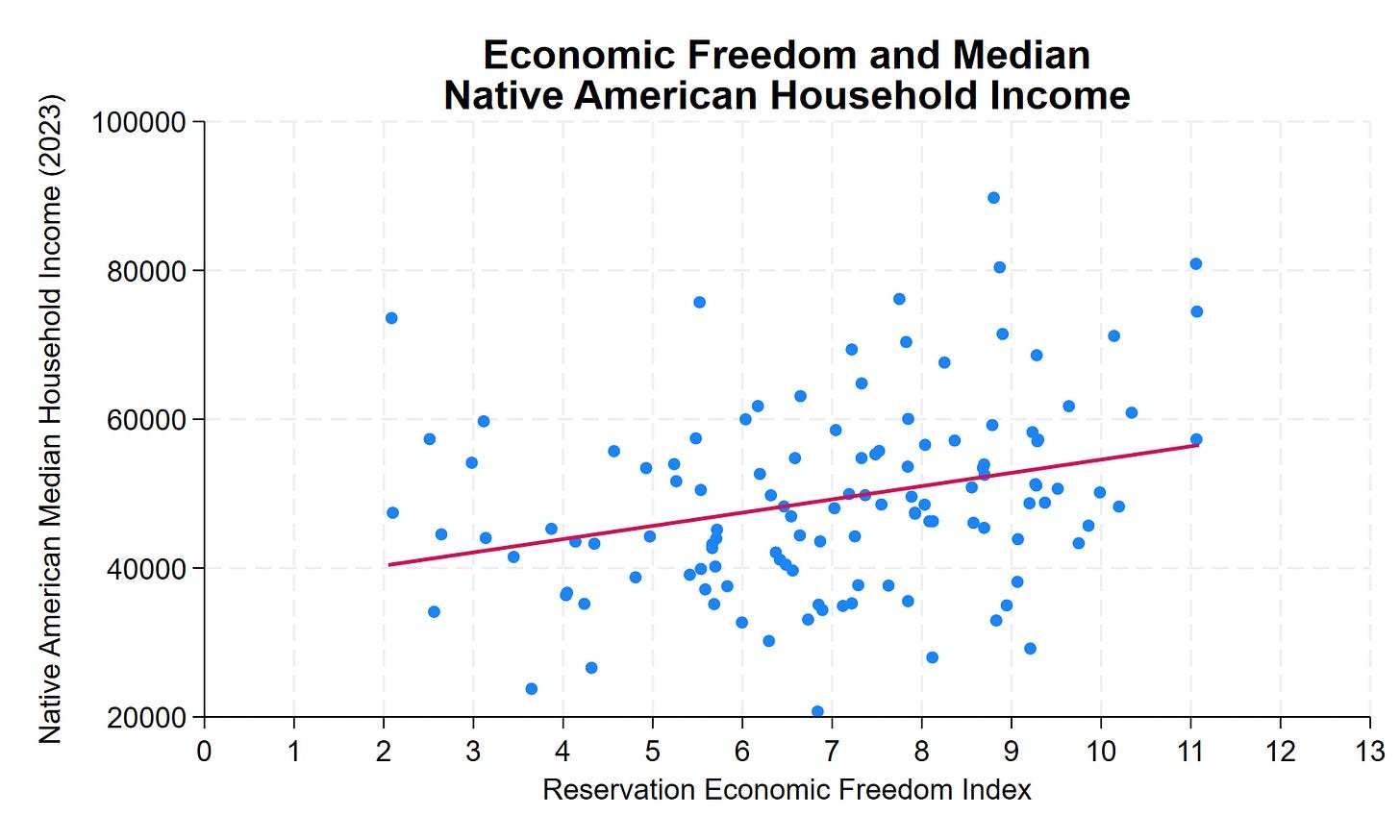
The Reservation Economic Freedom Index 2.0 measures how property rights, regulatory clarity, governance, and economic freedom vary across tribal nations. The correlation with prosperity is clear, consistent, and statistically significant. A 1-point improvement in REFI—on a 0-to-13 scale—correlates with approximately $1,800 higher median household income. A 10-point improvement? Nearly $18,000 more per household.
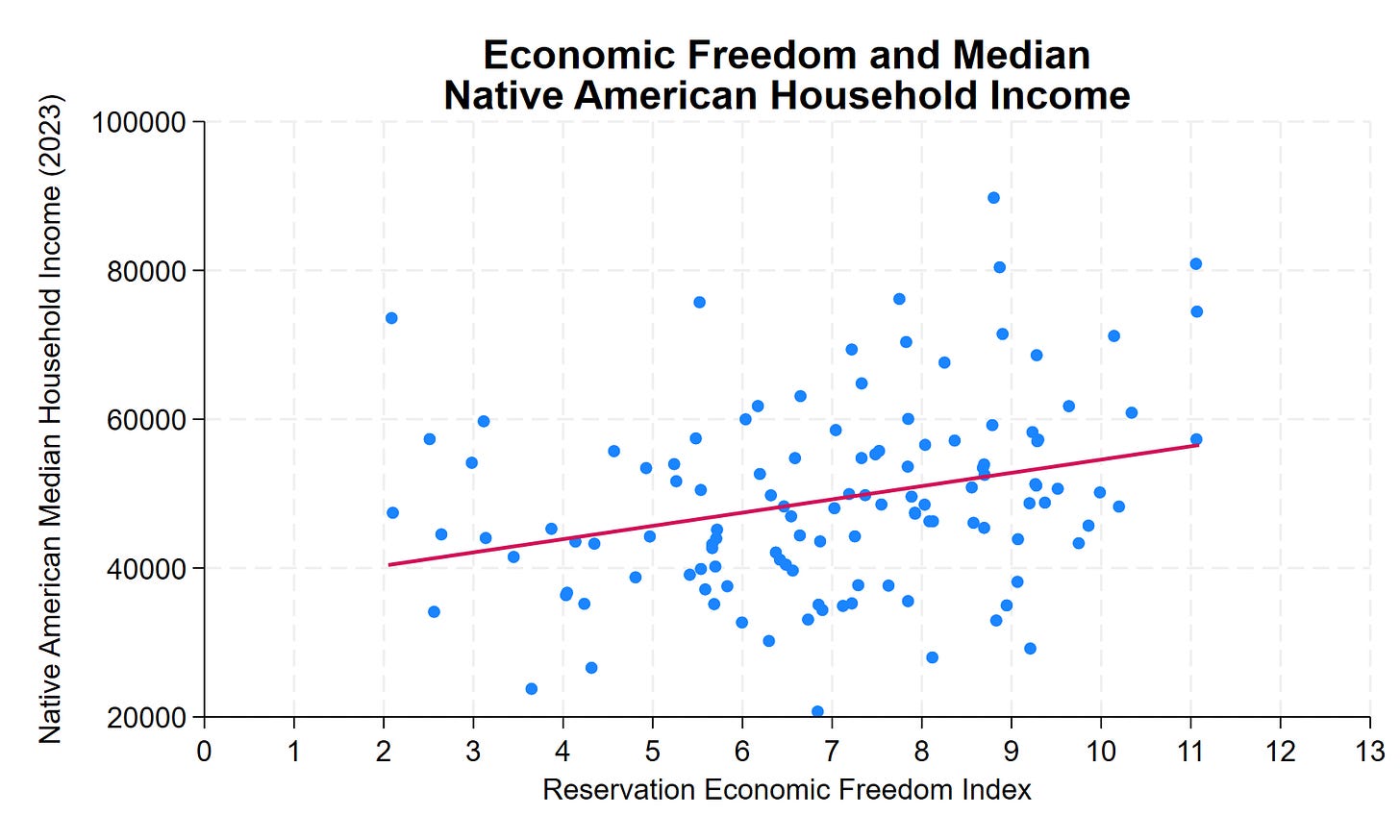
Scatter plot showing positive correlation between Reservation Economic Freedom Index scores (0-13 scale) and median Native American household income. Each blue dot represents one reservation. Red trend line shows approximately $1,783 higher income per REFI point. Chart shows 120 reservations after excluding 3 outliers. Income ranges from $20,000 to $100,000.

Many low-REFI features aren’t tribal choices—they’re federal impositions. Trust status prevents land from being used as collateral. Overlapping federal-state-tribal jurisdiction creates regulatory uncertainty. BIA approval requirements add months or years to routine transactions. Complex jurisdictional frameworks can deter investment when the rules governing business activity, dispute resolution, and enforcement remain unclear.

This is an important research program. In addition to potentially improving the lives of native Americans, the 123 tribal nations are a new and interesting dataset to study institutions.

See the post for more details amd discussion of causality. A longer paper is here.


Source link

  • Related Posts

    Ex-Credit Suisse Economist Quits Rate Panel to Become Thai Vice Finance Minister

    The appointment of Santitarn, who also served as the chief economist at e-commerce firm Sea Ltd., is expected to bolster the leadership at the Finance Ministry headed by Ekniti Nitithanprapas,…

    Georgia bans many midwives from practicing. Several are suing the state.

    Twice a month, Sarah Stokely travels 4½ hours from her home in Rome, Georgia, to work for a week at a birth center in Blountville, Tennessee. Subscribe to read this…

    Leave a Reply

    Your email address will not be published. Required fields are marked *

    You Missed

    Fund managers snap up bonds on growth threat from Iran war

    Artemis II on course for the moon after day in Earth orbit – National

    Artemis II on course for the moon after day in Earth orbit – National

    Artemis II crew talks to ABC News from space: Their journey so far and what’s ahead

    Artemis II crew talks to ABC News from space: Their journey so far and what’s ahead

    MLB’s ABS Challenge System is exposing the worst umpire in baseball

    MLB’s ABS Challenge System is exposing the worst umpire in baseball

    Lauren Price vs Stephanie Pineiro: Lauren Price in talks to fight Claressa Shields

    Lauren Price vs Stephanie Pineiro: Lauren Price in talks to fight Claressa Shields

    Mega Crit co-founder says he wasn’t bothered by the Steam backlash to Slay the Spire 2’s beta balance patch: ‘It’s difficult for players to feel like they’re heard’

    Mega Crit co-founder says he wasn’t bothered by the Steam backlash to Slay the Spire 2’s beta balance patch: ‘It’s difficult for players to feel like they’re heard’