dailynewsnblog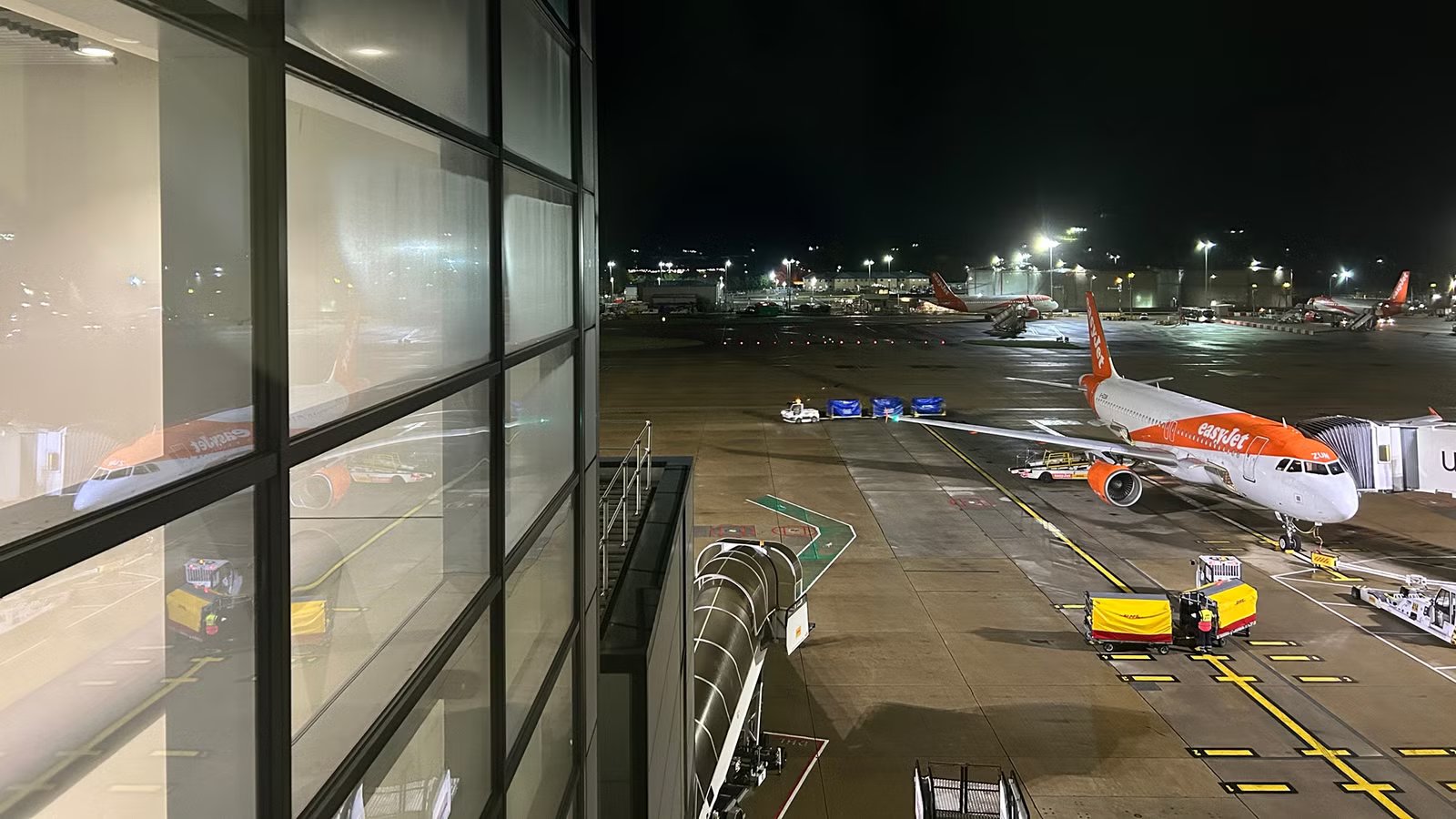
A total of 14 flights bound for  London Gatwick Airport (LGW) were forced to divert in the early hours of Wednesday morning, with nine of them declaring fuel emergencies and squawking 7700. This occurred after a
  British Airways Airbus A320 became disabled on the airport’s only operational runway, forcing many inbound flights into a sustained holding pattern.
The stricken aircraft, a 24-year-old A320 (G-GATS) operating flight BA2673 from Palma De Mallorca Airport (PMI), suffered a nose wheel failure and came to a stop on Runway 08L, leaving multiple arriving aircraft with nowhere to land. Diversion airports included London Luton (LTN), London Stansted (STN), Birmingham (BHX), and Bristol (BRS). Elsewhere, one aircraft was permitted to land at London Heathrow (LHR) despite its strict night curfew.
An Unprecedented Fuel Emergency Situation Over Gatwick

The incident began when BA2673 was on approach to Gatwick. The flight was scheduled to land at around 11:50 PM on Tuesday, but the flight crew reported a problem with the aircraft’s nose wheel on approach and entered a holding pattern. The flight eventually landed at 12:50 AM local time on Wednesday, where it was met by fire and ground vehicles as a precaution. However, due to the issue with its nose wheel, the A320 became stuck on Runway 08L, which is Gatwick’s only operational runway.
Consequently, various flights also scheduled to land at Gatwick around that time were unable to do so. Flight tracking data shows that nine aircraft eventually squawked 7700 to indicate an emergency, all of which are believed to be fuel-related. These were British Airways flights BA2607 from Bari and BA2703 from Tenerife, five easyJet flights, Jet2 flight LS3104 from Lanzarote, and TUI Airways flight BY4249 from Rhodes.
14 Jets Diverted To Other UK Airports

A handful of other jets were also forced to divert to other airports, with a total of 14 services affected. Five of these went to Luton, four to Stansted, three to Birmingham, one to Bristol, and another to Heathrow. The latter was allowed to land despite Heathrow’s night curfew, which caps the number of arrivals between 11:30 PM and 06:00 AM.
Not all of these flights declared a fuel emergency, although nine out of 14 did. Regulations require planes to have enough fuel to divert to an alternate airport and still land with a final reserve intact, which is enough to maintain roughly 30 minutes of flying time. A fuel emergency does not indicate that any of these flights were in immediate peril. Rather, it tells air traffic control that the aircraft can no longer continue holding and must be given priority to land, whether at its original destination or a diversion airport.
The majority of these flights later returned to Gatwick once the runway reopened. However, one of the easyJet flights ran into further trouble at Stansted after diverting. This flight became stranded after landing as there were no ground handling staff available for the unscheduled arrival, and it also could not be refueled. Passengers ended up spending over two hours on board the aircraft in the middle of the night before disembarking.
How Did One Aircraft Halt All Operations At Gatwick?

Although Gatwick has two parallel runways, 08L/26L to the north and 08R/26R to the south, they are positioned too close to be operated simultaneously. As a result, the Southern Runway typically handles all arrivals and departures, while the Northern Runway serves as the main taxiway and sometimes as an emergency runway if needed.
As the UK’s second-busiest airport behind London Heathrow, Gatwick is also known as one of the busiest single-runway airports in the world, handling around 280,000 flights per year. The airport is in the process of converting its Northern Runway into routine use by shifting its centerline 12 meters further north, which will make it operational by around 2030.
Tracking data shows that the British Airways A320 that precipitated the chain of events remains on the ground at Gatwick. It was also pulled from its scheduled rotation out to Alicante this morning.