dailynewsnblog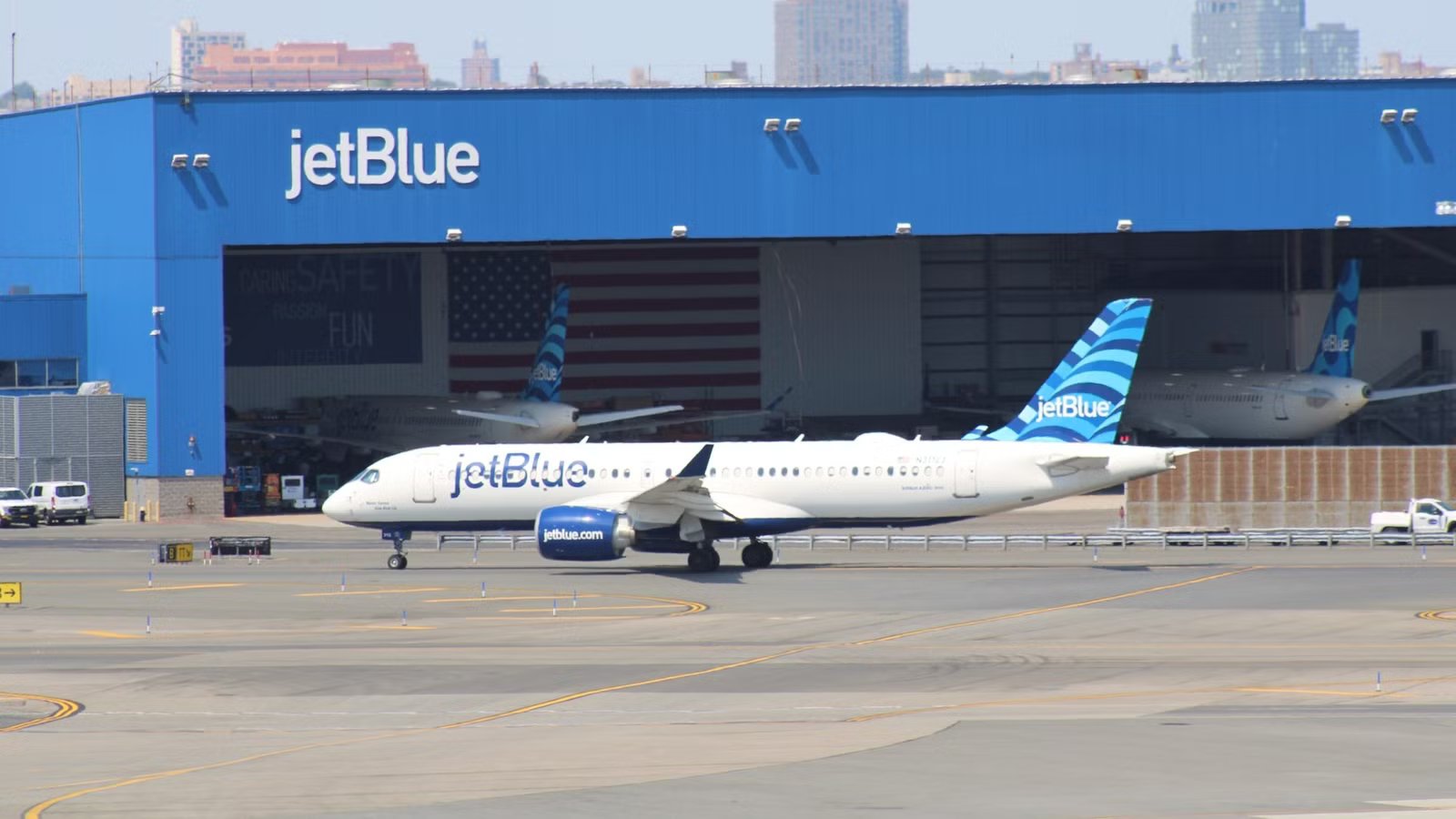
The latest data shows that JetBlue’s longest flight with the Airbus A220 is close to seven hours. Historically, airlines were forced to operate larger aircraft on routes with lower demand, purely because of the range capabilities of the aircraft. However, technological advancements have allowed for narrowbody aircraft to be able to fly for longer durations, covering more distance than ever before.
This mini-feature dives into how JetBlue deploys its fleet of A220s on services with block times well over five hours, and analyzes the technical specifications of the aircraft type and how it provides the operational flexibility required for airlines.
The Longest Nonstop A220 Services

American carrier JetBlue is the exclusive operator of narrowbody aircraft, and yet it operates some really long services, including transatlantic flights to Europe. The airline utilizes a fleet consisting of Airbus A320 family and Airbus A220 aircraft to operate all its flights. When it comes to the A220, the airline specifically operates a fleet of the larger Airbus A220-300 variant.
Data from Cirium, an aviation analytics company, shows that for the remainder of this year, the airline’s fleet of A220s will be operating some long flights, with many exceeding block times of six hours. The longest flight scheduled this year is the carrier’s service from  New York JFK Airport to Reno International Airport (RNO), with a block time of over 6.5 hours. The following interactive map shows details of the airline’s longest A220 services for 2026:
Loading map…
Drag to explore
On several routes where the airline faces competition, JetBlue is operating the smallest aircraft type, whereas other airlines are deploying larger equipment, such as the Airbus A321 or the Boeing 737 MAX aircraft. In the case of the airline’s services between Boston and Portland, the carrier deploys its A220 as a second service, complementing its A321 operations on the route.
How The A220 Compares To Other Narrowbody Jets?

The A220 originally began its life under the name C-Series, which is a program that was developed by Bombardier in Canada. This aircraft is not a regional jet, but because of its size and its capacity, the aircraft is often considered a bridge between regional aircraft and other mainline narrowbody jets such as the A320 and the 737 family aircraft. When Airbus took over the program from Bombardier, in terms of capacity, it became a suitable replacement for the smaller Airbus A319s.
As per manufacturer specifications, this is how the A220 aircraft compares with other mainline narrowbody jets such as the A320neo family and the Boeing 737 MAX family:
Aircraft | Airbus A220-300 | Airbus neo series | Boeing MAX series | ||||||
|---|---|---|---|---|---|---|---|---|---|
A320neo | A321LR | A321XLR | MAX 7 | MAX 8 | MAX 9 | MAX 10 | |||
Maximum Capacity | 160 | 194 | 244 | 172 | 210 | 220 | 230 | ||
Range | 3,400 nautical miles (6,300 km) | 4,000 nautical miles (7,400 km) | 4,700 nautical miles (8,700 km) | 3,800 nautical miles (7,040 km) | 3,500 nautical miles (6,480 km) | 3,300 nautical miles (6,110 km) | 3,100 nautical miles (5,740 km) | ||
The above data clarifies how the A220-300 can operate any route that the A320neo can (albeit with reduced capacity), while it can fly further than the Boeing 737 MAX 9 and the upcoming MAX 10 variant. It is also worth mentioning that there is the smaller A220-100 variant, which has a maximum capacity of just 135 passengers, but it has a longer range of 3,600 nautical miles (6,667 km), which exceeds the range of even the popular MAX 8 variant.
Delivering Operational Flexibility

As shown above, the A220 aircraft, despite having a lower capacity than all the other mainline narrowbody aircraft, can still compete with most of these aircraft on range. Furthermore, the range can be augmented if airlines opt to offset the aircraft weight by configuring their jets with lower passenger capacity. JetBlue has utilized this strategy with its A220-300 fleet.
According to data published by aeroLOPA, JetBlue’s aircraft is configured to carry a maximum of 140 passengers, which is 20 lower than the aircraft’s certified exit limit. However, the aircraft would have compensated for the weight saved by adding enhanced features such as larger overhead bins, USB and AC power capabilities, and even systems such as in-flight entertainment and WiFi services.
Ultimately, the A220 is a well-designed aircraft that can compete with several popular narrowbody aircraft in terms of routes, but having the type within the airline’s fleet provides operators the flexibility to downsize capacity on routes to reflect passenger demand, or as seen in the case of JetBlue’s Boston to Portland service, right size the capacity on a route by complementing existing services with an additional flight of lower capacity.
Catch what other flight trackers miss
Emergency squawks, holds, NOTAMs — live signals, no signup.
Open tracker
Catch what other flight trackers miss
Emergency squawks, holds, NOTAMs — live signals, no signup.
Open tracker


![Only 60% Full: Southwest’s 11 Emptiest Routes From This Massive Airport [Map]](https://dailynewsnblog.com/wp-content/uploads/2026/08/040826_airfield_southwest-011_cropped.jpg)