dailynewsnblog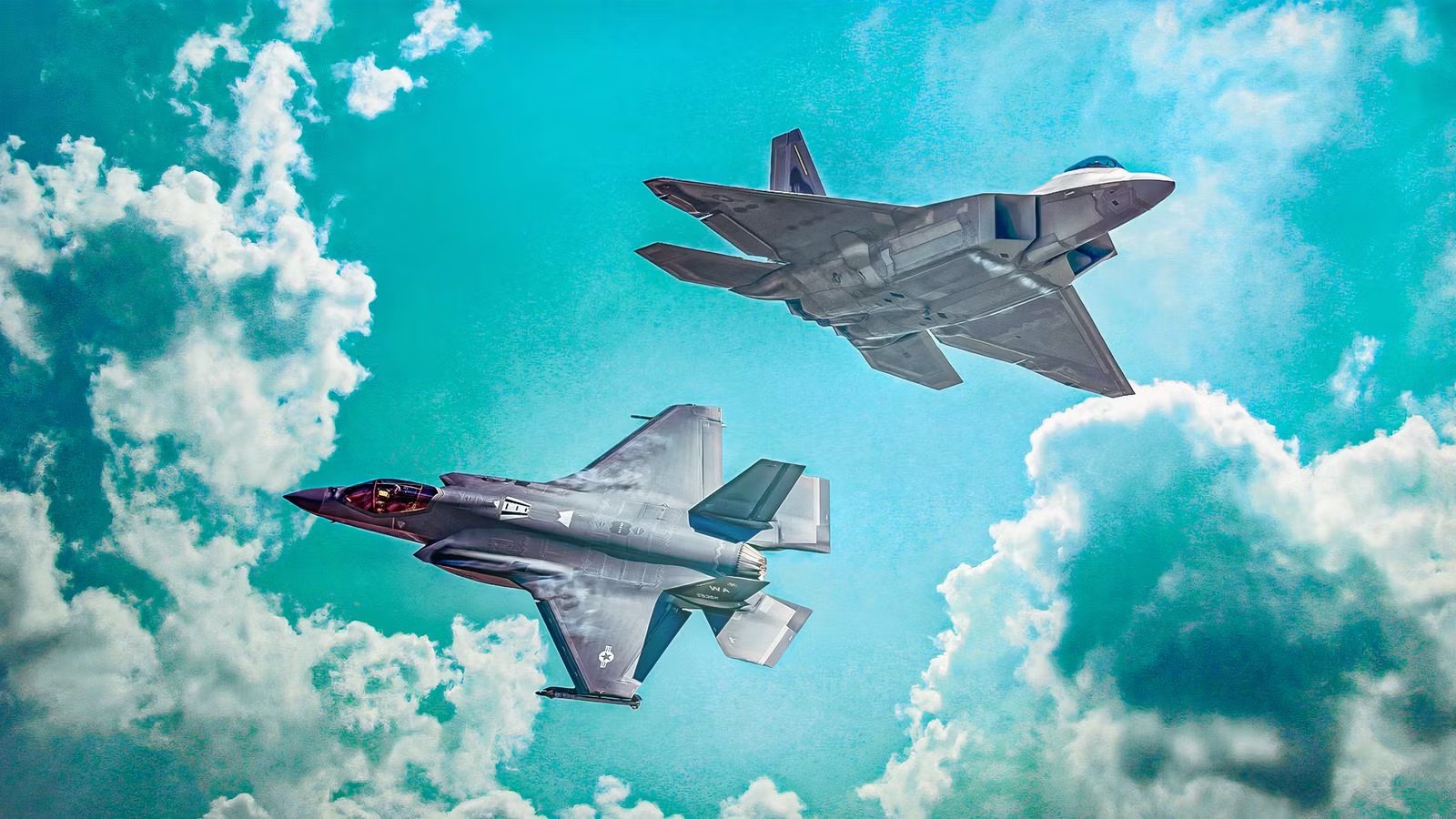
The Lockheed Martin F-22 Raptor and F-35 Lightning II are, and have been, two key defining aspects of American airpower. Combined, these aircraft provide the United States (US) military with the ability to secure hostile airspace, perform deep-strike missions, and conduct other combat-related operations. These aircraft have been involved in numerous operations from Europe to the Middle East to the Pacific. In any peer competition, these jets would be crucial not only to remaining competitive, but also to securing victory.
There are numerous factors that allow these aircraft to perform at such a high level. While both possess similar characteristics, incredible performance and advanced capabilities, they operate quite differently under combat conditions. These differences give the F-22 a substantial edge in areas such as raw power and close-range maneuverability, yet the F-35 offers advantages of its own through its advanced sensors and sensor fusion, allowing it to function as an airborne battle manager.
Thrust-Vectoring
This amazing feature allows the F-22 greater tactical control during low-speed flight

One of the most fascinating aspects of the F-22 Raptor is its sophisticated thrust-vectoring technology. The Raptor is equipped with two powerful Pratt & Whitney F119-PW-100 turbofan engines, each producing 35,000 pounds (15,876 kg) of thrust. While in flight, the pilot can direct this raw power using two-dimensional thrust-vectoring nozzles. Mounted at the aft end of each engine, these nozzles can deflect thrust up or down by up to 20 degrees, significantly improving low-speed pitch control, high-angle-of-attack (high-alpha) maneuverability, and nose-pointing authority during demanding maneuvers.
Lockheed Martin F-22 Raptor Characteristics | Related Data |
|---|---|
Thrust | 35,000 pounds (15,876 kg) per engine |
Wingspan | 44 feet, 6 inches (13.6 meters) |
Length | 62 feet, 1 inch (18.9 meters) |
Height | 16 feet, 8 inches (5.1 meters) |
Weight | 43,340 pounds (19,700 kilograms) |
Range | More than 1,850 miles (2,977 km) ferry range with two external wing fuel tanks |
Ceiling | Above 50,000 feet (15 kilometers) |
Inventory | Total force: 183 |
In combat, thrust vectoring allows the pilot to rapidly point the aircraft’s nose toward an opponent, increasing opportunities to employ weapons in close-range engagements. This is particularly valuable when employing high off-boresight missiles such as the AIM-9X Sidewinder, which features thrust vectoring and an infrared imaging seeker, enabling it to engage highly maneuvering targets.
While the F-35 is maneuverable, it simply cannot match the F-22’s agility in a dogfight. However, the Lightning II was never designed to be exceptionally fast or highly agile. Instead, it was built to rely on its low-observable design, advanced sensor suite, and sensor fusion to become a deadly hunter. These capabilities enable it to operate in contested airspace while detecting, tracking, and engaging targets with lethal efficiency. Combined with its low-probability-of-intercept sensors and stealth characteristics, they also make the aircraft exceptionally difficult for enemy forces to detect, track, and target.
Wing Loading
The aerodynamics of agility

Wing loading is one of the key aerodynamic factors that helps explain why the F-22 and F-35 handle differently in combat. It refers to the amount of weight supported by a given area of wing, with lower wing loading generally allowing an aircraft to provide more lift at a given speed. This enables it to operate more effectively during sustained maneuvers.
The Raptor has a wing area of approximately 840 square feet, giving it a relatively low wing loading for a fighter of its size and weight. By comparison, the Lightning has a wing area of approximately 460 square feet and carries considerably more weight relative to its wing area. As a result, the F-35A generally has a higher wing loading than the F-22.
This difference contributes to the aircraft’s contrasting handling characteristics. The F-22’s lower wing loading helps it maintain lift during hard turns and retain better sustained-turn performance, particularly when combined with its powerful engines and aerodynamic design. The F-35, on the other hand, can still perform demanding maneuvers; however, its higher wing loading places greater demands on its available lift and energy during sustained turning engagements. Ultimately, wing loading is only one part of the equation. However, it helps us to understand why the F-22 was optimized for outstanding air-combat agility while the F-35 was designed around a broader multirole mission.
Thrust-To-Weight Ratio
The importance of raw power

An aircraft’s thrust-to-weight ratio indicates how much power it has available relative to its weight. A higher ratio allows a fighter to accelerate more rapidly, climb faster, and maintain energy during demanding high-speed maneuvers. These characteristics can be particularly important in aerial combat, where maintaining and managing energy can determine which aircraft gains the crucial advantage.
A fighter with greater available thrust can recover lost speed with greater ease after executing a hard turn, which would otherwise leave it slow and vulnerable to a hostile aircraft. In an environment where a matter of seconds can determine whether a pilot successfully evades an incoming missile or is forced into a defensive position, the ability to rapidly regain speed can be a massive combat advantage.
When comparing the two aircraft, the F-22 holds an advantage in thrust-to-weight ratio over the F-35, giving it greater excess thrust for acceleration, climbing, and recovering energy after demanding maneuvers. The Raptor’s two F119 engines produce substantially more thrust relative to its combat weight, while the F-35 relies on a single F135 engine and carries significant weight associated with its multirole design and mission. This difference contributes to the F-22’s superior acceleration and its ability to maintain energy, agility, and performance in an air-to-air contest.
High-Angle-Of-Attack Performance
Maneuvering at extreme angles

Angle of attack (alpha) is an aerodynamic measurement that describes the relationship between an aircraft’s wing and fuselage and the direction of the airflow approaching them. During aggressive maneuvering, a fighter can operate at very high angles of attack, with its nose pointed significantly above the direction in which the aircraft is actually flying. The F-22’s ability to remain controllable at extremely high angles of attack, aided by its thrust-vectoring system, provides its pilot with greater freedom to rapidly point the nose toward an opponent, particularly during slow-speed, close-range engagements where conventional aerodynamic controls become less effective.
The F-35 is also capable of operating at high angles of attack, giving it useful nose-pointing and maneuvering control during close-range combat. Its advanced flight-control system helps maintain controlled flight as aerodynamic conditions become increasingly demanding, allowing the aircraft to perform aggressive maneuvers without relying on thrust vectoring.
However, unlike the F-22, the F-35 lacks a dedicated thrust-vectoring system, and its higher wing loading and multirole design impose different performance trade-offs. As a result, the F-35 can maneuver effectively at high AoA, but the F-22 retains a greater advantage in extreme high-AoA maneuvering.
Flight-Control Laws
The computers behind the controls

The F-22 and F-35 both use sophisticated, digital flight-control laws to translate pilot inputs into precise aircraft responses, yet their systems reflect divergent design priorities. The F-22’s control laws were developed around maintaining extraordinary maneuverability and controllability throughout demanding portions of the flight envelope.
They work with the aircraft’s aerodynamic surfaces and two-dimensional thrust-vectoring system to enable substantial control at high angles of attack and low speeds. This allows the Raptor to respond aggressively to pilot inputs during close-range engagements, including rapid changes in pitch and nose position. The result is an aircraft that can maintain considerable maneuvering control when conventional aerodynamic controls become less effective.
The F-35 also uses advanced flight-control laws designed to provide stable, predictable handling across broad operating conditions, including high angles of attack. However, its control system is more closely tied to the aircraft’s multirole design and does not incorporate the F-22’s dedicated thrust-vectoring system. Rather, the F-35 relies on aerodynamic control surfaces and its flight-control computers to manage the aircraft’s response. This gives the Lightning II highly capable and predictable handling, while the F-22’s control laws, combined with its aerodynamic design and thrust vectoring, give it an advantage when maximum agility and nose-pointing capability become critical in a close-range aerial contest.
Internal Fuel Fraction
The fuel behind the fighter

Internal fuel fraction is another design characteristic that helps to explain the different combat capabilities of the F-22 and F-35. Both aircraft were designed with large internal fuel storage, allowing them to conduct missions without external fuel tanks that would increase drag and, in the case of a stealth fighter, compromise its low-observable characteristics. The F-22 carries approximately 18,000 pounds (8,164 kilograms) of internal fuel, while the F-35A carries around 18,500 pounds. Despite their similar fuel capacities, fuel storage accounts for a different proportion of each aircraft’s overall weight due to differences in size, weight, and design requirements.
Lockheed Martin F-35 Lightning II Characteristics | Related Data |
|---|---|
Thrust | 43,000 pounds (19,504 kg) |
Wingspan | 35 feet (10.7 meters) |
Length | 51 feet (15.7 meters) |
Height | 14 feet (4.38 meters) |
Payload | 18,000 pounds (8,160 kilograms) |
Range | More than 1,350 miles with internal fuel (2,173.4 km) |
Ceiling | Above 50,000 feet (15 kilometers) |
Speed | Mach 1.6 (~1,200 mph/1,931.2 km/h) |
This design choice has important implications for combat performance. The F-22’s substantial internal fuel supply supports its role as an air-superiority fighter, providing greater endurance, which is needed to patrol, maneuver, and engage enemy aircraft without sacrificing its aerodynamic performance or stealth characteristics with external tanks. The F-35A’s comparable internal fuel capacity reflects its requirement to operate over significant distances while carrying out a broader range of strike and multirole missions. Its fuel load supports long-range operations in contested environments, but the aircraft’s heavier multirole design means it must balance fuel, weapons, and maneuverability differently than the more air-combat-focused F-22.
Mission Optimization (Air Superiority vs. Multirole Strike)
Two paths to combat power

Both the F-22 and F-35 were designed with different priorities when they were concepts on the drawing board. The Raptor was optimized to fight and win in the European theater against overwhelming numbers of Soviet aircraft. Such a complex mission would have demanded an aircraft with air superiority that could dominate and secure the skies, allowing ground forces to operate without aerial threats.
The Raptor’s stealth coatings, internal weapon bays, advanced sensors and powerful engines, coupled with thrust vectoring, could have enabled it to excel in such a scenario. Highlighting the aircraft’s advanced features, Colonel Michael J. Costigan (USAF) stated: “In a complex air battle with dozens of aircraft, the integrated avionics and stealth will allow the pilot to choose where and when to engage to maximize survivability while destroying enemy aircraft that are not even aware of the F22’s presence.”
Multirole fighters, on the other hand, emerged as nations sought to develop flexible platforms capable of undertaking several different missions in a single sortie. Such aircraft were designed to undertake operational roles including air-to-air combat, precision strike, reconnaissance, and maritime missions.
While the F-35 is in no way comparable to the Raptor in terms of raw power or close-range air-combat capability, it was never designed to dominate the sky through brute force like the F-22. The Lightning was purposely designed around an advanced sensor suite that provides comprehensive situational awareness, sensor fusion, intelligence, surveillance and reconnaissance, and information sharing across a battle network, enhancing the mission capabilities of the entire force. While it can perform deep-penetration strike missions, the F-35 is more akin to a flying data hub than a steamroller like the Raptor.
Catch what other trackers miss
Emergency squawks, holds, NOTAMs — live signals, no signup.
Open tracker
Catch what other trackers miss
Emergency squawks, holds, NOTAMs — live signals, no signup.
Open tracker