dailynewsnblog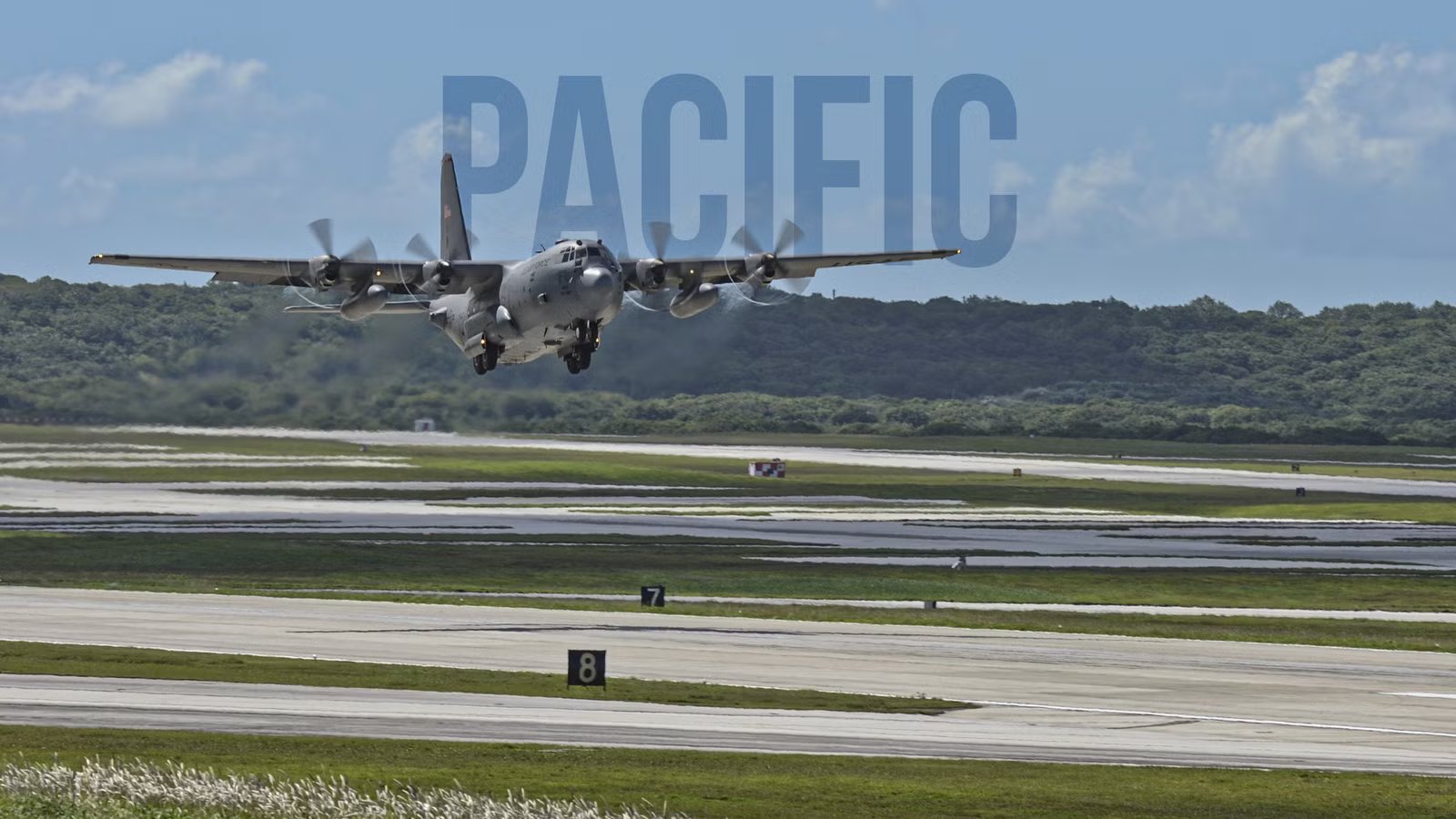
Andersen Air Force Base on Guam is the most important fully sovereign US Air Force base in the Eastern Pacific. However, it exists in a much broader context that includes important US bases in Japan and South Korea as well as bases in the Philippines and Australia. In the event of a conflict, some of these bases might not be available, as a country like South Korea could declare its neutrality.
Another issue is that Andersen is a very obvious target that could be knocked out, even temporarily. For aircraft to land and continue to operate, there need to be backup airbases in the region. There are other airports on Guam, most obviously the dual-use Antonio B. Won Pat International Airport ( Guam International Airport) as well as Claasson-Apra Regional Airfield and Northwest Field (being upgraded), which would be of use. Here are six airbases the US is building as backups to Andersen outside of Guam.
Roman Tmetuchl International Airport — Palau
Around 820 miles (1,319 km) from Andersen

Palau is interesting as it is an independent country and a member of the United Nations, although it is rarely listed among the US’s regional allies like Japan and South Korea. Palau is also an interesting case as it occupies a sort of middle ground between a fully sovereign state and a state with a level of autonomy a step or two above US territories (like Guam).
In 1994, the Compact of Free Association (COFA) with the United States entered into force, under which the US is responsible for Palau’s defense and has exclusive military operating rights in its land, air, and waters. The US had previously administered Palau since 1947 under the United Nations Trust Territory of the Pacific Islands (Trust Territory). One benefit of Palau is that it is further south than Guam, making it more complicated for Chinese targeting.
In 2021, the PACAF commander visited Palau, specifically being developed for the US’s Agile Combat Employment (ACE), which is the doctrine to disperse operations in the event of a major conflict. In 2023, US F-35As operated from Palau’s Roman Tmetuchl International Airport during Northern Edge. Six C-17 Globemaster IIIs used the airbase in 2024 as part of an exercise involving an airfield seizure by the US Army Rangers. Meanwhile, the US is rehabilitating the previously abandoned Peleliu Airfield on Palau’s southern Peleliu island.
Yap International Airport, Federated States of Micronesia
Around 540 miles (869 km) from Andersen

Similar to Palau, since 1986 (amended in 2004), the Federated States of Micronesia (FSM) has a Compact of Free Association (COFA). This agreement also makes FSM a sovereign nation, while also granting the US full defense authority over the island nation. The US Government writes, “Under the Amended Compact, the FSM and the United States agreed that the United States has full authority and responsibility for defense and security matters in and relating to the FSM.” It adds that the agreement does not have an end date.
It should be noted that these agreements come with a range of financial and other assistance measures for the island nations. FSM’s islands are dispersed across a large stretch of the North Pacific, although the most important island for Guam is Yap. Importantly, in the fiscal 2025 budget, the Air Force requested $400 million to extend the runway on Yap in both directions and expand facilities.
At the time, budget documents stated, “Yap Airport is capable of being an important divert location for aircraft transiting the Indo-Pacific area. However, the runway is too short to adequately support military aircraft operations and lacks other critical required facilities such as aircraft arresting systems capabilities.” The Fiscal 2027 budget requests include funding for a military runway extension at Yap Field in Micronesia “to facilitate military deployment and readiness exercises on Yap Island to boost Agile Combat Employment.”
Rota International Airport — Northern Mariana Islands
Around 50 miles (80 km) from Andersen

The Northern Mariana Islands are perhaps the most important series of backups to Guam. Like Guam, the Northern Mariana Islands are a US external territory controlled since WWII and are part of the same island chain. Historically, there were referendums on the islands to merge them into the same territory. The Northern Marianas have three main islands, all of which have potential backup air bases for Guam.
The island of Rota is home to less than 2,000 inhabitants but also has Rota International Airport. This airport is the closest airport to Guam and has been mentioned as a potential backup for Guam. Like some other airports on this list, it is not currently particularly militarized to support combat operations, but it is viewed as another option in ACE operations. Rota has also been repeatedly incorporated into exercises that focused on distributing assets across the islands (e.g., in Cope North 2023).
In June, the new Boeing Australia MQ-28 Ghost Bat was seen taking part in Exercise Valiant Shield 2026 on Rota Island. Meanwhile, in 2022, a THAAD unit deployed to Rota to test remote launch capability. The airport only has a single runway and limited infrastructure. It is best not thought of as a major secondary base, but as the closest one of many small alternative airfields that can help spread Guam’s operations across multiple islands in the region.
RAAF Base Tindal/Darwin/Amberley — Australia
Around 2,000 miles (3,218 km) from Andersen

Australia occupies a different position in this list. Whereas the other airfields are in US territory or on islands that the US is responsible for defending, Australia is different, and it is far from Guam. There are two notable airbases in Australia that the US is investing in (both near the northern city of Darwin): one is RAAF Base Tindal, and the other is RAAF Base Darwin. These are used in a number of important Australian-led exercises and are also important strategic airbases for the Royal Australian Air Force.
In Australia’s Top End, fighter jets are too far away to be able to conduct combat sorties (or they can do so at great cost), but not bombers. One of the US’s issues is protecting its bombers on the ground. Guam is likely too close to China. The bombers would be vulnerable, and the US Air Force would likely want to pull them back. But stationing them in the continental United States or Hawaii opens up punishingly long distances that will wreck sortie rates.
Three Australian airbases (per RAAF) | RAAF Base Tindal | RAAF Base Darwin | RAAF Base Amberley |
|---|---|---|---|
Runway(s) | 9,000 feet (2,743 meters) currently, being lengthened to 11,000 feet (3,353 meters) | 11,004 feet (3,354 meters) and 5,000 feet (1,524 meters) | 10,000 feet (3,047 meters) and 5,000 feet (1,523 meters) |
RAAF units based there (select) | No. 75 Squadron (F-35A), No. 17 Squadron, No. 2 Squadron Detachment | Headquarters No. 452 Squadron, No. 452 Squadron Darwin Flight | No. 1 Squadron, No. 6 Squadron, No. 33 Squadron, No. 36 Squadron |
Aircraft the US wants to operate there | Up to six B-52 bombers, B-2s, and eventual B-21 capability | B-1 and B-52 bombers, KC-135 tankers | B-2 Spirit bombers |
Distance from Guam | 2,100 miles (3,400 km) | 2,022 miles (3,254 km) | 2,890 miles (4,650 km) |
Australia offers a relative haven for long-range strategic assets like bombers and maritime patrol aircraft, and the US has been investing in infrastructure in these bases (including RAAF Amberley) to enable it to conduct bombing operations. This is perhaps similar to how the preferred posture for the USAF during Operation Epic Fury was to base them at RAF Fairford in England. The US Air Force’s Al Udeid Air Base in Qatar hosts heavy bombers, but it is too close to Iran for those bombers to be defended, while home bases in the US are far away.
Saipan International Airport — Northern Mariana Islands
Around 125 miles (201 km) from Andersen

Saipan became famous during the WWII island-hopping campaign and has remained controlled by the US and as a US external territory ever since. Saipan International Airport is a dual-use civilian and military airport that features prominently in US strategic thinking and ACE doctrines around Guam.
In April 2024, around 225 Hickam personnel established a bare-base operation at the airport during Exercise Agile Reaper. The exercise was to specifically test the ability of the 11th Air Force to transition from normal operations to an expeditionary posture on the island. The 2025 REFORPAC exercise also saw the US Air Force use the base and demonstrate that it can be used as an austere location.
Currently, the airport is not being built up as a dedicated backup airbase to Guam in the sense of installing large amounts of military infrastructure, unlike those on Tinian (discussed below). Instead, it is better to think of the airport as a backup airfield that can be activated when required.
Tinian International Airport / North Field — Northern Mariana Islands
Around 120 miles (193 km) from Andersen

Perhaps the best example of a backup airbase to Andersen is Tinian International Airport / North Field, located around 120 miles (193 km) north of Guam in the Northern Mariana Islands. In 2024, The Guardian reported, “The governor of the Northern Mariana Islands says an $800m US military upgrade plan which includes a new airfield in the Pacific territory “has to happen’ amid concern over China’s recent missile tests in the region.” Plans for upgrading the bases date back to at least 2020.
In 2024, the US Air Force reported that US Marines F/A-18 Hornets “conducted Agile Combat Employment operations, practicing combat air forces dispersal activities [at Tinian International Airport] with US, Royal Australian Air Force, Japan Air Self-Defense Force, Royal Canadian Air Force, Republic of Korea Air Force and French Air and Space Force.”
Currently, the US military is rehabilitating the island’s old North Field infrastructure and is investing heavily in the international airport. The Pentagon has described Tinian as a base able to support missions if Guam or other Pacific bases become unavailable. From what is publicly known, it seems the US Air Force regards Tinian as the most important backup to Guam.
Catch what other trackers miss
Emergency squawks, holds, NOTAMs — live signals, no signup.
Open tracker
Catch what other trackers miss
Emergency squawks, holds, NOTAMs — live signals, no signup.
Open tracker