dailynewsnblog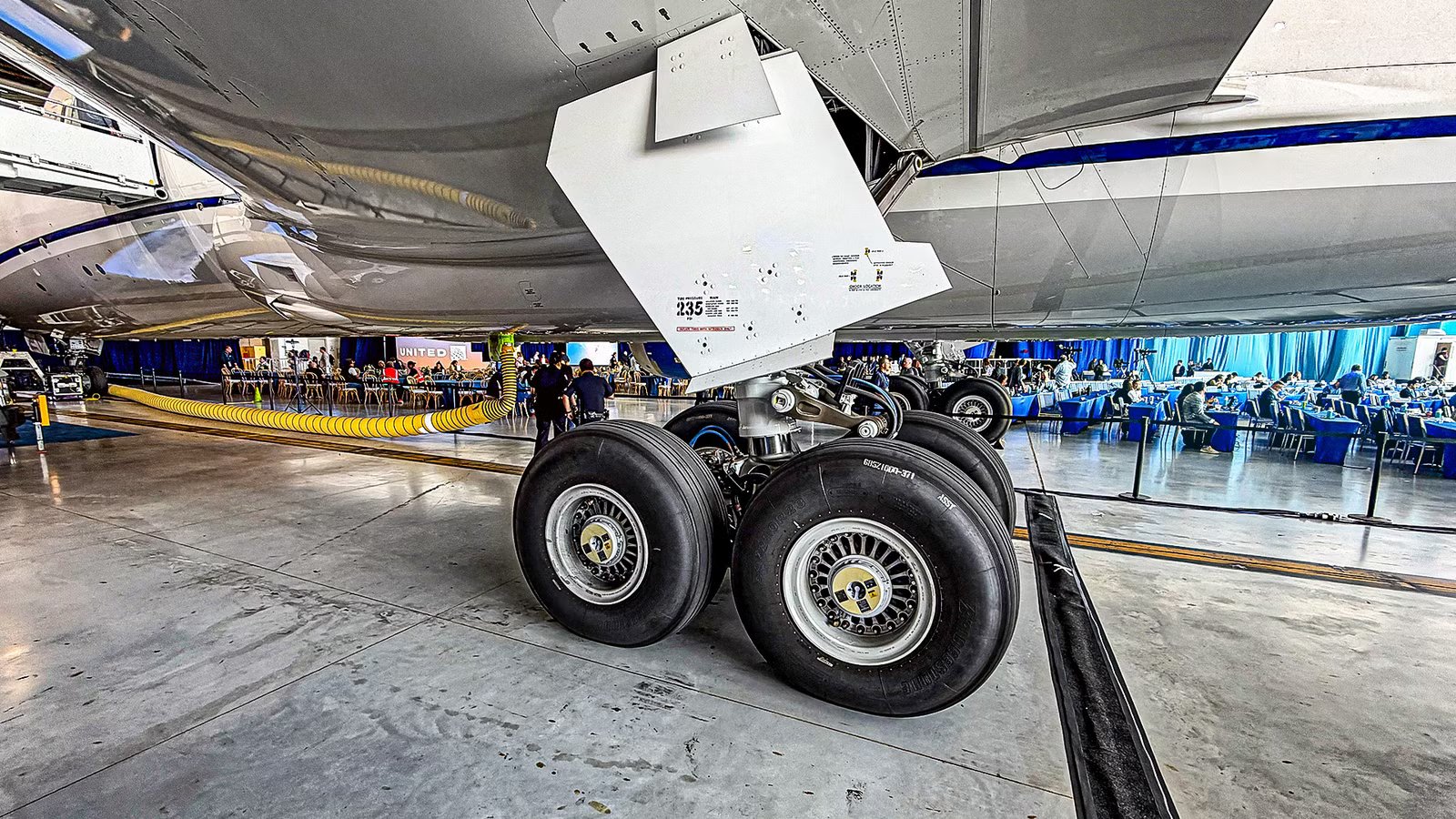
Modern landing gear systems on aircraft like the Boeing 787 Dreamliner and Airbus A350 are engineered to absorb landing forces with near 90% energy efficiency, withstand brake temperatures exceeding 1,000°C, and modulate brake pressure up to 20 times per second.
While the gear systems of most aircraft are tucked away and out of sight for passengers, they are home to some of the most crucial pieces of engineering in aviation. From shock absorbers to brakes that work better the hotter they get, these are just six of the most notable design features of modern landing gear systems that otherwise would go unnoticed.
The Oleo Strut
Two fluids, one elegant truck

The oleo strut is one of the most important parts of every modern aircraft’s landing gear system. This simple mechanism, consisting primarily of hydraulic fluid, nitrogen gas, and a small opening between the two, is what dissipates the tremendous amount of energy generated by an aircraft during touchdown. In fact, the oleo strut can be found on the majority of aircraft, including both general aviation and commercial planes.
When the wheels of an aircraft make contact with the runway, the sudden upward force on the landing gear from the ground forces hydraulic fluid through a narrow orifice and into a chamber filled with nitrogen gas above. As the fluid is pushed into the nitrogen-filled chamber, it compresses the gas, acting as a shock absorber for the landing. Additionally, as the hydraulic fluid rapidly flows through the orifice, its kinetic energy is converted into thermal, or heat, energy. As such, the violent shocks encountered during the landing are dissipated as heat, cushioning the impact and transferring the energy into something harmless.
Most modern designs refine this basic mechanism further by adding a tapered metering pin that can vary the size of the office as the strut compresses further. This keeps the resistive load on the strut approximately constant throughout the landing process, rather than allowing it to spike immediately on impact, resulting in practical efficiencies of between 80 and 90%. Nitrogen gas is also typically used in favor of ordinary air due to its properties as a chemically inert gas, preventing corrosion of the internal surfaces over many landing cycles.
Carbon Brakes
Brakes that work better the hotter they get

In contrast to traditional steel brake discs found on the vast majority of cars, trucks, and older-generation aircraft, carbon brakes, standard on new airliners, actually work more effectively the hotter they get. Steel brake discs behave in a way that engineers describe as fade. As temperatures climb above a critical value, typically above 1,100°F (600°C), the frictional force diminishes, resulting in a loss of stopping power.
On the other hand, carbon brakes do the opposite. Carbon brakes’ higher specific heat, or the amount of heat any given material can absorb per unit of mass, and superior thermal conductivity allow them to absorb and distribute heat more effectively than steel. Carbon brakes also offer lower thermal expansion when compared to steel, as well as a higher resistance to thermal shock. These properties result in carbon brakes maintaining, and sometimes even improving, their friction at temperatures where steel brakes would be ineffective.
Today, carbon brakes can be found on many modern airliners, including the Boeing 787 and Airbus A350 families, as well as on Formula 1 cars and spacecraft heat shields. The Sepcarb III carbon brakes, manufactured by Safran Landing Systems and used on the 787, 737, A350, and others, are significantly lighter than steel assemblies and offer three times the endurance and energy absorption capacity. However, carbon brakes are much more expensive and complex to manufacture and can actually accumulate more wear during taxi (about 79%) than on landing (just 19%).

Why The Airbus A380’s Main Landing Gear Needs 20 Tires
From mass to mechanics: why the A380 needs more wheels than a semi-truck.
Anti-Skid Brakes
Modulating brake pressure 20 times per second

Aircraft anti-skid systems are not new technology and have been fitted to modern airplanes and cars (as anti-lock systems) for several decades. However, they continue to serve an extremely important role in modern landing gear, designed to help pilots maintain control during landing by preventing the wheels from skidding across the runway.
The anti-skid system works by continuously comparing the aircraft’s actual ground speed with the rotational speed of each wheel. If any individual wheel is turning too slowly relative to the aircraft’s speed, indicating the start of a skid, brake pressure on that wheel is momentarily released to allow the wheel to spin faster. The anti-skid process is entirely automatic and is active all the way from when the wheels initially contact the ground on landing to when the aircraft slows to a speed of less than 15 knots.
Compared to older anti-skid systems, what makes modern versions so effective is the speed at which they can operate. Modern systems can adjust brake pressure up to 20 times per second on each individual wheel, providing a tremendous amount of precision. This fast-modulating brake pressure becomes even more important during demanding stopping scenarios, like those on short runways or in the event of a rejected takeoff.
The Hydraulic Tiller
Why a widebody can’t steer with its rudder pedals alone

On light training aircraft like the Cessna 172 or Piper Archer, the nosewheel is mechanically connected to the pilot’s rudder pedals. Through a simple pulley linkage system, this direct connection is enough for the small forces and turning radii experienced by these aircraft. However, for larger commercial jets, this simple system is not enough, necessitating the use of a hydraulically assisted nosewheel steering system instead.
These hydraulic steering systems are made possible by the use of a tiller, a small wheel or handle mounted on the side console of the flight deck that gives pilots direct control of the nosewheel. The tiller can move the nosewheel up to 70 degrees right or left, a far greater amount than what rudder input alone could achieve. This allows commercial jets to make extremely tight turns given their size, a crucial feature especially when taxiing in tight corridors at busy airports or making a 180-degree turn to back-taxi on a runway.
More recent aircraft designs integrate both inputs from the rudder pedals and those from the tiller. The tiller provides full authority steering while the rudder pedals offer greater authority the faster an aircraft is moving. Centering cams are also built into the shock strut structure and align the landing gear for retraction into the belly of the aircraft on takeoff. An upper cam is free to move into a lower cam recess when the gear is fully extended, and when weight returns to the wheels after landing, the shock strut is compressed and the centering cams separate, allowing the lower strut to rotate in the upper strut’s cylinder.
The Squat Switch
The circuit that physically prevents gear retraction on the ground

Of all the safety devices incorporated into the landing gear system, the squat switch is one of the simplest and most important ones. The squat switch is usually a small electrical switch mounted on a bracket and attached to one of the main gear shock struts. When the weight of the aircraft compresses the strut on the ground, the switch opens or breaks the electrical circuit to the retraction mechanism, preventing the gear from retracting on the ground. If a pilot were to move the gear lever to the retract position while still on the ground, nothing would happen due to the switch’s open circuit.
On large commercial aircraft, this protection against retracting gear on the ground is both electrical and mechanical. A spring-loaded plunger physically holds the gear selector in the down position and can only be released by a solenoid. The solenoid itself is controlled by the squat switch, so until the strut extends after takeoff as a result of the pressure being lifted from the gear, the plunger will lock the gear in place.
These two layers of protection, both the mechanical pin and the electrical impulses, make accidental gear retraction on the ground very difficult to achieve. The squat switch also feeds signals to many other aircraft systems and acts as the general sensor for whether an aircraft is on the ground or airborne. This can include cabin pressurization, various warning systems, and even systems like thrust reversers. However, if the squat switch fails in the wrong state, it can cause a series of failures across multiple systems at the same time.

Why Did Airbus Build The A350-1000 With Extra Wheels?
With six wheels on each side compared to just four, the A350-1000’s extra wheels help with stability, pressure distribution, and braking action.
Emergency Free-Fall Extension
Gravity as the last resort

Every retractable landing gear system today must also include an independent backup extension system, capable of operating without any assistance from the primary hydraulic system. While backup systems often come in the form of secondary hydraulic systems, emergency electrical extension, or, in some smaller aircraft, as a hand pump, using gravity is also commonly used as a last resort.
On many aircraft, an emergency release handle in the flight deck is connected through a mechanical cable directly to the gear unlocks. When the crew pulls the handle, it releases those locks, and the gear swings down and locks in place thanks to gravity. After a free-fall extension, the gear doors typically remain open as there is no hydraulic pressure available to close them. In the emergencies that these systems are used in, the minor drag penalties this causes are irrelevant.
As previously mentioned, aircraft may also carry additional backup layers beyond the basic gravity drop. Certification standards require that any backup system must be able to function reliably if the primary hydraulic system is fully depressurized. This ensures that the failure of the hydraulic system alone won’t result in a gear-up landing, as long as at least one of the backup options remains functional.