dailynewsnblog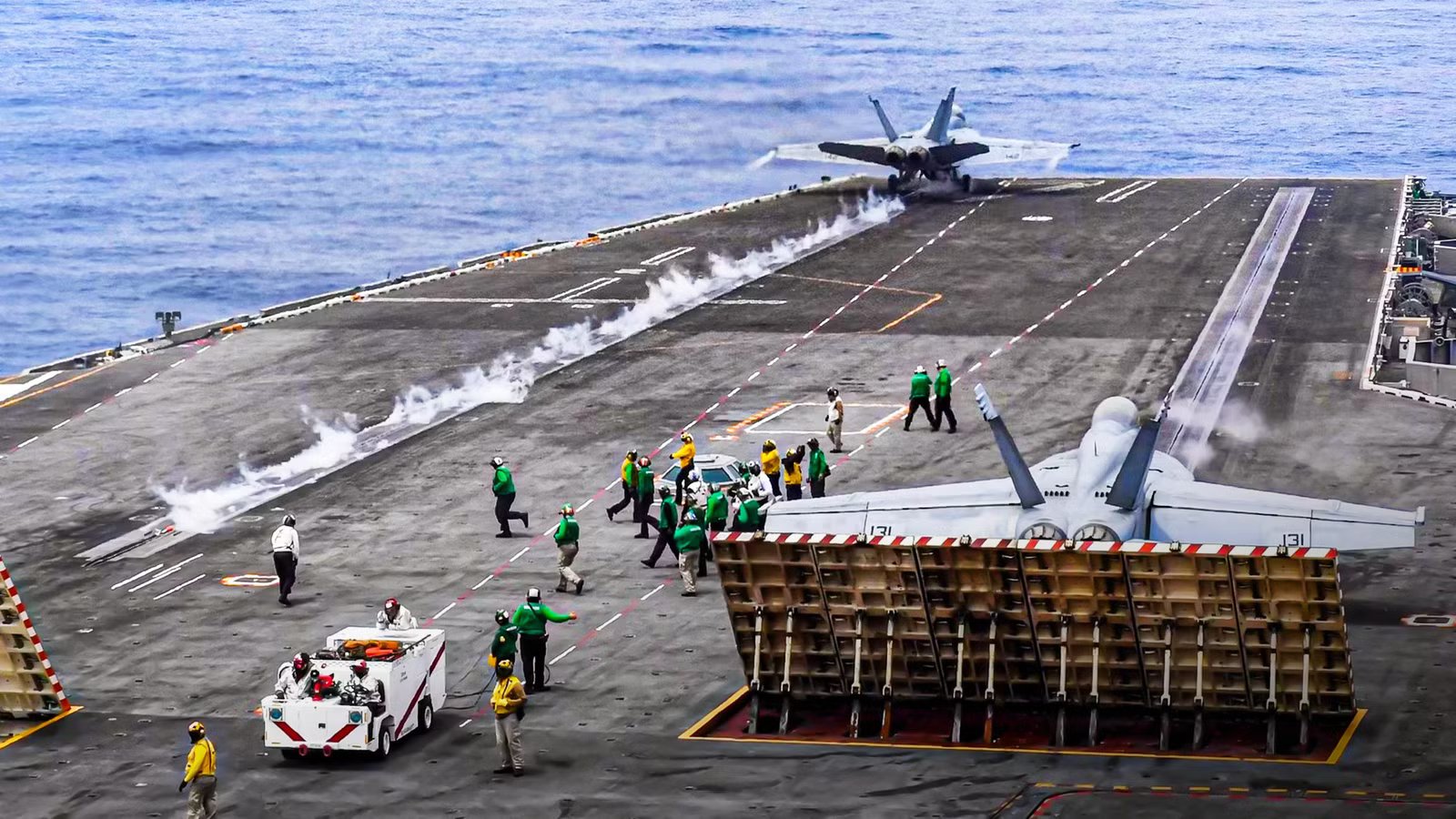
The United States Navy ( US Navy) operates one of the world’s largest military aviation networks, supporting everything from carrier-based fighter squadrons to advanced weapons testing and pilot training. While aircraft carriers are often described as floating airfields, the Navy also maintains impressive shore-based aviation infrastructure. Some naval aviation installations cover hundreds of thousands of acres and include vast training ranges, testing facilities, and controlled airspace that allow pilots and engineers to prepare for modern warfare.
For this ranking, installations are ordered by the total land area controlled by the naval aviation facility, including associated ranges and annexes where they form part of the installation’s mission. This approach highlights the true scale of the Navy’s aviation footprint across the United States. From the sprawling deserts of California and Nevada, far from the sea, to major fleet support bases on both US coasts, these are the six largest naval aviation installations by land area.
6
NAS Oceana, Virginia
10,000 acres ( 40.5 km²)

Covering more than 10,000 acres (approximately 40.5 km²) when its primary facilities and the nearby Dam Neck Annex are considered together, Naval Air Station Oceana serves as the Navy’s premier East Coast master jet base. Located in Virginia Beach, the installation is home to numerous carrier-based strike fighter squadrons.
NAS Oceana became the Navy’s principal East Coast fighter base following the closure of several other naval aviation facilities during the Cold War drawdown. Today, nearly every Atlantic Fleet carrier air wing relies on squadrons based at Oceana. The installation’s runways and support infrastructure are specifically designed to accommodate the high operational tempo associated with carrier aviation.
Beyond supporting operational fighter squadrons, Oceana plays a critical role in maintaining combat readiness. Pilots regularly conduct training sorties before deploying aboard aircraft carriers, while maintenance personnel ensure aircraft remain mission capable. The installation’s strategic location near the Atlantic Fleet headquarters and major naval facilities further strengthens its importance within the Navy’s aviation enterprise.
Catch what other flight trackers miss
Emergency squawks, holds, NOTAMs — live signals, no signup.
Open tracker
Catch what other flight trackers miss
Emergency squawks, holds, NOTAMs — live signals, no signup.
Open tracker
Oceana’s importance is reflected in the aircraft that operate from the installation. The base is home to numerous fleet replacement and operational squadrons that fly primarily the  Boeing F/A-18E/F Super Hornet, the Navy’s primary carrier-based strike fighter. The aircraft is capable of air-superiority, strike, close air support, reconnaissance, and aerial-refueling missions, making it one of the most versatile aircraft in naval service. Carrier air wings assigned to Atlantic Fleet aircraft carriers rely heavily on Oceana-based squadrons to maintain readiness for deployments around the world.
5
NAS Patuxent River, Maryland
14,500 acres (58.7 km²)

Naval Air Station Patuxent River occupies more than 14,500 acres (5,868 hectares or 58.7 km²) along the shores of Maryland’s Chesapeake Bay. Better known as “Pax River,” the installation serves as the headquarters of Naval Air Systems Command (NAVAIR) and is arguably the most important naval aviation research and development center in the country, according to its official website.
This is the base where tomorrow’s Naval aircraft are developed. Unlike operational fleet bases, Patuxent River focuses heavily on testing and evaluation. Nearly every modern naval aircraft has undergone development or testing at the installation. Programs ranging from the F-35 Lightning II to advanced unmanned aerial systems have relied on Pax River’s specialized facilities and extensive testing infrastructure.
The installation also controls thousands of square miles of restricted airspace over the Chesapeake region. This allows engineers and test pilots to evaluate aircraft performance, avionics systems, sensors, and weapons in a controlled environment. The combination of technical expertise, dedicated test ranges, and proximity to Washington, DC has made Patuxent River the center of naval aviation innovation for decades.
Patuxent River is unique because it hosts aircraft from across the naval aviation inventory, focused on various mission sets. Test squadrons routinely evaluate platforms, including the Lockheed Martin F-35 Lightning II, Boeing P-8A Poseidon, CMV-22B Osprey, MQ-25 Stingray, and numerous rotary-wing aircraft. The installation’s role is not simply to fly aircraft but to determine how future systems will perform before they enter fleet service. This makes Pax River one of the most technologically significant aviation facilities in the United States.
The 5 Oldest United States Navy Bases & Their Strategic Roles
Discover the hidden history behind the Navy’s oldest aviation hubs.
4
NAS Lemoore, California
29,800 acres (121 km²)

Naval Air Station Lemoore encompasses approximately 29,800 acres (121 km²) in California’s Central Valley. Opened in 1961, it was designed to meet the growing demands of carrier-based jet aviation and remains the Navy’s primary West Coast master jet base, according to Photorecon magazine.
The installation hosts the majority of the Pacific Fleet’s carrier strike fighter squadrons. Aircraft based at Lemoore routinely deploy aboard aircraft carriers operating throughout the Pacific Ocean, making the installation a cornerstone of American naval power projection. The base supports both operational units and replacement squadrons responsible for training new aviators.
One of Lemoore’s greatest advantages is its location. Situated far from dense urban development, the installation enjoys relatively unrestricted airspace and room for expansion. Its extensive infrastructure includes multiple runways, maintenance facilities, training centers, and support services capable of sustaining thousands of sailors and dozens of frontline aircraft squadrons. As carrier aviation remains central to US naval strategy, Lemoore continues to serve as one of the Navy’s most important operational air stations.
Today, NAS Lemoore serves as the primary West Coast hub for the Navy’s carrier-based fighter force. The installation is the principal operating base for both the Boeing F/A-18E/F Super Hornet and the Lockheed Martin F-35C Lightning II. The Navy selected Lemoore as the West Coast home for the Super Hornet fleet in the late 1990s, and the installation later became one of the first operational centers for the carrier-capable F-35C. More than 200 frontline fighters are based there, supporting multiple carrier air wings and training organizations.
3
NAS Whidbey Island, Washington
55,000 acres (approximately 223 km²)

Naval Air Station Whidbey Island controls more than 55,000 acres (approximately 223 km²) when associated training properties are included. Located in Washington State’s Puget Sound region, the installation is best known as the home of the Navy’s EA-18G Growler electronic attack community.
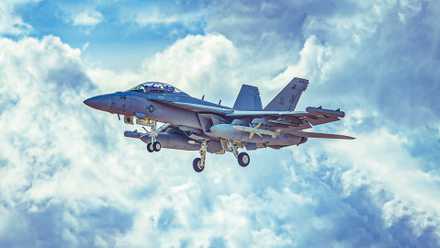
Electronic warfare has become increasingly important in modern military operations, and Whidbey Island sits at the center of that mission. The EA-18G Growler specializes in disrupting enemy radar systems, communications networks, and air defense capabilities. Derived from the F/A-18F Super Hornet, the Growler is also designed to suppress enemy air defenses, jam radar systems, disrupt communications networks, and support strike operations in contested environments. Nearly every Growler squadron in the fleet is based at the installation, including the fleet replacement squadron responsible for training new crews, making it a uniquely specialized aviation center.
The base’s expansive footprint includes support facilities, operational airfields, and associated training properties that provide realistic environments for electronic warfare training. Its location in the Pacific Northwest provides access to extensive training airspace while remaining close to major naval facilities. As military strategists place greater emphasis on operating in contested electromagnetic environments, Whidbey Island’s strategic importance continues to grow.
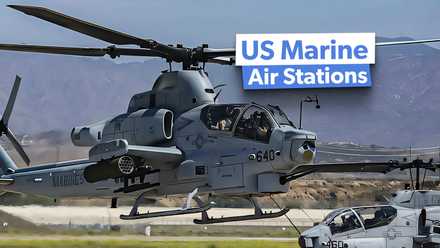
The 5 Largest US Marine Air Stations
Discover the five largest US Marine Corps air stations, supporting global missions, training, and readiness.
2
NAS Fallon, Nevada
240,000 acres (approximately 971 km²)

Naval Air Station Fallon, also known as TOPGUN’s training ground, together with the associated Fallon Range Training Complex, encompasses more than 240,000 acres (approximately 971 km²) across the Nevada desert. This makes Fallon by far the largest traditional Naval Air Station in the United States and one of the most important aviation training facilities in the world.
The installation is home to the Naval Aviation Warfighting Development Center (NAWDC), which includes the famous TOPGUN program. While popular culture often associates TOPGUN with fighter pilot training alone, the organization actually oversees advanced instruction for entire carrier air wings, integrating fighters, electronic warfare aircraft, airborne early warning platforms, and helicopters into realistic combat scenarios.
Fallon’s vast size is one of its greatest strengths. The surrounding desert allows pilots to train over enormous ranges free from many of the restrictions found near populated areas. Aircrews can practice air-to-air combat, precision strike missions, electronic warfare operations, and large-force exercises under conditions designed to replicate real-world combat. The installation also benefits from more than 300 flyable days per year and has one of the longest runways in the Navy inventory, making it the centerpiece of advanced naval aviation training.
Unlike most operational bases, Fallon regularly hosts a wide variety of aircraft from across naval aviation. During advanced training exercises, visiting units bring F/A-18E/F Super Hornets, EA-18G Growlers, E-2D Hawkeyes, MH-60 helicopters, and occasionally Marine Corps and Air Force aircraft. The Naval Aviation Warfighting Development Center uses these assets to create highly realistic combat scenarios designed to prepare carrier air wings for deployment. Fallon is also home to adversary aircraft (known as “aggressors”) that simulate enemy fighters during training events. This combination of aircraft types and large training ranges allows aircrews to practice the complex missions they may face in real-world operations.
1
NAWS China Lake, California
1.1 million acres (4,452 km²)

With more than 1.1 million acres (445,154 hectares or 4,452 km²) under its control, Naval Air Weapons Station China Lake is not only the largest naval aviation installation in the United States but also the Navy’s largest single landholding anywhere in the world.
Located in California’s Mojave Desert, China Lake was established during World War II as a site for weapons development and testing. Over the decades, it evolved into one of the most important military research facilities in the country. The installation supports the Naval Air Warfare Center Weapons Division and has played a major role in the development of countless missiles, bombs, rockets, and aviation technologies.
The sheer scale of China Lake is difficult to comprehend. Its land area is larger than the state of Rhode Island, while its surrounding restricted airspace covers nearly 20,000 square miles (51,799 km²) . This combination of vast terrain and controlled airspace allows engineers and military personnel to conduct testing activities that would be impossible elsewhere. From advanced air-to-air missiles to next-generation precision weapons, many of the technologies carried by Navy and Marine Corps aircraft today were developed or tested at China Lake.
Largest US Naval Aviation Installations By Land Area
Rank | Installation | State | Land Area (Acres) | Land Area (km²) |
1 | NAWS China Lake | California | 1,100,000+ | 4,452 |
2 | NAS Fallon | Nevada | 240,000+ | 971 |
3 | NAS Whidbey Island | Washington | 55,000+ | 223 |
4 | NAS Lemoore | California | 29,800 | 121 |
5 | NAS Patuxent River | Maryland | 14,500+ | 58.7 |
6 | NAS Oceana / Dam Neck | Virginia | 10,000+ | 40.5 |
China Lake’s enormous size means it alone accounts for the overwhelming majority of land dedicated to naval aviation testing and weapons development. Combined with installations such as Fallon, Whidbey Island, and Lemoore, it illustrates the extraordinary scale of the infrastructure required to train aviators, develop technology, and maintain one of the world’s most capable naval aviation forces.
China Lake’s flight line also differs significantly from those found at operational fleet bases. Instead of housing large numbers of deployable squadrons, the installation supports test aircraft, research platforms, and specialized evaluation units. Aircraft ranging from the F/A-18 Super Hornet and F-35 Lightning II to unmanned systems regularly operate from the facility while evaluating new weapons and sensors. Many of the Navy’s most important aviation weapons, including variants of the Sidewinder missile, were developed or tested at China Lake. The vast desert environment allows engineers to conduct live-fire evaluations and weapons-development programs that would be difficult or impossible elsewhere. As a result, China Lake remains one of the most important centers for naval aviation research and weapons integration.