dailynewsnblog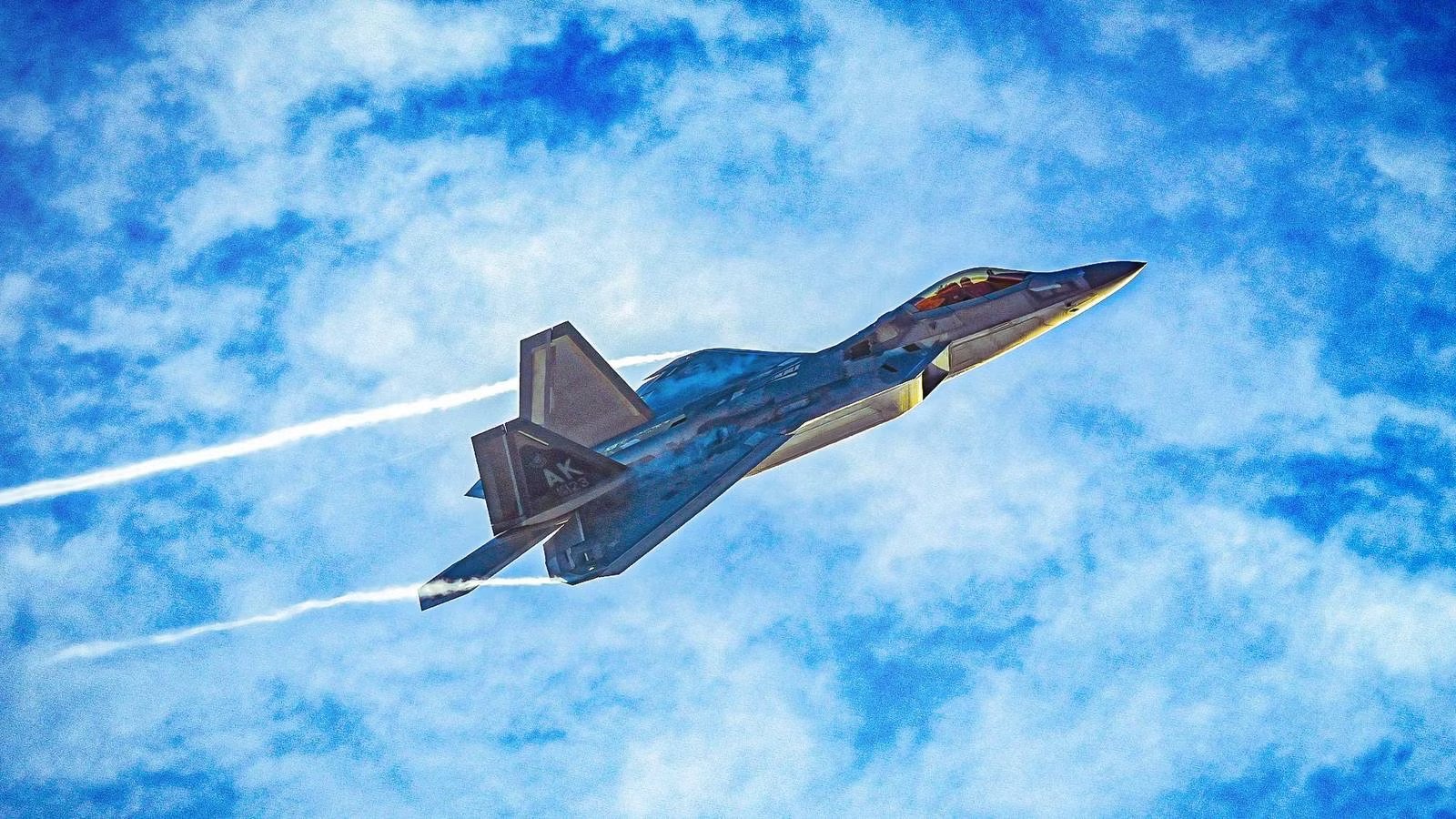
Beyond-visual-range missiles and stealth coatings were supposed to make the dogfight obsolete, yet high off-boresight weapons still win if the engagement collapses inside visual range. Six fighter jets currently in production or front-line service are built, in whole or in part, around winning that merge. The question is which design philosophy actually holds up once the distance narrows, and it becomes a battle of dogfighters, not missile trucks.
Lockheed Martin F-22 Raptor
The apex predator of the sky

The Raptor was conceived during the late Cold War by Lockheed Martin to achieve absolute air dominance over Soviet fighters. The case for within-visual-range supremacy starts with its two Pratt & Whitney F119 engines. Together, these produce a massive 70,000 lb (31,751 kg) plus two-dimensional thrust-vectoring nozzles. That combination gives Skunk Works’ F-22 a thrust-to-weight ratio (TWR) above 1:1 and the ability to perform post-stall maneuvers through sheer engine power.
Layered onto the world’s first stealth fighter is radar-absorbent material to give it the lowest known radar cross-section of any fighter jet today. The Raptor’s arsenal is tailored for over-the-horizon engagement, but its ‘supermanueverability’ also makes it the deadliest dogfighter in the world. It is also described as nearly impossible to detect until it is already inside gun range thanks to that stealth.
Yet, Raptor pilots reportedly view thrust-vectoring’s real value as maintaining control authority at high angle of attack rather than as an outright dogfighting trump card. On paper, that combination of stealth, sustained energy and high-alpha control authority looks unbeatable at the merge. Whether it plays out that way against a non-stealthy but purpose-built dogfighter is a separate question, and one of NATO’s own pilots has already tested it.
German Eurofighter pilots have had a handful of chances to find the chinks in its armor directly during joint exercises with the US. According to the German pilots, the Typhoon’s superior climb performance allowed it to hold its own, as the F-22 can turn on a dime, but extreme maneuvers bleed airspeed, which supposedly leave it briefly vulnerable.
Eurofighter Typhoon
Built as an energy fighter first

Where the Raptor treats agility as a backup plan, the Typhoon was engineered from the outset as a purpose-built energy fighter. It combines the aggressive aerodynamics of a canard-delta layout with twin Eurojet EJ200 engines for a TWR that lets it out-climb and out-accelerate most rivals in its class. While it is a brutally fast climbing interceptor, the design choices show up as a major advantage in subsonic maneuvering.
Comparisons of NATO’s 4.5-generation fleet single out the Typhoon’s instantaneous turn rate and vertical energy retention as its standout trait, ahead of the F-16 and F/A-18 in the same tier. In fact, in real-world exercises like Red Flag Alaska, when forced into a visual merge, the Typhoon proved it could trade ‘kills’ with the F-22 Raptor.
A US F-22 pilot was quoted by STRASAM after flying in one during dogfight drills, commenting:
“The Eurofighter Typhoon is absolutely stunning in terms of smoothness of control and the ability to pull (and maintain high G-forces). The Typhoon is designed for agility and ease of control. Especially in the version we flew, the avionics, color moving map displays, etc. are all absolutely first class. The maneuverability of the aircraft in close combat was also very impressive.”
The F-22 wins ‘one-circle’ fights where a pilot snaps the nose around using thrust vectoring to shoot at extreme angles. However, if the F-22 misses that initial snapshot, it bleeds airspeed rapidly. The Typhoon can capitalize on this by utilizing its superior energy retention to climb out of trouble and out-turn the Raptor as the speeds drop. Which brings us to another Eurocanard, but one built as more of a jack-of-all-trades than a pure interceptor.
Dassault Rafale
Dogfighting as an insurance policy

Dassault built the Rafale to fit a broad mission-set that includes air-to-air combat, nuclear strike, and even carrier aviation. The canard-delta wing that resulted is the workhorse of the French Air Force and Navy that the planemaker describes as superbly agile even at high angles of attack. The airframe is deliberately unstable in pitch to achieve this. Like the Typhoon, F-16 and F-22, it is tamed by an advanced digital fly-by-wire system.
In close-in engagements, the Rafale’s canards do double duty. Their vortices energize airflow over the wing at high alpha, improving lift and nose authority right in the moments that can decide a dogfight. That performance is most noticeable at the merge, in within-visual-range combat. Here, the Rafale’s rapid nose-turning and high angle-of-attack control pair with the helmet-cued infrared missile to let it in turning fights against nearly any foe.
The Rafale is optimized for the medium-to-low altitude omnirole mission. Its canards are placed further forward and closely coupled with the wing, giving it superior lift and tighter instantaneous turn rates at lower speeds and lower altitudes. Additionally, its heavy-duty airframe also allows it to carry heavier maximum payloads relative to its empty weight, which makes it one of the best 4.5-generation platforms in the world.
Boeing F-15EX Eagle II
The airframe that never lost a dogfight

Boeing’s F-15EX inherits the aerodynamic bones of a jet with a combat record of 104 confirmed air-to-air victories and zero losses. The Eagle II was rebuilt around the same energy-maneuverability principles with minimal changes. It has a refined but still generous wing area and the twin engines with a TWR that made the original Eagle dominant in the 1970s.
What is new is a digital FBW system, the F-15’s first, which Boeing engineers say sharpens the tighter turn radii and reduces stick forces to let pilots hold aggressive high-g turns longer without fatigue. Paired with the Joint Helmet Mounted Cueing System for high-off-boresight shots, that gives the F-15EX greater close-in lethality than ever before, even though its primary selling point is elsewhere.
The F-15EX’s 29,500-lb (13,381 kg) payload across 25 hardpoints lets it carry up to 12 AMRAAMs or as many as 22 air-to-air missiles in a ‘missile truck’ configuration no stealth fighter can match. That colossal air-to-air magazine makes it one of the deadliest over-the-horizon jets in the world.
That magazine depth is precisely why the US Air Force is buying it as a complement to the F-22 and F-35 Lightning II rather than a replacement for either. Congress has already pushed the program past its original target by adding funding for roughly two dozen extra jets over the Pentagon’s own retirement plans for the aging F-15C/D fleet it replaces.
Lockheed Martin F-35 Lightning II
Using tech to win in the merge

A leaked January 2015 test report, written by an F-35 Lightning pilot with extensive F-16 and F-15 dogfighting experience, found the jet’s energy maneuverability “substantially inferior” to legacy platforms. The pilot found the Joint Strike Fighter lacking in comparison with F-15s, F-16s and F-18s, noting it could win a visual engagement against a decades-old F-16 only by executing specific energy-bleeding maneuvers before having to disengage.
The Pentagon’s own Director of Operational Test and Evaluation report behind that account showed flight-control software had capped hard defensive turns at 6.5 G, short of the aircraft’s 9 G design specification. The Joint Program Office did not directly dispute the finding that the F-35 underperformed the F-16 in pure turning maneuverability, arguing instead that sensor fusion and stealth are meant to prevent the merge from happening in the first place.
Lockheed Martin markets its Distributed Aperture System, six infrared cameras stitched into a 360-degree feed on the pilot’s helmet, as giving F-35 pilots the ability to ‘look through’ the airframe and cue weapons at whatever they are looking at, dogfight or not. That sensor advantage is real, but the jet’s lethality rests on sensors to deny opponents the surprise merge. A distinction the USAF’s other current-production fighters do not need to make.
Saab JAS 39 Gripen E
Agility as an export argument

Saab’s Gripen E pairs a delta-canard airframe with a single General Electric F414G engine putting out roughly 22,000 lb (9,979 kg) of thrust. Those give the lightweight jet a strong TWR that Saab credits for exceptional agility in high-speed engagements. Meanwhile, the aircraft’s short-range ‘punch’ comes from the IRIS-T missile. This IR-seeking missile has its own thrust-vector control and control surfaces capable of engaging targets that have already flown out of the line of sight.
The missile also marks a step forward in Sweden’s growing role under NATO’s reinvest in domestic defense technology after it became the most recent member of the Alliance in 2024. Henrik Höjer, responsible for the Gripen program within Saab Aerosystems, gave these remarks after the initial Swedish Air Force flight tests in 2020:
“IRIS-T is a European collaboration and development project within the missile area, where Saab has a leading role for the integration of complex future missile systems”
Cued through a helmet-mounted display, that pairing gives Gripen pilots a genuine look-and-shoot capability without needing to maneuver the jet’s nose onto the target first. Saab’s impressively lethal and affordable airframe has translated into contracts. Colombia signed a $3.6 billion order for 17 Gripen E/F jets in November 2025, joining Sweden, Brazil and Thailand as customers. Saab reported a backlog worth roughly $33 billion this year as it works to nearly double annual production.