dailynewsnblog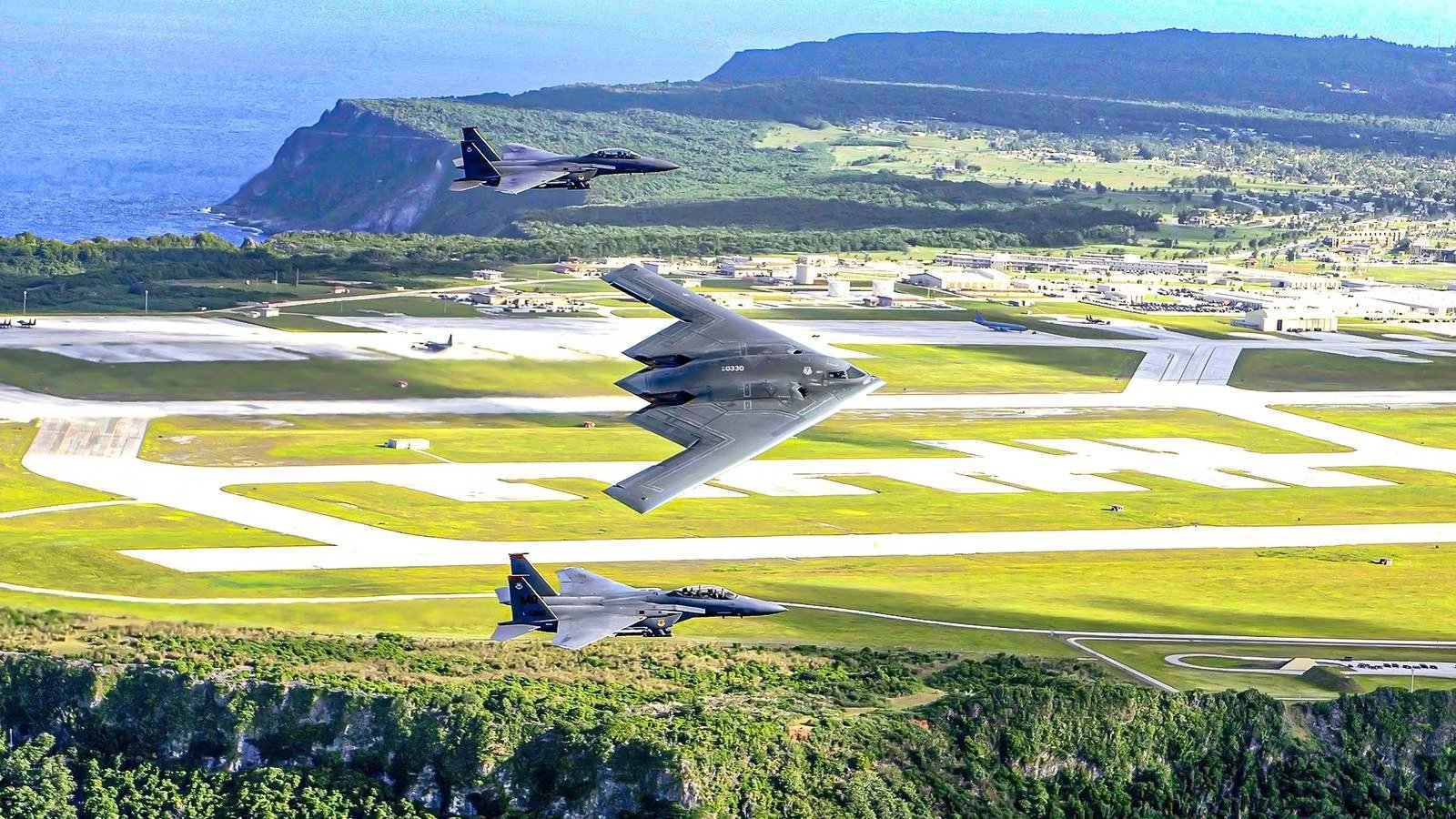
Golden Dome for America is a homeland missile-defense initiative that was officially commenced in January 2025. The plan directs the Pentagon to build an integrated system of systems for missile defense nationwide. This system combines current sensors and interceptors with new space-based technology to stop ballistic, hypersonic, and advanced cruise-missile threats from the most advanced adversaries.
The Missile Defense Agency’s director has said publicly that the technology needed to build the Golden Dome already exists and simply needs integrating. Congress has also funded the effort heavily, providing $24.4 billion through FY2025 reconciliation legislation, with the FY2027 budget request adding $17.9 billion. Whether that scaling happens on the timeline and budget as promised will be one of the most closely watched tests of American defense-industrial capacity through the rest of this decade.
Andersen Air Force Base
The testbed for multi-layered defense

At the fringe of the US borders, in the territory of Guam lies Andersen Air Force Base. It has hosted the forward-deployed Task Force Talon since 2013. It was the US Army’s first-ever forward-stationed THAAD unit and, for over a decade, the backbone of Guam’s ballistic missile defense. That changed on July 1, when Task Force Talon turned in its colors in a ceremony at Andersen, transferring its mission. The reactivated 3rd Battalion, 43rd Air Defense Artillery Regiment is now rapidly scaling up Talon’s mission as it builds toward full activation in October with a far more extensive arsenal of counter-missile weaponry.
Guam’s defenses now form the leading edge of the Enhanced Integrated Air and Missile Defense program, a roughly $1.7 billion Missile Defense Agency initiative. EIAMD will deliver 360-degree protection against ballistic, cruise, and hypersonic threats. It will also layer land-based Aegis capability on top of the existing Patriot and THAAD batteries. A separate battalion is also bringing Indirect Fire Protection Capability systems designed against rockets, artillery, mortars, and drones for close-range defense.
Guam’s new array of anti-missile batterieswork because Patriot and THAAD cover different altitude bands rather than simply duplicating each other. Patriot’s PAC-3 Missile Segment Enhancement interceptor is a hit-to-kill missile carrying no explosive warhead. It is guided by an active radar seeker and a dual-pulse solid rocket motor. PAC-3 engages threats out to roughly 37 miles (60 km) and up to about 50,000 feet (15,000 meters) in altitude, making it the terminal, mid-tier shield in terms of range.
On Guam, the Aegis System is meant to extend that same logic further. The Missile Defense Agency has expanded a Lockheed Martin contract to $1.935 billion through 2029 to link Navy SM-3 and SM-6 interceptors, Army THAAD and Patriot PAC-3, and joint sensors into one battle-management network. Impressive as that firepower concentration and weapons integration is, none of it functions without a broader command-and-control structure. This is the crucial connection to the wider network across America.
Joint Base Lewis-McChord
Guarding the skies without firing a shot

The Western Air Defense Sector is headquartered at Joint Base Lewis-McChord, Washington. WADS illustrates that some of the country’s most important air-defense nodes hold no interceptors whatsoever. It is a Washington Air National Guard unit that, together with its counterpart on the East Coast, forms one of two sectors reporting strategic air defense operations across the continental US. WADS serves the North American Aerospace Defense Command for peacetime air sovereignty.
Its area of responsibility covers roughly 63% of the continental landmass, monitored from a Sector Operations Control Center that fuses radar, airborne, and civil air-traffic data into a single air picture used to scramble fighters or direct other assets against unidentified or hostile aircraft. The unit is binational and joint, staffed by Washington ANG, US Army and Navy personnel, plus a Royal Canadian Air Force detachment. It also recently completed a major overhaul of its operations center, installing ten server racks and roughly two million feet of new fiber cabling in the largest technology leap since the post-9/11 buildup.
Since 2022, Lockheed Martin has demonstrated that Patriot’s M903 launchers and PAC-3 MSE interceptors can be commanded directly through THAAD’s own radar and fire-control network, letting a single battery span both altitude bands without physically co-locating separate Patriot and THAAD equipment. WADS demonstrates that command-and-control nodes are just as essential to the layered architecture as interceptor batteries, because a Patriot or THAAD system is only as useful as the decision cycle that tells it what to engage. That principle scales up dramatically at the installation that sits above every sector in the chain. The joint headquarters that watches for missile launches aimed at North America itself.
Cheyenne Mountain
The nation’s missile warning hub

Peterson Space Force Base in Colorado Springs is the day-to-day headquarters of NORAD and US Northern Command, the command that would receive WADS’ air picture and any missile-warning data generated anywhere in the network. Missile and space warning functions that once ran exclusively out of the Cheyenne Mountain Complex, the granite-buried bunker built to survive a nuclear strike, largely shifted to Peterson starting in 2006, though Cheyenne Mountain never went fully dormant.
Today the mountain complex operates on ‘warm standby,’ serving as the hardened, EMP-resistant alternate command center that NORAD and NORTHCOM would transition to immediately if Peterson suffered a physical attack. A skeleton crew keeps it ready, but it is fully staffed only when required by a strike, a cyber intrusion, or electronic warfare attack. Inside the mountain, the 21st Space Wing’s Missile Warning Center still operates radar systems that monitor for ballistic missile launches and objects in space. Those systems feed the same integrated tactical warning and attack assessment process that has run continuously since the Cold War.
That redundant, dual-site design is itself a form of layered defense applied to command and control rather than interceptors. The architecture assumes that any single node, however well protected, can fail. An active command center at Peterson is backed by a hardened bunker inside a mountain. It builds into a second one that cannot be taken out by the same attack.
Fort Bliss
Where the army’s newest command system goes operational

Fort Bliss, Texas, is the clearest example of a base defined by mission rather than geography. The site hosts the 32nd Army Air and Missile Defense Command, a theater-level headquarters. It is tasked with a standing 72-hour deployment mission that synchronizes Patriot and other air defense forces for combatant commanders worldwide. Under it is the 11th Air Defense Artillery Brigade, which fields three Patriot battalions, three THAAD units, and a critical Integrated Air and Missile Defense Battle Command System.
The Army has said that, eventually, every Patriot battalion, along with Indirect Fire Protection Capability and maneuver air defense units, will run on IBCS. Fort Bliss is among the first to receive complete production-representative systems in 2024. In October 2025, soldiers used IBCS to track two missiles in a contested electronic environment and destroy both, the capstone test of the system’s follow-on operational evaluation.
Compared to Patriot, THAAD is built to intercept in the terminal phase of flight but very high and far out. A complete battery fields six truck-mounted launchers carrying eight interceptors each, for 48 missiles total, engaging targets from roughly 25–93 miles (40-150 km) in altitude and out to 125 miles (200 km) in range, operated by a crew of about 95 soldiers.
THAAD’s X-band radar, priced at $400–500 million per unit, received a gallium-nitride upgrade in 2025 that roughly doubles its detection range. It also sharpens its ability to pick out smaller, low-observable targets like hypersonic glide vehicles. Fort Bliss’s importance is not just that it hosts Patriot and THAAD batteries, but that it is where the Army is proving IBCS actually works under stress before pushing it Army-wide. That raises a follow-on question. Who trains the soldiers who will operate this modernized force once it leaves Fort Bliss?
Fort Sill
The schoolhouse behind every battery

The answer, since a 2005 Base Realignment and Closure decision, is Fort Sill, Oklahoma. The US Army Air Defense Artillery School relocated from Fort Bliss to Fort Sill’s Fires Center of Excellence, where it now trains every enlisted, officer, and warrant-officer air defender in the force, from Patriot fire-control operators to the launching-station crews who load PAC-3 interceptors.
Fort Sill also hosts the 31st Air Defense Artillery Brigade, itself a Patriot-equipped formation. It is also home to the 30th Air Defense Artillery Brigade, which runs the schoolhouse of “the world’s best Air & Missile Defense Soldiers capable of winning on any battlefield.” The school’s mission has also broadened to include the newly built Counter-small Unmanned Aircraft Systems University. This program trains planners and operators to defeat emerging drone threats that have come to dominate air defense since the war in Ukraine.
This base is not an operational interceptor site in the way Fort Bliss is; its importance is institutional. Yet, every Patriot crew fielded anywhere in the world, including the ones defending forward-deployed islands in the Pacific, passes through Fort Sill at first. That forward deployment is where the stakes of that training become most visible, nowhere more so than on the single US territory closest to a potential adversary’s missile inventory.