dailynewsnblog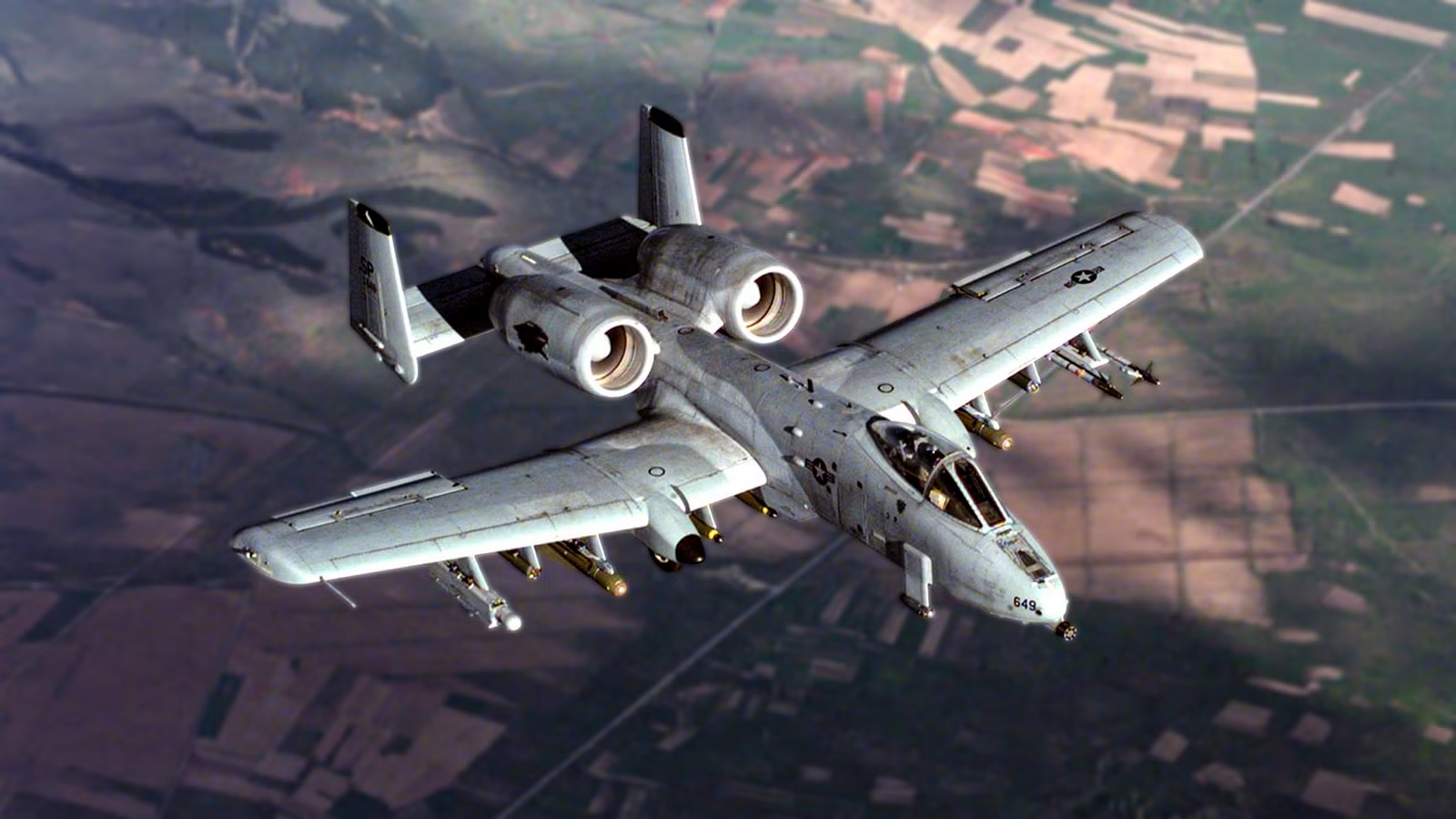
The Fairchild Republic A-10 Thunderbolt II, more commonly known as the A-10 Warthog, was built around one primary mission above all others. The plane was exclusively designed for close air support missions. That singular focus explains why the plane’s reputation has endured long after many faster and more modern jets entered military service. Unlike multirole fighters adapted for strike missions, the Warthog’s structure was purpose-built for the brutal realities of supporting troops near the front line, where low-altitude maneuvering, resistance to ground fire, and the ability to keep flying after damage all matter more than speed. The United States Air Force (USAF) still describes the A-10 as its first aircraft specifically designed for close air support, with features that emphasize survivability, accuracy, and low-speed handling over sleek performance.
That is ultimately what makes the A-10 such an interesting aircraft to analyze through a more structural lens. Its strengths are not just the famous GAU-8 cannon, but more so regarding the way the airframe itself was engineered to absorb punishment and stay useful over the battlefield. From the titanium-protected cockpit and redundant flight controls to the broad straight wing, engine placement, and rugged landing gear, the aircraft is designed to reflect a consistent logic. The plane is designed to survive, loiter, maintain a clear view of the flight, and support ground forces. Those five structural advantages are the key to understanding why the A-10 became one of the most distinctive close air support aircraft ever built.
A Bathtub Of Titanium Armor
1,200 lbs (544 kg) of capable cockpit protection

One of the A-10’s core defining structural advantages in its role as a close air support aircraft is that it features an armored cockpit “bathtub” that surrounds the pilot with roughly 1,200 pounds (544 kg) of titanium. That is not just a dramatic design flourish, but rather a reflection of the aircraft’s entire close air support philosophy. As a jet serving this role, it is expected to operate low and relatively close to hostile ground fire where small arms, anti-aircraft artillery, and shrapnel are all legitimate threats to both a pilot’s livelihood and his or her ability to do his or her job.
By physically protecting the pilot alongside key pieces of the flight-control system, the A-10 was designed to keep the aircraft in the fight even after taking hits that might cripple much more delicate high-speed jets. The Air Force has also noted that the aircraft can survive direct hits from armor-piercing and high-explosive projectiles, which underlines how survivability was built directly into the structure of the aircraft from the outset.
From a structural perspective, this matters because the protection of the pilot is what preserves the plane’s combat usefulness in the middle of a dangerous low-altitude mission. In close air support situations, the ability to continue flying after taking damage is often more important than speed or maneuverability. The A-10’s armored shell, therefore, gives it a uniquely blunt but highly practical advantage. The aircraft was designed to withstand punishment in the exact environment where close air support is ultimately the most demanding.
The Plane Has A Large, Straight Wing
The aircraft’s wingspan exceeds 57 feet (17.42 meters)

The A-10 Warthog’s broad, straight wing has historically been one of the most important reasons why it can work so well in a close air support role. With a wingspan that exceeds 57 feet (17 meters), the jet was designed for low-speed maneuverability, stable weapons delivery, and long loiter time over the battlefield rather than dash performance.
In overall structural terms, that straight, high-area wing gives the pilot significantly better control of the aircraft at low altitude and lower airspeed, something which is ideal for close air support missions. Fast swept-wing fighters can strike targets, but they are much less comfortable orbiting close to friendly forces, visually identifying threats, and making repeated accurate passes. The A-10’s wing is its secret weapon in this context. It allows the plane to turn tightly, remain controllable at lower speeds, and spend more time near troops who may need immediate support.
The Air Force specifically highlights its excellent maneuverability at low air speeds and altitude, alongside its unique ability to loiter near the battlefield for impressively extended periods of time. Those are not separate virtues unto themselves, but they come directly from the plane’s structural design. The wing is what gives the A-10 the patient, almost deliberate handling qualities that ground forces value. In practice, that means that aircraft can see more, react more carefully, and attack more precisely in the messy, fluid environment of close combat operations.
A Pair Of High-Mounted Twin Engines
Each engine offers 9,065 lbf (40.3 kN) of thrust

There is another key structural advantage of the A-10 Warthog that we have not yet discussed, and that is the plane’s extremely unusual engine placement. The plane is powered by a pair of TF34 turbofans, each of which is rated at 9,065 lbf (40.3 kN) of thrust, and they are mounted high on the rear fuselage rather than low under the wings like most conventional turbofan-powered aircraft. This arrangement helps the plane in multiple key ways that directly matter for close air support operations.
First, the elevated position reduces the risk of foreign object damage when operating from rougher forward locations, as these are places where debris of all kinds is often left on runways, and improvised airstrips are often used for landings. Second, spacing the engines apart improves overall survivability, primarily because damage to one engine is less likely to disable the other at the same time. Third, their position helps shield exhaust with the tail structure, reducing infrared exposure somewhat compared with a more exposed layout.
All of this reflects the A-10’s design logic. The plane is not designed for elegance. Rather, it is optimized for battlefield practicality. In CAS, aircraft often need to operate from austere bases closer to the front and remain resilient in hostile airspace where both missiles and gunfire are threats. The engine placement, therefore, serves as a structural survivability feature, not just a packaging choice. It helps the Warthog stay flying, stay supportable, and stay useful in the low-level, high-risk environment for which it was purpose-built.
Redundant Flight Controls With Manual Reversion Systems
Backup control is available even after a 100% hydraulic loss

The A-10 Warthog was designed with redundant hydraulic flight-control systems backed up by a manual reversion mode, and that may be its most battle-proven structural advantage after armor. The Air Force’s fact sheet explicitly notes that manual systems back up the redundant hydraulics, allowing pilots to fly and land when hydraulic power is lost. That ultimately matters enormously in close air support situations, primarily because low-altitude attack profiles expose aircraft to a much greater chance of battle damage from ground fire.
A more fragile aircraft might become uncontrollable after a hit to its hydraulic lines or actuators. The A-10, by contrast, was built with the expectation that such damage could very much happen. The best-known demonstration came in Iraq in 2003 when Captain Kim Campbell recovered and landed her battle-damaged A-10 after switching to manual reversion following hydraulic failure.
From a structural perspective, this gives the Warthog a unique toughness. It is not merely armored against damage, but it is also engineered to remain flyable after key systems are compromised. That is a critical distinction to make. Survival in combat is not just about resisting hits, but rather about preserving control after the aircraft has already been hit. From a close air support platform operating in dense threat environments, that ability to limp home can be every bit as important as firepower or overall endurance.
Rugged Landing Gear And Austere-Field Design
The aircraft offers a maximum takeoff weight (MTOW) of 51,000 lbs (23,133 kg)

The A-10 Warthog’s landing gear is another structural feature that directly supports its unique close air support mission. The plane has a maximum takeoff weight exceeding 50,000 lbs (22,000 kg), and yet it is designed with rugged gear, short takeoff and landing capabilities, and the ability to operate in and out of locations that are near the front lines. That is ultimately central to the close air support mission the plane is tasked with.
A support aircraft is far more useful if it can base closer to the troops that it serves, reduce transit time, and keep flying even when main operating bases are damaged or austere in nature. The A-10’s gear was built for exactly that kind of overall practicality. The plane’s sturdy arrangement and rough-field tolerance mean that it can use more limited infrastructure than many high-performance jets. Just as importantly, the plane’s semi-exposed main wheels reduce damage in a gear-up landing, another example of survivability being built into the structure rather than added as an afterthought.
This is a less glamorous advantage than the gun or armor, but operationally, it is fundamentally essential. Close air support depends on responsiveness, repetition, and persistence, all of which improve when an aircraft can operate from forward locations with minimal overall fuss. The Warthog’s undercarriage therefore contributes directly to its battlefield usefulness by making the airframe more forgiving, more durable, and more deployable under combat conditions.