dailynewsnblog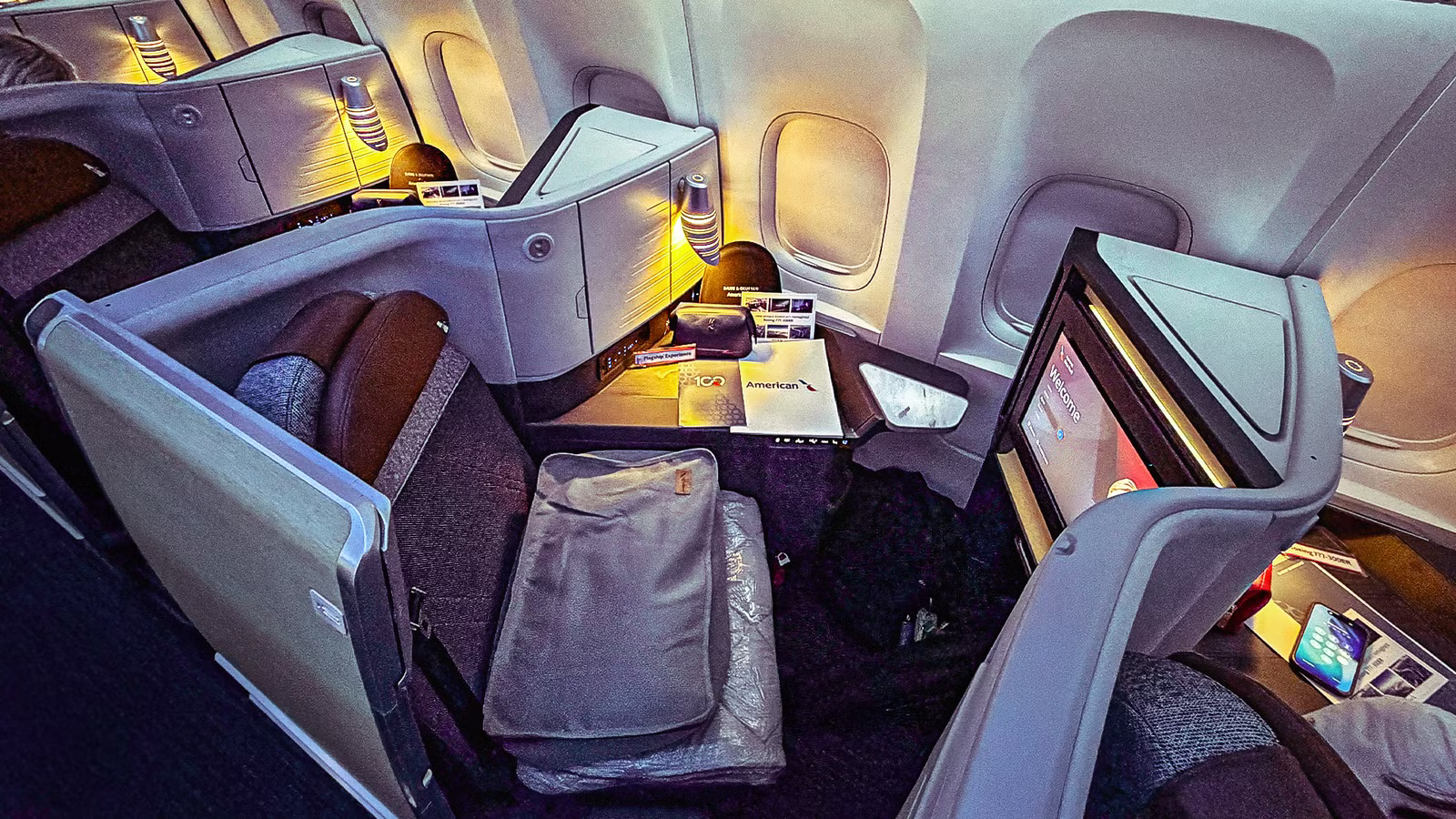
 American Airlines has officially introduced its retrofitted Boeing 777-300ER that completely eliminates its traditional first class cabin, signaling a permanent strategic shift for the carrier. The refreshed widebody completed its inaugural flight from New York to Buenos Aires on September 2, configured with 70 business class suites, 44 premium economy seats, and 30 extra-legroom economy spaces.
American will completely stop selling its legacy international Flagship First product for travel beginning November 19, effectively ending the era of long-haul first class among all major US network airlines. While removing the most expensive inventory from a flagship jet looks like a retreat from the premium market, American’s leadership concluded that first class had simply stopped earning its physical footprint on the aircraft.
Shrinking Demand For Top-Tier Seats
American answers the market

Going back to AA’s third quarter earnings call in 2022, then chief commercial officer Vasu Raja was asked whether first class was leaving the 777, and he answered that it would not exist on that aircraft or anywhere else at American, because customers were not buying it, as Inc. recounted. Raja added that business class seats had improved enough to narrow the gap between the two cabins, and that the space freed by removing first class could hold more business seats, which AirlineGeeks described as the product customers were more willing to pay for.
Load factors reveal that international first-class cabins rarely achieve the standard 80% to 85% occupancy baseline for optimal route profitability, with first-class load factors regularly plummeting as low as 20% on certain long-haul sectors. Because these expansive first-class footprints consume premium cabin real estate while severely capping total revenue-generating seat counts, under-occupied front cabins represent an immense financial drain.
This space constraint became a critical liability for AA, whose legacy Flagship First product faced mounting criticism. Its top-tier product accelerated significantly following AA’s 2016 introduction of international premium economy, which established a highly lucrative intermediate pricing tier while blurring the prestige of the forward cabin.
Although leadership finalized the cabin elimination strategy in 2022, industrial delays pushed the initial 777-300ER retrofits nearly two years behind their original 2024 target. Even so, did the ultimate death of American’s international first class stem from terminal demand decay for the legacy pod, or from the overwhelming corporate revenue potential of the modern business suites replacing it?
How Business Class Replaced First Class
A different era of flying

The headline of American’s release earlier this month, “Flagship Suite seats are the new first,” clarified the airline’s clear intention for the suite to replace the traditional cabin. According to the AA Newsroom, every business class traveler in AA’s Flagship Suite has a sliding privacy door, direct access to the aisle, additional personal storage, and a chaise lounge position that allows a passenger to stretch out beyond the typical flat bed.
The design is the same on the service side. The airline stated that business class travelers receive expedited check-in, security, boarding, and luggage handling in addition to a meal, and that it recently extended access to Flagship Dining, its top dining option, to all Flagship customers. That narrows the service gap between the two cabins further than the seat alone does.
The design did not begin on the 777. AA introduced Flagship Suites in 2025 on a premium-heavy version of the Boeing 787-9 with 51 suites and on the Airbus A321XLR with 20, AirlineGeeks reported. The 777-300ER borrows cabin design elements from both aircraft. Delta Air Lines pioneered doors on business class seats in 2017.
Squeezing More Revenue-Generating Seats Onto The Jet
No substitute for capacity

The reality of American’s strategy is spelled out directly in the new seat counts. Before the conversion, the flagship 777-300ER rolled with eight first-class pods, 52 business-class seats, 28 premium economy spots, and 216 total economy seats, maxing out at 304 passengers.
The new layout aggressively tears out the front cabin to pack in 70 upgraded business suites, 44 premium economy seats, and 216 economy positions, squeezing a total of 330 passengers onto the exact same airframe. By wiping out just eight first-class seats, AA managed to buy enough physical real estate to add 18 business class suites and 16 premium economy recliners, while only giving up two standard coach seats in the back.
Looking purely at premium, lie-flat real estate, the cabin gets a net gain of ten beds, bumping the total from 60 up to 70. AA now aggressively clusters its business, premium economy, and extra-legroom seats under a single ‘premium’ umbrella, driving that high-margin inventory up to 144 seats from a previous baseline of 116. This shift instantly lifts the premium share of the entire aircraft to 44% of the cabin.
AA boasts that this 144-seat premium layout is larger than any other widebody configuration operated by a domestic carrier. By trading specialized luxury for high-density business space, the airline turns its biggest jet into a massive revenue-generating machine.
The tradeoff sits at the back of the aircraft. Standard economy shrinks, and Airways cautioned that the change does not mean every passenger gets more room. The conversion is also slow, with all 20 aircraft now expected to be finished sometime in 2027, Reuters reported.
Some jets will keep their physical first class seats for months after November 19, and Live and Let’s Fly said AA plans to sell those seats as part of business class until each aircraft is modified. More seats help only if buyers pay for them, which is the premise AA has to defend with revenue.
The High Profit Margins Of Premium Flying
Selling the cabin product that brings in the cash

When it comes to the sources of its income, American has been remarkably explicit. According to Reuters, AA revealed in August that, although occupying roughly 30% of its seats, premium customers generated nearly half of its ticketed revenue in the second quarter. Inc. described this ratio as three out of ten seats earning nearly half of ticket sales.
According to Airways, AA’s own second-quarter materials revealed that premium unit revenue increased by more than 13% year over year, with lie-flat and premium economy capacity growing over twice as quickly as Main Cabin capacity during the period. The 777-300ER is only one part of the approach. According to AA, deliveries of the upgraded 787-9 and A321XLR, as well as retrofits of the 777-300ER and older 777-200ER.
Catch what other flight trackers miss
Emergency squawks, holds, NOTAMs — live signals, no signup.
Open tracker
Catch what other flight trackers miss
Emergency squawks, holds, NOTAMs — live signals, no signup.
Open tracker
Combined, those upgrades will raise lie-flat seating on its international aircraft by more than 50% by the end of the decade, Airways reported. On narrowbody jets, Inc. wrote, the airline plans to lift premium seating to roughly 40% from about 25% today. Delta Air Lines reported premium revenue growth of 17% in the second quarter against 8% for main cabin ticket revenue.
JetBlue also announced a new domestic first class cabin called BlueFirst around the same time, as evidence that the premium push is spreading even as international first class fades. Still, Airways stressed that these aggregate figures do not establish the return of any single cabin class, which leaves open whether 70 suites will fill on a given route.
AA’s 777-300ERs fly to London, Tokyo, Sao Paulo, Buenos Aires and Sydney, the AA Airlines Newsroom said, and those markets differ sharply in how much premium demand they generate. The airline’s confidence rests on a wager about the future as much as on past results, and the wager looks more reasonable when set beside what its competitors have already done.
First Class Earned Its Eviction
Putting its seats where the money is

American Airlines is working to catch up with competitors who have already adapted their international and domestic service offerings. As noted by Reuters, United Airlines eliminated its international first class in 2018, while Delta combined its business and first class cabins in 1998. By terminating Flagship First sales on the 777-300ER, AA becomes the last of the three major US airlines to maintain a distinct international first class.
In pursuit of competitive advantage, AA’s floorplan from April 2025 shows a shift in seat configurations, with United’s Polaris 777-300ERs now offering 60 business seats and new elevated configurations on 787-9s featuring 64 seats. AA is also shifting its domestic strategy, with Flagship First no longer sold on transcontinental flights starting March 28, 2027, transitioning its A321 fleet from the older A321T, which has ten first class and 20 business seats, to the A321XLR, which will feature a combined Flagship Suite with 20 seats.
The long-term viability of this higher density seat layout remains uncertain. Initial media charter flights did not effectively demonstrate how these packed business suites perform during full-capacity services, nor how the general public will respond to the new configurations. Critical decisions regarding the airline’s strategy will be revealed soon.
AA plans to officially cease Flagship First sales on the 777-300ER in November and end transcontinental first class sales by March 2027. The airline’s strategy hinges on a new standard of a 70-suite configuration for its flagship widebodies, with forthcoming earnings reports looking to establish whether former first class customers will transition to the higher-margin business suites introduced.