dailynewsnblog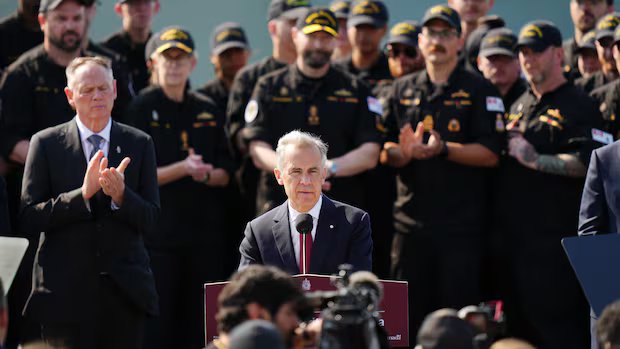

Listen to this article
Estimated 5 minutes
The audio version of this article is generated by AI-based technology. Mispronunciations can occur. We are working with our partners to continually review and improve the results.
In announcing that Canada is negotiating to buy up to a dozen submarines from German shipbuilder ThyssenKrupp Marine Systems (TKMS), Prime Minister Mark Carney marked the end of a tight competition to win the right to replace Canada’s aging fleet of Victoria-Class boats.
Both bids — from South Korea with Hanwha Ocean and Germany and Norway with TKMS — made offers that extended well beyond just a submarine procurement, each pledging to make serious investments and contributions to Canada’s economy.
While the government is tight-lipped on many of the details as negotiations are ongoing, here are five takeaways from what Carney called “the most consequential defence procurement in Canadian history.”
4 subs by 2036, then up to a dozen
TKMS offered to deliver four Type 212CD submarines to the Royal Canadian Navy by 2036. In a news release, the federal government said the first submarine is to be delivered by 2034.
The German submarine-maker just about matched its South Korean counterpart who offered to deliver four of their subs by 2035 from the outset of the competition to replace Canada’s aging fleet.
Timing is an important part of the deal, as the navy’s four Victoria-Class subs are slated for retirement in the mid-2030s. As of now, only one is operational.

Ahead of meeting his Norwegian and German counterparts in Norway, Prime Minister Mark Carney said he wouldn’t discuss German submarine-maker TKMS’s bid backed by both allies on the trip. Carney said ‘we’re blessed by having options, very much including the German, Norwegian option.’
“This was a difficult, close decision between two highly qualified suppliers,” Carney said in Halifax. “Both the TKMS and Hanwha platforms met the very high capabilities of the Royal Canadian Navy.”
In selecting the TKMS bid, Canada is now entering negotiations to procure up to 12 submarines.
Thousands of jobs, billions for the economy
Carney confirmed that one condition of the deal is that 100 per cent of the value of the federal government’s investment has to be matched in economic benefits to Canada.
He said that Canada will receive “tens of billions of dollars in investment” from TKMS “across key defence and industrial domains, including space, munitions, autonomous technology, critical minerals and R&D.”

Prime Minister Mark Carney says Canada is set to receive ‘tens of billions in investment’ as part of a deal with Thyssenkrupp Marine Systems, the German shipbuilding company that won Canada’s bid for new submarines. Carney said the investments ‘will impact every region of the country.’
Prior to the announcement, information viewed by CBC News showed the combined impact of the proposed investments from TKMS and the German government could contribute an $86-billion surge to Canada’s gross domestic product.
Carney said the TKMS contract is also set to “directly create and sustain an ecosystem of well over 100,000 well-paying jobs” across the country.
He said that the initial phase of the project will see Canadians working on the direct construction of the submarines and requires workers like welders, pipefitters, engineers, machinists and researchers.
Before the announcement, CBC News learned the German bid could create an average of up to 50,000 jobs over the next five years and over 654,695 job years of employment over the project’s lifetime.
Germany’s proposed range of investments
The Germans offered up a number of major investments as part of their bid, but Carney did not disclose many of those details.
Ahead of the announcement, information viewed by CBC shows TKMS suggested the construction of a maintenance facility on one of Canada’s coasts. The proposal also called for the creation of manufacturing centres to build torpedoes and anti-torpedo systems.
“In Manitoba, our aerospace technicians will help build the torpedoes” the new fleet of submarines will carry, Carney said
Prior to the bid selection, the Germans offered to turn Manitoba’s Port of Churchill into a major export hub to help move Canadian liquefied natural gas (LNG) and critical minerals to global markets from the port on Hudson Bay.
Manitoba Premier Wab Kinew has been pushing for an expansion of the port.
The German government also proposed establishing a carbon capture facility deploying TKMS technology in partnership with Alberta.
The Germans’ winning offer falls in line with a number of the Canadian government’s economic objectives, including Canada’s goal to increase the country’s LNG production to 50 million tonnes per year by 2030.
Deeper ties with NATO and Europe
A notable factor in the bid is compatibility with NATO forces as TKMS is already a supplier for the alliance. The first 212CDs are currently in development for Germany and Norway.
“The TKMS platform is optimized for Arctic waters and it’s fully NATO interoperable, allowing it to communicate seamlessly, to share intelligence and carry out joint missions,” Carney said.

German Minister of Defence Boris Pistorius tells CBC News that he trusts German submarine builder TKMS to deliver if Canada decides to purchase its boats. ‘We are talking about NATO requirements, NATO capabilities, so there is nothing to lose,’ he said.
This deal is notably yet another integration with Germany specifically. Canada brokered a deal in May to sell one million tonnes of LNG from Ksi Lisims — a largely Indigenous-owned terminal being developed in northern B.C.
But Carney was clear that opting for the German bid does not mean Canada is moving away from its Indo-Pacific strategy.
As it stands, Hanwha is still officially the reserve supplier for the Navy’s submarine fleet replacement and could take over the contract if negotiations with TKMS fail.
Outsized benefit for Canada’s coasts
Delivering the announcement in Nova Scotia’s capital, Carney suggested Halifax could see significant benefit in shipbuilding and maintenance.
“It’s reasonable to expect that there will be very substantial activity here in Halifax for decades as a consequence of this,” Carney said.
He said the West Coast is also set to see economic activity as a result of the German and Norwegian contract, adding the benefits would be seen “throughout Canada.”
“This is just the beginning,” Carney said.