dailynewsnblog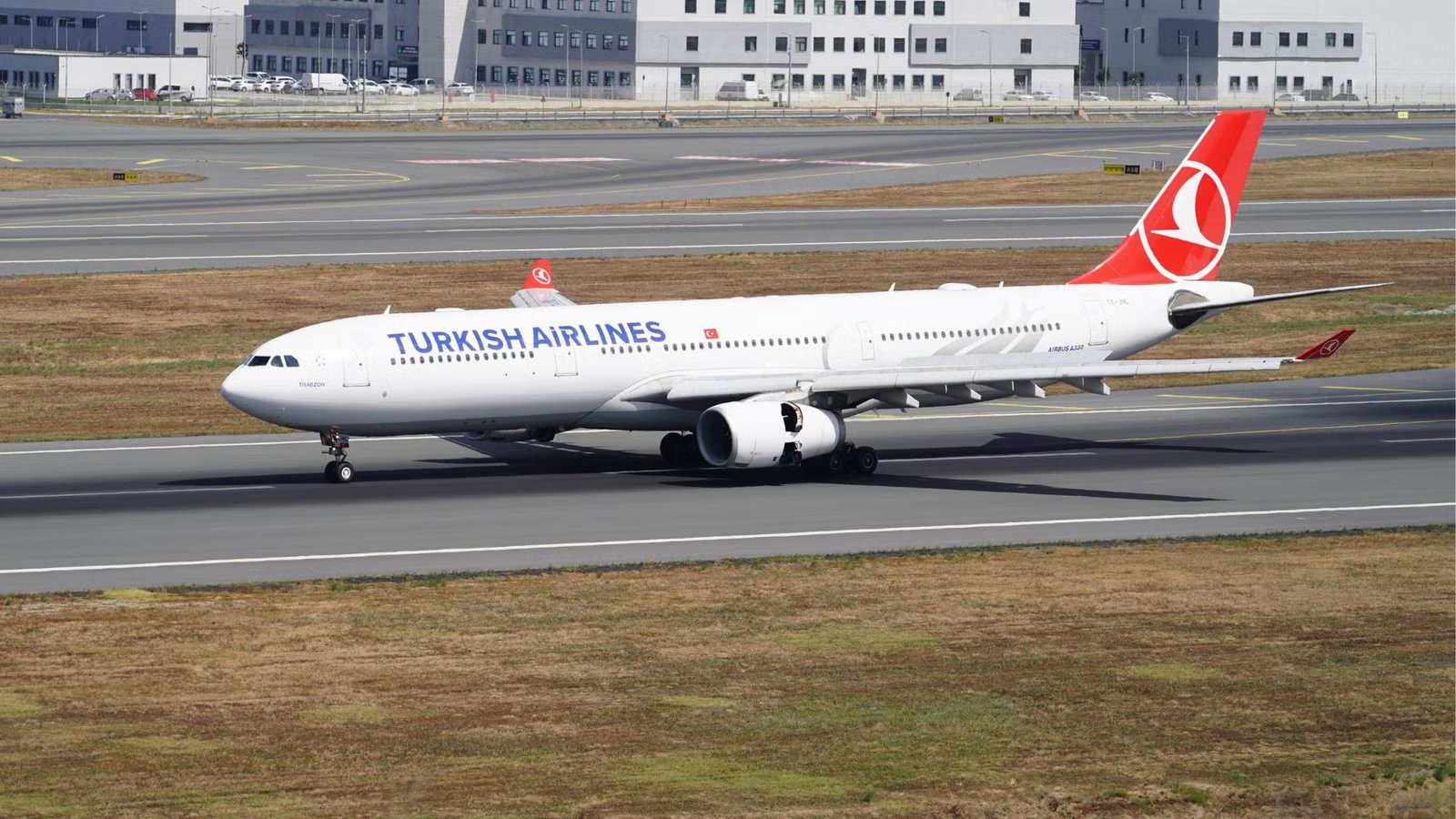
 Turkish Airlines evacuated 288 people after one of its Airbus A330 aircraft experienced a landing gear fire while arriving at Tribhuvan International Airport in Kathmandu, Nepal, on Monday morning. According to the Economic Times, Flight TK726 from Istanbul had just landed when smoke and flames were seen coming from the aircraft’s right landing gear during taxi operations. Cabin crew immediately initiated an emergency evacuation using inflatable slides as airport firefighters rushed to the scene. All passengers and crew safely exited the aircraft, and no injuries were reported.
The aircraft involved was an Airbus A330-300, registered TC-JNP, operating the airline’s scheduled service between  Istanbul Airport (IST) and Tribhuvan International Airport (KTM). Nepalese aviation authorities temporarily suspended airport operations for approximately two hours while emergency crews extinguished the fire and removed the aircraft from the runway. Turkish Airlines confirmed that a return flight was planned and opened an investigation into the incident as engineers continue technical inspections of the aircraft.
Turkish Airlines Airbus A330 Evacuated After Kathmandu Landing Incident

The incident unfolded shortly after Flight TK726 completed its landing rollout at Tribhuvan International Airport on May 11, 2026. According to the airline, smoke was observed coming from the landing gear while taxiing, and passengers were evacuated via slides as a precaution. Initial assessments indicated that the smoke may be caused by a technical malfunction in a hydraulic pipe. Online footage showed smoke rising from beneath the aircraft as emergency vehicles surrounded it.
All 277 passengers and 11 crew members evacuated safely from the Airbus A330-300 without reported injuries. Fire crews managed to contain the blaze before it spread beyond the landing gear area, while airport staff coordinated runway closures and emergency procedures. The temporary shutdown of Kathmandu’s only runway caused operational delays for multiple regional and international flights. Yahya Ustun, the operator’s senior vice president, said:
“Technical inspections of the aircraft have been initiated by our teams. Initial assessments indicate that the smoke was caused by a technical malfunction in a hydraulic pipe.”
Emergency Evacuation Procedures Help Ensure Passenger Safety

Emergency evacuations are among the most important safety procedures in commercial aviation, allowing passengers and crew to leave an aircraft quickly during fires, smoke events, or mechanical failures. International certification rules require aircraft manufacturers to demonstrate that a fully loaded aircraft can be evacuated within 90 seconds using only half of the available exits. Widebody aircraft such as the Airbus A330 are equipped with multiple inflatable slides, illuminated escape-path lighting, and emergency-exit systems designed for rapid evacuation.
Cabin crew members receive recurrent evacuation training, including drills involving smoke-filled cabins, blocked exits, and passenger management during high-stress situations. During landing gear or brake fire incidents, pilots and cabin crews must decide within seconds whether passengers are safer remaining onboard or evacuating immediately onto the runway.
Airports regularly conduct emergency response exercises involving aircraft fires and mass evacuations to improve coordination between airlines, firefighters, medical teams, and air traffic controllers. Widebody aircraft evacuations often involve hundreds of passengers, requiring careful crowd management once people reach the runway or taxiway. Modern commercial aviation maintains a strong safety record partly because of these strict training standards, aircraft certification requirements, and coordinated airport emergency procedures.
The 10 Largest Airbus A330-900 Operators: Passenger Experience Compared
Delta is currently the world’s largest A330-900 operator, while Cathay Pacific has the most on order.
Airbus A330 Plays Key Role In Turkish Airlines’ Long-Haul Network

The A330-300 is part of Turkish Airlines’ long-haul widebody fleet used extensively across the carrier’s international network. Turkish Airlines has operated the A330 family for many years, deploying the aircraft on routes throughout Europe, Asia, Africa, and the Middle East from its Istanbul hub. The type remains one of the airline’s most versatile aircraft types, offering a balance of passenger capacity, operational efficiency, and long-range capability. Turkish Airlines operates five weekly flights between Nepal and Istanbul.
Turkish Airlines currently operates multiple A330 aircraft in both passenger and cargo configurations, with the A330-300 commonly assigned to medium and long-haul services where demand does not require larger aircraft such as the Boeing 777 or A350. The type plays an important role in the airline’s international expansion strategy, particularly on routes linking Istanbul with destinations in South Asia, Central Asia, and Africa. Many of the carrier’s A330 aircraft feature dual-class cabins with business and economy seating, allowing Turkish Airlines to maintain premium long-haul service standards across a wide range of markets.
The A330 has become a core part of Turkish Airlines’ global operations due to its reliability, flexibility, and suitability for airports with varying operational constraints. The aircraft type is capable of operating long-distance international sectors while maintaining lower operating costs than larger widebody jets, making it especially useful on developing or seasonal routes.