dailynewsnblog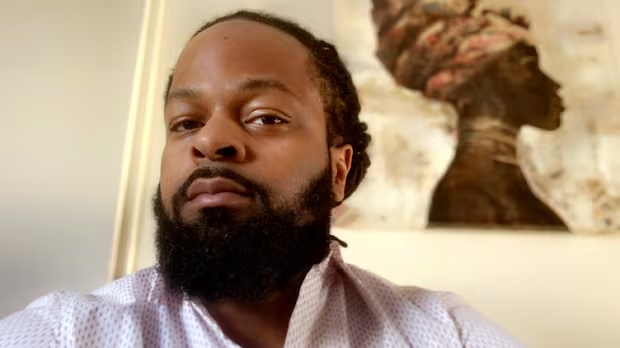

Listen to this article
Estimated 4 minutes
The audio version of this article is generated by AI-based technology. Mispronunciations can occur. We are working with our partners to continually review and improve the results.
Leslie Blot was driving down a highway in Mascouche, Que., on Dec. 4, 2020 after a visit to his mother’s grave, when he was pulled over by two provincial police officers.
After asking for his licence, they went on to accuse Blot, a Black man, of possessing drugs, having a criminal record and of “reverse racism.”
A recent decision by Quebec’s police ethics tribunal reaffirmed what Blot already knew.
The Tribunal administratif de déontologie policière concluded that Sgt. Simon Deveault-Bonenfant and officer François Bleau-Goulet of the Sûreté du Québec (SQ) engaged in discriminatory actions based on the colour of Blot’s skin.
“Virtually all circumstances surrounding the stop pointed to racial profiling,” Justice Isabelle Côté wrote in the decision, published in June.
The decision was in part based on a video of the incident Blot took on his phone.
In the video, the officers tell Blot they noticed a white substance in his bag and say he needs to open it so they can check it for drugs. When looking for his licence, which Blot realizes he left in a different jacket, an officer is heard calling him a “drama queen.” They eventually fine Blot for not having winter tires on his car, and tow it.
“What saved my case was … the recording,” Blot said in an interview with CBC.
“You can see … the way the officers talked to me,” he said, adding that he wasn’t hiding the fact that he was recording the interaction.
According to the decision, Deveault-Bonenfant abused his authority by searching Blot’s bag without reasonable suspicion, and failed to act with respect and politeness toward Blot.
The tribunal notes that Deveault-Bonenfant called Blot “national victim of the century,” told him to “calm his nerves,” and said “the only racist here is you.”
“I think [police officers] think they can do anything they want and won’t face consequences,” Blot said.
“With this judgment, I think things are maybe going to change a little bit.”
Long-term solutions needed
Fo Niemi, director of the Center for Research-Action on Race Relations (CRARR), hopes so too.
“The tribunal rejected the officers’ version, basically accused them of not only negligence … but also of lying. So we expect the sanctions to be tough,” he said.
Those sanctions will be determined at a separate hearing, but Niemi says similar cases have resulted in officers being suspended without pay.
Despite the ethics tribunal’s decision, Blot says he still feels unsafe around police and hopes for more long-term solutions to address racial profiling in the province.
“This happened to me from the age of 16 and now I’m 44,” he said. “That’s why I have to take action now, to make sure that the other generation doesn’t have to live like this.”
CRARR also filed a complaint on Blot’s behalf with Quebec’s human rights commission. In 2024, the Commission des droits de la personne et des droits de la jeunesse concluded that Blot faced discrimination and recommended the officers pay him around $20,000 in damages.
Niemi said that case was settled out of court for an undisclosed amount.
The human rights commission also made recommendations to the SQ, including the introduction of new policies and training to counteract racial profiling, acknowledging that systemic racism can exist without racist intent, and collecting anonymized data on the racial identity of individuals subject to a police stop in order to detect racial profiling.
The SQ did not respond to CBC’s request for comment or questions regarding the implementation of the human rights tribunal’s recommendations in time for publication.