dailynewsnblog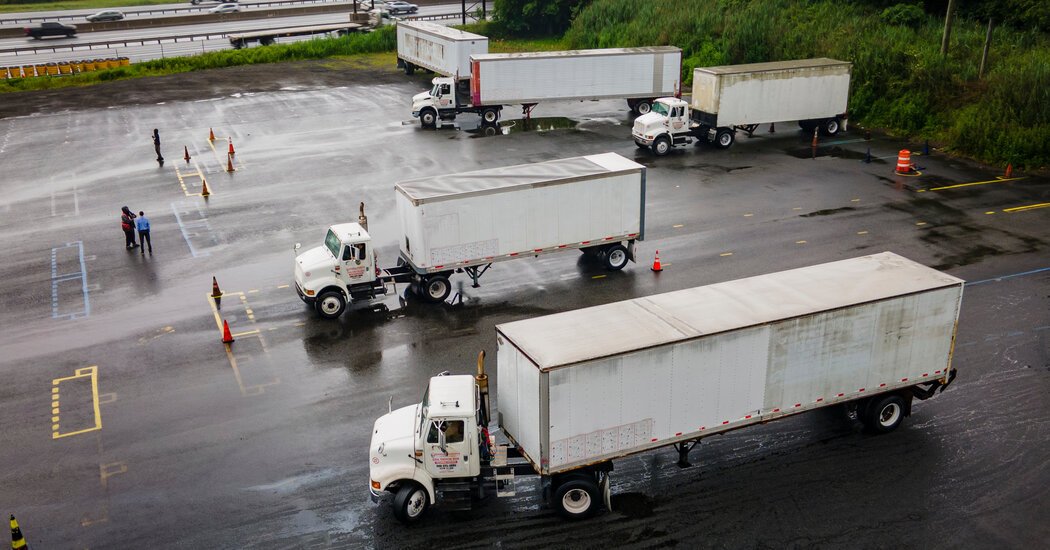
Transportation Secretary Sean Duffy announced on Monday that his department was immediately revoking the accreditation of 110 commercial trucking schools for certifying drivers who failed to demonstrate spoken or written English proficiency, as part of a new, multiagency effort to expand the Trump administration’s crackdown on abuses in the industry.
Mr. Duffy said the schools had collectively trained over 5,000 drivers who were granted licenses, but then subsequently could not demonstrate English-language proficiency during roadside inspections.
Commercial truck drivers have been required since the 1930s to have a basic command of English so that they can read road signs and interact with law enforcement officials, but the requirement has not been consistently enforced. In April 2025, President Trump issued an executive order dictating that truck drivers who failed to meet that requirement would be placed “out of service” and immediately forced to stop operations.
Mr. Duffy said the department had also taken steps to shut down an additional 160 schools for certifying insufficiently trained drivers, noting that many operated with unlicensed instructors, no classrooms or inadequate outdoor space to give students opportunities to operate a truck as part of their training. Schools authorized to train commercial drivers appear in the Federal Motor Carrier Safety Administration’s Training Provider Registry; by removing them from that list, the department can effectively force them to cease operations.
“We have schools that know the rule and still pass people through their school who can’t speak the language,” Mr. Duffy, speaking in Michigan, told reporters.
“If you’re here illegally and you can’t speak the language and you’re not well trained, you don’t deserve to be in a big rig, driving on American roads, endangering American citizens,” he added.
In recent months, Mr. Duffy’s crusade against commercial trucking has focused chiefly on immigrant drivers working illegally, and threatening the states that granted licenses to drivers without adequate work authorization with consequences if they fail to make changes. The campaign was fueled by high-profile fatal accidents involving immigrant commercial truck drivers.
But his latest announcement reflects an apparent shift in the messaging of the crackdown to focus more acutely on poor English-language ability, and how training institutions fail to certify that students meet those and other requirements, as a means of rooting out potentially dangerous drivers.
This year, the Transportation Department claimed that in 2025, truckers with nondomiciled commercial driver’s licenses — a category held by foreign nationals authorized to work in the United States who do not have permanent residency — had caused at least 17 crashes, resulting in 30 deaths.
On Monday, Mr. Duffy said that since the start of the current Trump administration, commercial truckers who could not demonstrate English-language proficiency had been involved in accidents causing at least 239 deaths, a figure drawn from police and other accident reports, according to a department spokesman. The statistics could not be independently verified.
The Transportation Department claims that since June 2025, more than 28,000 truck drivers have been “placed out of service” for failing to demonstrate English-language proficiency in interactions with law enforcement and other roadside officials. While being placed “out of service” means truck drivers cannot complete their route, it does not necessarily result in the suspension or revocation of their license.
The department also said that in the last year and a half, it has forced states to cancel over 30,000 licenses illegally issued to foreign drivers, and expunged over 8,000 unqualified training schools from its registry of accredited institutions. That includes the 110 schools transportation officials targeted in their latest emergency move, citing examples that they said demonstrated a pattern of turning a blind eye to the requirements surrounding English-language ability.
Derek Barrs, the administrator of the Federal Motor Carrier Safety Administration, said on Monday that one of the schools the administration had shut down was Platinum Plus Driving School’s location in Fresno, Calif., accusing it of training 36 drivers who were later found not to have English proficiency. One of them, Mr. Barrs said, went on to be involved in a fatal accident in Oklahoma.
Mr. Barrs also cited ASC Technical Institute, a school in El Paso, accusing it of graduating 58 drivers later cited for insufficient English proficiency, including one who killed a man after running a stop sign.
Mr. Barrs gave other examples of schools that the department was taking steps to shut down because of substandard training practices. Among them was Angel’s Transportation of New Jersey, where he said students were not able to get any practical truck driving experience.
“They couldn’t even do the maneuvers because the parking lot was too small,” Mr. Barrs said.
“Our investigators,” he added, “went into 400 driver training schools and we found that 40 percent of those we investigated did not meet the rules and requirements of our regulations.”
Representatives of the schools did not respond immediately to emailed requests for comment.
Department officials added on Monday that the administration would also conduct a nationwide audit of third-party testers, whom states sometimes deputize to conduct licensing exams, arguing that investigators had identified a subset of particularly egregious actors in that corner of the industry as well.
“We have 10 skill testers who have given over 2,000 driver’s licenses to people who can’t speak English,” Mr. Duffy told reporters, adding, “and they still were able to get a state license.”
The announcement was an apparent turning point in how the Trump administration plans to address violations. Over the last several months, a key part of the Transportation Department’s strategy has been targeting the states issuing the greatest number of what it sees as problematic licenses, sometimes by threatening to withhold highway funds from those states unless changes are made.
This spring, the Supreme Court also shot down a bid by Florida to sue California and Washington over their practices of awarding licenses to immigrants.