dailynewsnblog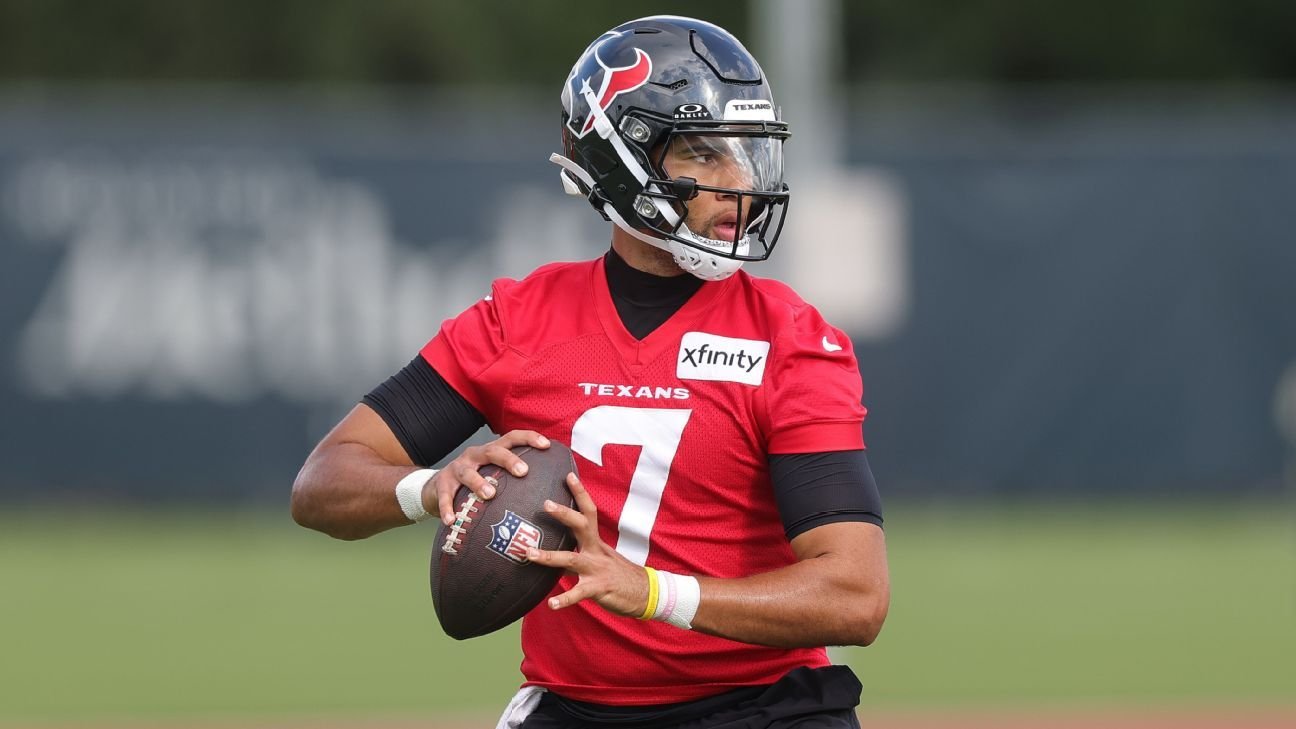

Jeremy Fowler

Multiple Authors
Player contracts are accelerating at an Xavier Worthy-esque pace this offseason. The past six months have triggered an avalanche of market-topping deals, from a quarterback making $64 million per year (Patrick Mahomes) to an edge rusher earning an annual average of $50 million (Will Anderson Jr.).
Five players have become positional cash kings this summer alone, with several more setting high marks back in the spring. Since June, five defensive tackles have earned deals worth at least $30 million per year.
Some teams privately grumble over ballooning salaries and the inherent challenges of building a competitive team around star players who eat up much of their salary cap. But the soaring costs simply parallel a 44.7% increase in the NFL’s cap over the past four years, from $208.2 million in 2022 to $301.2 million now.
The previous four-year spike was 17.4%, from $177.2 million in 2018 to the 2022 number, and while the pandemic stalled progress, nothing is slowing down what’s happening now. But many elite players still need new deals with Week 1 just days away. Some will get to the finish line before kickoff; some won’t.
ESPN made calls around the league to provide the latest information on many of the key contract extension candidates: Who gets paid and who will strategically wait things out until the offseason?
Jump to a topic:
Lamar Jackson | C.J. Stroud
Christian Gonzalez | Joey Porter Jr.
DJ Turner | Quenton Nelson
Tucker Kraft | Detroit duo


Jackson, to his credit, is fiercely private about his negotiations. And as his own agent, he has proved to be a shrewd negotiator. Just look back at 2023, when Jackson remained patient, requested a trade after being franchise-tagged and finally landed a five-year, $260 million deal.
It’s no surprise this negotiation is void of many details. But the league sentiment is this: Jackson has massive leverage and appears ready to use it, which means the chances of him playing out 2026 without an extension could grow by the day.
He is owed $52 million in cash in each of the next two seasons with an $84.3 million cap hit in 2027, which might as well be a poison pill. He has a no-franchise-tag provision and a no-trade clause. If he wants to entertain a new home outside of Baltimore in future years, he has full control of where it is — especially if he has another banner season.
Perhaps Baltimore gives Jackson an offer he can’t refuse soon. But he can sit tight and let the market do the work for him next offseason, when several star quarterbacks from the 2024 draft class will be eligible for extensions.
Perhaps then Jackson will become the NFL’s first player to earn $70 million per year.

Several people with knowledge of the situation believe Stroud is prepared to play out this season without a new deal, despite Houston making what it considered a competitive offer.
There’s still time before kickoff to reach a deal — and the Texans’ front office is aggressive in re-signing core players — but the current sentiment is Stroud will most likely not end up with a new deal.
My understanding is Houston is prepared to put Stroud in what it feels is a strong place among the 12 quarterbacks in the $50 million club.
But like Jackson, Stroud can let an exploding quarterback market do the work for him if he waits an additional six to eight months. By all accounts, Stroud had a strong training camp and believes he can rebound from last season’s struggles. Houston is squarely in the Super Bowl discussion based on its talent level and elite defense. There’s a lot for Stroud to gain — and potentially lose — by delaying a deal. He has had moments of brilliance since entering the league in 2023. Channeling that brilliance while properly managing the game will go a long way.
On Tuesday, Texans general manager Nick Caserio set a Week 1 deadline for a deal with Stroud.
“If we don’t get it figured out before the season starts, then it’ll be something we address in the offseason,” Caserio said.

On the surface, this deal feels like a no-brainer. Gonzalez was the No. 3 cornerback as ranked by executives, coaches and scouts, a true press-man coverage player who dominated late last season. He has an All-Pro and a Pro Bowl nod. Seattle Seahawks corner Devon Witherspoon’s four-year, $132 million deal set the table.
But this one is taking a while to reach a conclusion. Gonzalez did not appear thrilled when addressing local media members this summer. Perhaps that had something to do with team owner Robert Kraft floating publicly at the start of camp that New England offered to make Gonzalez the highest-paid cornerback in NFL history.
My understanding of this situation is that if Gonzalez were to sign a market-setting deal — and it will need to be just that — then it has to be buttoned up. And the sides are not close on several elements of the deal.
It’s worth noting New England hasn’t executed many recent top-line extensions from which to draw. Rob Gronkowski’s six-year, $54 million extension in 2012 was the highest for a tight end at the time but was considered team friendly due to the number of years. Tom Brady was famously underpaid. New England has spent big on free agents but not necessarily on many market-resetting extensions. Gonzalez, who as of now does not plan to negotiate during the season, is testing that in a big way.

This is probably the most complicated of them all. Momentum for a deal just hasn’t been there. My sense is the player has been frustrated that, despite his status as a high-level man corner, he hasn’t been made a priority. The 2023 draft picks getting paid by Pittsburgh — linebacker Nick Herbig and defensive tackle Keeanu Benton, who received four-year extensions this summer — play smaller roles.
Sources say the Steelers’ lack of a formal offer for weeks sent the clear message to Porter that they would like him to play out the final year of his rookie contract, which prompted him to consider the possibility of a trade or sitting out for an extended period. The 26-year-old stayed away from the practice field for weeks but returned Tuesday. Perhaps his participation ignites talks, but he’s leaving that up to his agents.
The semantics are this: The Steelers most likely would do a deal with Porter. But the mechanics of the cornerback market (as outlined above with Gonzalez) are hard to ignore. Five cornerbacks make $30 million or more per year. After that, there’s a drop to $25 million (the Carolina Panthers’ Jaycee Horn). Porter essentially has to pick which group he thinks he belongs in, and all indications are it’s not the latter. And the Steelers might not want him in the former on their dime.
The Steelers don’t negotiate during the season, which fuels the urgency over the coming week.
I’m told the new coaching staff is not a deterrent here. They are all-in on his ability as a high-level cover man.
Another hurdle: The 2027 franchise tag at cornerback is a below-market $23 million.

Like Porter, Turner is an underrated cover man out of the AFC North. But this deal has virtually no chance to get done before Week 1, barring a massive and unexpected uptick. It isn’t close, and Turner is poised to play out his rookie deal.
If Cincinnati follows its own blueprint, it will franchise-tag Turner as it did with another star defensive back, Jessie Bates III, in 2022. Bates had to play on the tag, before reaching a four-year deal with the Atlanta Falcons in free agency.
Turner will be in line for a large payday in free agency, if he reaches it. But the franchise tag is a real possibility here.

Nelson is a candidate for another extension after maintaining his high level of play at age 30. But talks are stagnant at the moment. Nelson preferred to sign a deal before training camp, which came and went. Though discussions haven’t intensified, the Colts could pursue a deal before Week 1 kicks off Sept. 13.
Nelson will likely need to be the highest-paid interior offensive lineman, which means topping Las Vegas Raiders center Tyler Linderbaum’s three-year, $81 million deal ($27 million per year). The highest-paid guard is the Tennessee Titans’ Peter Skoronski at $25 million annually.
A franchise tag for Nelson in 2027 would cost Indianapolis $29 million to $30 million. He is due $18 million in cash this season, the final season of his current deal.
No other guards are set to get paid in the short term, clearing the runway for Nelson to do something now — or play it out.

The Packers appear motivated to reach a deal with Kraft. While talks are idle right now, they certainly aren’t dead, and a lot can happen over the next 10 days.
Most around the league, even on the team side, acknowledge the tight end market needs a reset. It’s the lowest paid of the 11 primary positions (special teams excluded), with the Arizona Cardinals’ Trey McBride topping the market at $19 million annually.
Yet nine tight ends were selected in the first three rounds of April’s draft. Offenses frequently put two or three tight ends on the field together. Kraft is in a position to enhance the market.
He is coming off a torn ACL, which is a factor, but he didn’t hold in, and he has done everything asked of him by Green Bay.
One important name to note here: Raiders TE Brock Bowers. He is eligible for an extension in the 2027 offseason and will most likely reset the positional market in a significant way.


Free agency is kind to ascending wide receivers; just ask Alec Pierce, who now makes $28.5 million per year with the Colts. Wilson and Washington clearly know this.
The Cardinals have attempted to extend Wilson, who is coming off his first 1,000-yard season as a key target for Jacoby Brissett. But right now, the likeliest path for Wilson is to enter Week 1 on the final year of his rookie deal. Perhaps the team finds a way to get a deal done, but sources indicate he’s likely to be a key free agent.
Washington was a prime option for Trevor Lawrence last season, and based on the stories out of camp, Washington will catch a ton of passes this campaign. The Jaguars are comfortable with in-season negotiating, but I’m told Washington would prefer not to do so. Jacksonville has engaged in talks with Washington, but no deal is imminent. This one has a chance to get done.


The Lions have committed more than $1 billion to a bevy of star players, and two more players who fit that mold are up for deals. As it stands, neither is poised to sign before Week 1.
Branch is starting the year on the reserve/physically unable to perform list due to last year’s Achilles tear, but he is a top-five safety when healthy. LaPorta returned from injury, and this could be a case where an in-season deal makes the most sense. Like Branch, LaPorta has a case as a top-five player at his position.
Expect Detroit to make efforts to keep both. It might just take a while.