dailynewsnblog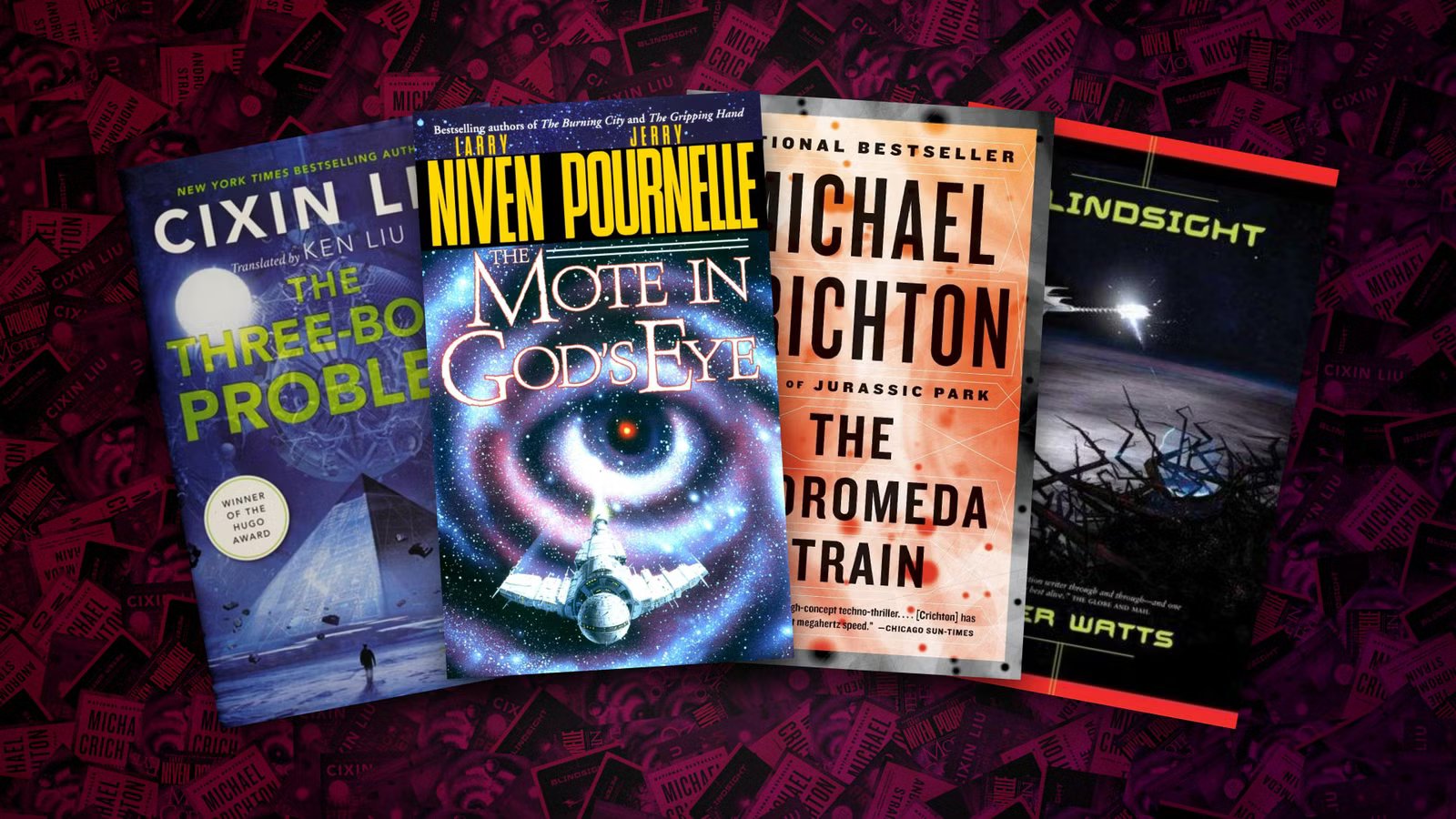
Hard sci-fi is speculative fiction for the obsessive. Such stories dive deeper than others into raw science, explaining how the exact orbital mechanics of a spacecraft work, how a synthetic consciousness compiles itself from raw code, how a dying star affects planetary gravity, and how lifeforms could exist outside our known laws of physics. In this subgenre, science is the driving narrative force.
Pioneers like Jules Verne and H.G. Wells were among the first to devise stories of this magnitude, focusing on scientific realism before the genre exploded during the Golden Age through authors like Isaac Asimov and Arthur C. Clarke. Since then, writers from Robert L. Forward to Greg Egan have rocketed the genre into increasingly strange territory, using everything from theoretical physics to genetic engineering as fuel for their stories.
The best hard sci-fi books, however, don’t require over a hundred pages to truly get going. Whether it’s the sudden arrival of an impossible alien structure or a random breakthrough that reshapes civilization, these books waste little time showing you what their authors are capable of even without needing textbooks to help them. These are 10 hard sci-fi masterpieces that had me convinced within their first 10 pages that I was reading something special.
The Mote in God’s Eye (1974) by Larry Niven & Jerry Pournelle

Niven and Pournelle’s ingenious first-contact tale approaches the discovery of an alien civilization with intense scientific scrutiny. Set in a future where a sprawling human empire is recovering from an interstellar civil war, The Mote in God’s Eye wastes no time in introducing its hard sci-fi premise. The opening pages drop you directly into a tense scramble to intercept an alien solar-sail spacecraft, kicking off our first contact with another intelligent lifeform.
The central mystery eventually widens to focus on whether an entire species can escape the biological realities that govern it, with the Moties proving one of the most fascinating elements of the story. It’s ambitious science fiction built from concrete scientific ideas, and you can feel that ambition from the first few pages.
The Gods Themselves (1972) by Isaac Asimov

Asimov’s The Gods Themselves is the sort of book that reminds you how strange sci-fi can get when the author stops worrying about making the aliens feel relatable. He approaches the story through three distinct but interconnected perspectives set across space and reality itself. The novel’s most fascinating section takes place among the inhabitants of a parallel universe whose biology, relationships, and understanding of the physical world are radically different from ours. Asimov uses that alien society to explore an energy exchange between universes, twisting what might initially sound like a brilliant scientific solution into something much more complicated.
Featuring some of the most brilliant non-humanoid alien biology ever put to paper, The Gods Themselves is Asimov at his most ambitious. The novel’s middle section transports you to an entirely alien world, a space where radically different ideas about reproduction, societal structures, and forms of life give the story a flavor all its own. It’s also where Asimov’s warnings about scientific hubris begin to take shape, as its central thesis focuses on a miraculous discovery that gives way to consequences humanity never fully considered.
Dragon’s Egg (1980) by Robert L. Forward

If you want hard science fiction that takes the “hard” part seriously, Dragon’s Egg is difficult to ignore. Robert L. Forward builds an entire alien civilization on the surface of a neutron star, an environment so extreme the beings living there experience time on a radically different scale from us humans. Called the Cheela, Forward’s fictional aliens aren’t just humanoids with funny biology. Their entire civilization evolves at a pace that makes our history look glacial, allowing Forward to shorten enormous stretches of cultural and technological development à la Asimov’s Foundation into a more compressed story observed by human scientists from orbit.
Written by a professional physicist, Dragon’s Egg takes one of the most hostile environments in the cosmos and uses it to construct a civilization from scratch. Forward turns raw astrophysics into narrative momentum, showing how extreme gravitational forces shape every facet of how his creatures survive. It’s hard sci-fi pushed to its absolute physical limits, grounding a wildly imaginative first-contact premise with prose and insight that makes it all feel tangible.
Rendezvous with Rama (1973) by Arthur C. Clarke

While much of hard sci-fi aims to explain every corner of the universe, Arthur C. Clarke understood that the most awe-inspiring stories leave the grandest mysteries unsolved. His 1973 novel Rendezvous with Rama is a perfect example. The story opens with the discovery of a cylindrical object passing through the solar system on a hyperbolic trajectory, giving humanity a razor-thin window to intercept it.
Little do the scientists know the object, called Rama, is a self-contained world operating according to physical laws humanity barely comprehends. Clarke grounds the expedition in rigorous science, calculating spin, gravity, atmospheric dynamics, and orbital vectors, yet never lets the mechanics overpower the cosmic dread. The result is a masterclass in hard sci-fi that makes the vast unknown feel terrifyingly real from page one.
The Andromeda Strain (1969) by Michael Crichton

Creator of everything from Westworld to Jurassic Park, Michael Crichton is the poster boy for designing exciting stories around scientists simply doing their jobs. Before his theme-park disasters took off like wildfire, The Andromeda Strain showed he could tackle hard sci-fi better than most of his contemporaries. When a military satellite crashes in a remote Arizona town, almost every resident dies in seconds, their blood inexplicably clotted into powder. From that gruesome opening, The Andromeda Strain launches into a clinical race against time as an elite team of scientists retreats to an underground facility to isolate a lethal extraterrestrial microorganism.
It’s clear from the very outset that the people investigating the organism don’t have a clue what they’re dealing with, and that dread keeps you hooked from the start. Crichton’s obsession with process is exactly what makes the book work. He bypasses typical thriller tropes, building heart-pounding suspense out of realistic laboratory protocols, electron microscopy, and pathological analysis. The terror comes from watching brilliant minds battle a microscopic predator that mutates faster than their containment levels can hold. By treating the outbreak with a cold and procedural rigor, Crichton turns pure scientific method into utter terror.
Spin (2005) by Robert Charles Wilson

The premise of Spin is deceptively simple: on one fateful night, the stars in the night sky suddenly disappear, and not metaphorically. Robert Charles Wilson could have turned that into a straightforward disaster novel, but instead he uses the phenomenon to completely warp our understanding of time. Outside the Spin, billions of years can pass while only decades tick away on Earth, transforming the premise from a cosmic mystery into something much stranger and more intimate.
Beginning with its unforgettable opening scene where three childhood friends watch the night sky go black, Spin proves an immediate masterpiece in how Wilson grounds this staggering concept in human reality. As scientists calculate that the sun outside the barrier will age and burn out within a single human lifetime, humanity is forced to confront its own sudden extinction. Wilson filters the hard physics of temporal dilation and atmospheric engineering through religious panic, geopolitical desperation, and the fragile bonds of his main characters. Through all its big words, Spin seeks to ask how ordinary people endure living under a literal countdown to the end of the world.
A Fire Upon the Deep (1992) by Vernor Vinge

Vernor Vinge doesn’t exactly ease you into A Fire Upon the Deep. He opens the door on a galaxy where intelligence itself is constrained by geography, with different regions of space permitting radically different levels of technology and cognition. The idea behind the Zones of Thought is already enough to carry an entire novel, but Vinge keeps stacking impossible concepts on top of it, like superintelligent entities, galaxy-spanning communication networks, an artificial intelligence gone haywire, and the Tines, an alien species whose individual “people” are actually groups of creatures functioning as a hivemind.
Despite this dizzying density, Vinge’s world never feels like a textbook. He understands that high-concept computing theory and galactic physics only work when they carry tangible human stakes behind them. By balancing cosmic-scale, existential horror with the intimate survival story of two shipwrecked kids on a medieval alien world, he filters that hard sci-fi intellect through pure narrative thrill. The result is a masterpiece that leaps between galactic dread and planetbound adventure without ever losing its sense of wonder.
The Three-Body Problem (2006) by Cixin Liu

There are plenty of reasons to love Cixin Liu’s The Three-Body Problem, but the thing that makes its first few pages so devastating is how directly it ties a dark chapter of human history to an unspooling cosmic nightmare. Opening during the raw violence of the Chinese Cultural Revolution, where a young astrophysicist Ye Wenjie watches her father get beaten to death in a Red Guard struggle session, the novel focuses its high-concept science on human trauma before expanding into the ethereal.
The clinical bluntness of Liu’s prose coupled with the scale of his ideas makes those first few pages so effective. The author isn’t interested in making the universe feel cozy or conveniently understandable, nor do his fictional aliens exist to give humanity a comforting pep talk. Liu treats theoretical physics as an arena of existential dread. His science is terrifying because it suggests how little control we have over the cosmic forces surrounding us, turning our fundamental understanding of nature into a house of cards.
Blindsight (2006) by Peter Watts

Blindsight is one of my favorite books on this list because it’s the type of hard science fiction story that can make you feel uncomfortable about being human. Peter Watts opens with a familiar first-contact scenario, but he quickly discards the tired question of whether the aliens are friendly or not and instead asks whether consciousness is even necessary for intelligence. When an unknown alien species maps Earth in a grid of falling probes, a crew of radically modified transhumans, led by a genetically resurrected vampire, is dispatched to the edge of the solar system to intercept them.
As the story dissects neuroscience, AI, and biology, even the crew sent into the void becomes a walking thought experiment, with Watts actively picking apart what constitutes a “person.” He brings the receipts for every scientific concept he introduces, but it’s always in service of actively undermining human exceptionalism. That’s the secret weapon of Blindsight: every time you think you’ve figured out the true weight of the narrative, Watts drops another seemingly peer-reviewed nightmare into the mix just to shake things up.
Permutation City (1994) by Greg Egan

Taking the familiar idea of simulated consciousness, Greg Egan’s Permutation City refuses to treat digital immortality as a cheap technological gimmick. He pursues the thought experiment to its absolute limit, systematically dismantling our assumptions about selfhood and existence. Through the story of Permutation City, Egan forces us to confront the unsettling reality that a conscious digital copy possesses an equal claim to your identity, that simulated universes carry the exact same physical validity as our own, and that once reality reduces to pure information, the concept of a “real” human being completely dissolves. Think Black Mirror to an unhealthy extreme.
Egan’s mathematics and philosophy can be dense, and often even deliberately intimidating, but that rigor is the entire appeal of his stories. Permutation City feels like someone took the ultimate existential questions about identity and existence, loaded them into a supercomputer, and refused to dilute the output. From the moment the novel opens on Paul Durham running a slow-motion simulation of his own mind, you know you’re in the hands of an author operating on a completely different frequency.