dailynewsnblog
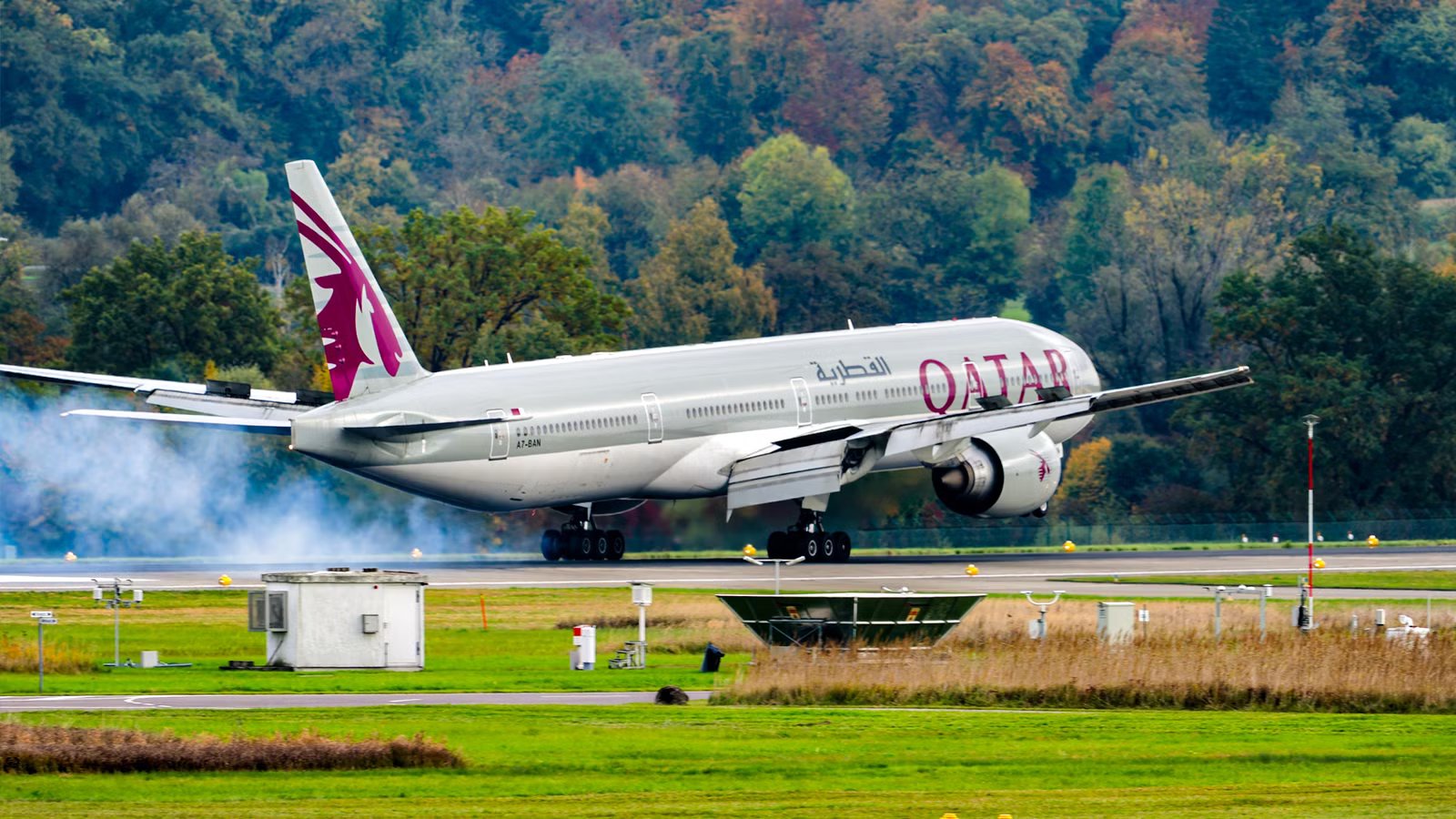
The Boeing 777 is hardly the newest or most capable long-range airliner in service today, but it remains a reliable workhorse for airlines worldwide. With over 2,000 examples delivered, the 777 is the most popular widebody program ever, and it’s still a popular machine for long-haul and ultra-long-haul flights. The 777-300ER in particular stands out for its compelling operating costs and is the most ordered variant by far.
Although the 777-300ER is over 20 years old, airlines still operate it on some of the longest flights in the world. The type is particularly popular with Asian and Middle Eastern airlines. Using data from Cirium, an aviation data analytics company, let’s examine the world’s ten longest regularly scheduled nonstop Boeing 777-300ER flights in 2026 by great-circle distance.
10
New York –Mumbai
6,774 nautical miles (12,551 km)

New York is Air India’s biggest US market, as it operates daily flights between its hub in Delhi Indira Gandhi International Airport (DEL) and John F. Kennedy International Airport (JFK), as well as between its hub in Mumbai Chhatrapati Shivaji Maharaj International Airport (BOM) and JFK. In addition, the carrier also operates flights between these two hubs and nearby Newark.
Air India used to have a fleet of 13 777-300ERs, but post-pandemic, the airline acquired six additional 777-300ERs that were formerly operated by  Etihad Airways. These aircraft retain their original interiors, and while the cabins are aging, they represent a significant upgrade in business class as Etihad installed staggered seats with direct-aisle access.
Air India’s original 13 planes have business class arranged seven-abreast. Economy passengers, however, will find the ex-Etihad planes tighter, as economy is configured ten-abreast rather than nine-abreast. Air India has long operated between BOM and JFK nonstop.
However, recent airspace restrictions in Pakistan and the Middle East have made a nonstop route unviable when headed west. As such, the BOM-JFK flight is forced to stop in Rome for extra fuel. However, because flying east means that the flight catches a tailwind over the Atlantic, Air India does operate the return segment from JFK nonstop.
9
Newark – Mumbai
6,784 nautical miles (12,565 km)

Air India is notable for serving JFK as well as Newark Liberty International Airport (EWR), and it even deploys the 777-300ER (its largest aircraft) to EWR. Once again, airspace restrictions mean that the westbound departure from BOM has to stop in Rome for refueling, while the eastbound flight from EWR can go nonstop.
Air India also uses the former Etihad 777-300ERs to EWR from BOM, just like on the JFK route. Both the ex-Etihad 777s and Air India’s original examples feature a three-class layout with first, business, and economy, but the ex-Etihad aircraft feature twice as many first class seats, five additional business class seats, and 28 fewer economy seats.
In addition to BOM,  Air India also connects JFK and EWR to DEL, which is its primary hub. Unlike the BOM flights, however, the DEL services operate with smaller, newer Airbus A350s. In addition, while the JFK-BOM flight runs six times per week, the EWR-BOM route operates thrice weekly.
8
Taipei – New York
6,785 nautical miles (12,566 km)

This route is notable for being the only one on the list currently operated by two airlines: in this case, EVA Air and China Airlines. Both carriers operate the 777-300ER nonstop on this route, although only EVA Air operates it daily. China Airlines, on the other hand, operates this route three to five times per week, depending on the time of year.
Both airlines offer very similar reverse herringbone business class seats, with EVA Air selecting the Safran Cirrus while China Airlines uses the Collins Aerospace Super Diamond. In addition, the 777-300ER configuration that EVA Air sends to JFK has 39 ‘Royal Laurel’ business class seats, whereas China Airlines’ 777-300ERs have 40 seats. Meanwhile, EVA Air installs 56 premium economy seats, whereas China Airlines installs 62 seats.
Airline | Business Class | Premium Economy | Economy | Total Seats |
|---|---|---|---|---|
China Airlines | 40 | 62 | 256 | 358 |
EVA Air | 39 | 56 | 238 | 333 |
Economy is where you see the biggest difference, as EVA Air configures this 777-300ER subfleet with 238 economy seats, while China Airlines’ 777s come with 256 economy seats. The main reason behind this difference is that China Airlines installs ten seats per row in economy on the 777, while the 777 subfleet that EVA Air deploys to JFK has nine seats per row in economy.
7
San Francisco – Kolkata
6,802 nautical miles (12,598 km)

The combination of airspace restrictions in Pakistan and the Middle East has severely impacted Air India’s North American operations. Since these routes are all at least 13 hours or more nonstop, the added distance required to maneuver around airspace restrictions severely cuts into an aircraft’s payload, requiring Air India to make fuel stops so that it can carry full passengers and cargo.
For the most part, the airline makes fuel stops in Europe, but its DEL-San Francisco routes are a notable exception. Departing Delhi, Air India flies the 777-300ER nonstop to  San Francisco International Airport (SFO), while on the return segment, the aircraft stops in Kolkata Netaji Subhas Chandra Bose International Airport (CCU).
Air India doesn’t sell SFO-CCU or the 777’s CCU-DEL flights separately, so Kolkata serves purely as a fuel stop, and passengers don’t even leave the plane. Still, the SFO-CCU segment remains one of the longest 777 flights in the world. Unlike the New York routes, however, this service is operated by one of Air India’s original 13 777-300ERs.
While the economy cabin is spacious due to the nine-abreast layout, the seats themselves are aging, while Air India installs seven seats per row in business class. What’s more, the interiors on these planes are notorious for their rough condition, although the airline does plan to eventually retrofit these aircraft.
6
Dubai – Miami
6,817 nautical miles (12,626 km)

Miami International Airport (MIA) is a relatively recent addition for Emirates, as the carrier first began flying here in 2021. It replaced the airline’s previous nonstop service from Dubai International Airport (DXB) to Fort Lauderdale, as this route underperformed. This route is typically blocked at over 16 and a half hours westbound, while the return to Dubai is blocked at 14 hours and 15 minutes.
At the time of writing, Emirates is deploying the 777-200LR on this route, but it also schedules the 777-300ER to serve MIA during the northern summer season, including in 2026. Both aircraft feature premium economy, but the 777-300ER also offers an eight-seat first class cabin, which is not available on Emirates’ 777-200LRs.
Emirates Fleet | Business Class Seat | Configuration |
|---|---|---|
Airbus A350-900 | Safran S-Lounge | 1-2-1 |
Airbus A380-800 | Safran SkyLounge | 1-2-1 |
Boeing 777-200LR | Collins Aerospace MiniPods | 2-2-2 |
Boeing 777-300ER | Collins Aerospace MiniPods Safran S-Lounge | 2-3-2 1-2-1 |
In addition, the 777-300ER subfleet that Emirates will deploy to Miami for the 2027 summer season will feature its updated business class, whereas the 777-200LRs still feature older seats configured six-abreast. Rather uniquely, the flights don’t end at MIA.
Instead, the carrier operates a fifth-freedom segment that continues on from MIA to Bogota El Dorado International Airport (BOG), carrying the same flight number. On this segment, the airline is competing against narrowbodies flown by American Airlines, Avianca, and LATAM, which makes its 777s by far the most comfortable option from MIA to BOG.
5
Taipei – Houston
6,899 nautical miles (12,776 km)

EVA Air serves eight destinations in the United States, and the longest of them (as well as the airline’s longest route overall) is from Taipei Taoyuan International Airport (TPE) to Houston George Bush Intercontinental Airport (IAH). The carrier has flown this route for over a decade and has seen enough success to boost frequencies over the years.
EVA Air deploys the same 777 subfleet to IAH as on its JFK route. For economy passengers, this means that they can travel in nine-abreast economy seats, rather than the tight ten-abreast layout common on 777s today. Considering that EVA Air also has excellent service standards and is consistently ranked as one of the world’s best airlines, it makes for one of the most comfortable ultra-long-haul flights that you may fly on the 777 in economy.
HOW MANY ARE FLYING?
Pick an aircraft to see how many are in the air right now
EVA Air is the only Taiwanese airline serving IAH, and it also flies to more US destinations than its local competitors, serving eight in total. China Airlines serves six US airports, while STARLUX Airlines operates to five gateways. As such, the airline is a formidable force across the Pacific.
4
Guangzhou – New York
6,953 nautical miles (12,878 km)

Before the pandemic, major Chinese carriers had a massive presence in the US, challenging the US airlines with competitive schedules and aggressive pricing. China Southern, the largest airline in China, operated six routes between the two countries in 2019, while its route between Guangzhou Baiyun International Airport (CAN) and JFK launched in 2014.
Today, however, the current bilateral agreement limits US and Chinese airlines to 50 weekly departures each, dramatically lower than pre-COVID-19. The airlines can add more than this, but then this would grant additional frequencies to both sides, and the US airlines in particular have been hoping to avoid added competition with the Chinese carriers, given their attractive cost structures.
China Southern only flies between CAN and JFK once weekly, using the 777-300ER. The airline’s 777s feature 361 seats, split between 28 business class seats, 28 premium economy seats, and 305 economy seats. This is not a premium-heavy layout, but what’s most interesting is that the carrier uses a nine-abreast layout on the 777 in economy, making the ride in the back relatively comfortable compared to most 777s.
3
Dubai – Dallas/Fort Worth
6,987 nautical miles (12,940 km)

While  Emirates is most famous for its massive Airbus A380 fleet, the airline’s 777-300ER fleet is also impressive, as it’s the world’s largest 777 operator. With 116 passenger 777-300ERs in service (along with one converted 777-300ER freighter), these planes fly almost everywhere around the world, including on some of the airline’s longest routes.
The route between DXB and Dallas/Fort Worth International Airport (DFW) is Emirates’ longest 777-300ER route, and one of the longest within its entire network. The airline also operates a route between DXB and IAH, as well as between DXB and Auckland; while the Auckland route is the longest by great circle distance, the Texas services can sometimes be just as long or even longer by flight time.
Emirates has faced criticism for the business class seats on its 777-300ERs, as these planes have long featured a seven-abreast layout. However, the carrier is retrofitting these planes with premium economy and updated business class seats that offer direct aisle access, and DFW is one of the destinations that the retrofitted planes serve.
2
Hong Kong – New York
7,014 nautical miles (12,990 km)

Cathay Pacific has long been a powerhouse over the Pacific, offering a five-star passenger experience and a comprehensive connecting network. While the airline is smaller than it was pre-pandemic, due to how Hong Kong’s economy and political status have shifted, the airline and its home market remain extremely relevant globally.
The carrier operates three daily flights between Hong Kong International Airport (HKG) and JFK, one of which uses the 777-300ER. Cathay Pacific also uses the Airbus A350-900 and A350-1000 on this route, the latter of which is essentially the same size as the 777-300ER. However, Cathay Pacific’s A350-1000s are in a three-class layout with 46 business class seats and 334 seats in total.
In comparison, the 777-300ERs that Cathay Pacific flies to JFK have a four-class layout with six first class seats, 53 business class seats, and just 294 seats in total. This is a significantly more premium layout than the A350s, and the 777-300ERs are the only aircraft in Cathay Pacific’s fleet that feature its excellent first class.
1
Jeddah – Los Angeles
7,240 nautical miles (13,409 km)

Earlier in 2026, Saudia operated what was, at the time, the world’s longest 777-300ER flight, from Jeddah King Abdulaziz International Airport (JED) to Los Angeles International Airport (LAX). It’s also the world’s 17th longest flight, slotting between Qatar Airways’ slightly shorter route from Doha to LAX (which usually operates with an A350) and Emirates’ slightly longer route from DXB to LAX (usually with an Airbus A380).
Saudia operates multiple 777 subfleets with different configurations, but the one used for the LAX flight features 12 first class seats, 36 business class seats, and 242 economy seats, for a total of just 290 seats. The first class cabin is particularly large for a 777, while Saudia installs reverse herringbone seats with direct aisle access in business class. What’s more, economy is configured nine-abreast.
Saudia suspended this route during the first half of 2026 and only operated it for a few months during the summer, before suspending it again. It’s unclear when this route will return, but for now, it remains the longest regularly scheduled flight operated by a 777-300ER in 2026.