dailynewsnblog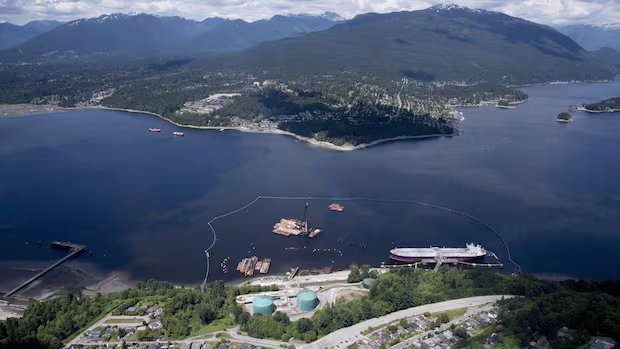
As the war in Iran disrupts oil and gas exports from the Gulf region, the Canadian energy sector could see a jump in demand — and federal officials are positioning Canada as a beacon of stability during an unpredictable moment.
Energy prices have soared since the U.S. and Israel launched a joint attack on Iran Saturday. Iran has warned tankers not to pass through The Strait of Hormuz, a crucial artery for a fifth of the world’s oil. Meanwhile, several energy companies have halted Gulf operations after their facilities were caught in the crossfire, and it’s unclear how long the conflict will continue.
Enter Canadian oil and gas, which doesn’t pass through the Middle East, has stronger environmental regulations than non-democratic oil producers Qatar and Russia, and is in closer proximity to Europe than energy heavyweights like the United States and Venezuela, with the latter now under U.S.-control.

With the Iran war threatening to upend much of the world’s oil and gas supply from Gulf states, experts say there could be a big uptick in demand for Canadian energy products, but Canada’s limited ability to get the products to market could be an obstacle.
“We heard previous to this weekend that the world wants more Canada,” said Energy and Natural Resources Minister Tim Hodgson during a global mining conference in Toronto this week.
“Our allies around the world see Canada as a stable, reliable, predictable, values-based producer of energy and critical minerals in a world where there are very few countries that meet all of those criteria.”
Whether Canada currently has the capacity to meet that demand is far less certain, according to experts and stakeholders who spoke with CBC News.
Canada’s energy sector can fill the gap to “a small degree,” said Tristan Goodman, president and CEO of the Explorers and Producers Association of Canada (EPAC). “Can it in any way contribute in a large or significantly meaningful way to what is being lost? The answer is no, it cannot today.”
Canada’s capacity
It shouldn’t come as a surprise that countries are knocking on Canada’s door for oil and gas, according to Renaud Brossard, vice-president at the Montreal Economic Institute, who listed Poland, Germany, Japan, South Korea and India as current and potential customers of the Canadian energy sector.
The U.S. has long been the primary buyer of Canadian oil and gas, but recent Statistics Canada figures indicate a shift, with Canada having supplied a record share of oil to non-U.S. countries last November.
With the price of crude oil now hovering around $80 US a barrel — a figure that is still historically low but could creep up, depending on the length of the conflict — European and Asian buyers may be looking to diversify or add redundancies to their oil and gas supply.
“The issue we have right now, actually, is that we lack the infrastructure to get our necessary resources to those markets,” said Brossard.
When operating at 100 per cent capacity, the Trans Mountain Expansion can send about 890,000 barrels of oil a day from Edmonton to Burnaby for transport to Pacific Rim countries, with more expansions planned. Last fall, it was operating at 80 to 85 per cent capacity.
And a newly operational LNG plant in Kitimat, B.C., that serves Japan, Korea and Malaysia has a capacity of 14 million tonnes per annum.
Energy investment projects proposed in Quebec’s Baie-Comeau and approved in Newfoundland’s Bay du Nord could eventually service Europe — and a recent memorandum of understanding between Alberta and Ottawa floated the idea of a new pipeline.
But expanding capacity on Canada’s existing infrastructure won’t be enough to meaningfully fill the 20-million-barrel-a-day void left by the war in Iran, and the proposed projects could take years to finish, according to EPAC’s Goodman.
“There are some minor things that could certainly be considered by individual companies and governments that can support a bit of increased production to fill that void. But over the long term, you need to build fairly major pieces of infrastructure,” he said.

Will demand for Canadian oil be able to meet demands for energy as the conflict in the Middle East continues?
Russia could emerge as dark-horse supplier
The European Union abandoned Russia’s natural gas exports in response to its invasion of Ukraine, instead turning to Norwegian gas producers — a sore spot for those in the Canadian industry who felt it was just the latest example of Canada missing a chance to stake its claim as a reliable energy alternative for Europe.
But regulators in Norway expect the country’s LNG production to decline toward 2030, opening a vacancy for another supplier to European countries.
And there are lingering concerns that Russia could leverage the war and emerge as a dark horse to address the gap in global energy needs.

“It’s a luxury to have had Russia out of the mix,” said Heather Exner-Pirot, director of energy, natural resources and environment at the MacDonald-Laurier Institute. She noted that Europe, Japan and South Korea are among those that have sought alternatives to Russian energy.
Still, she cautioned, “in a situation where you have this Iran conflict and you’re seeing 20 per cent of global supply impacted, when push comes to shove, you’ll start to see countries … importing some Russian supply,” even if they hold their noses to do it.
Since December, Russia’s oil exports have strengthened from under $40 US a barrel to about $62 over fears of conflict in the Gulf region.
The country’s energy industry has largely funded its fight against Ukraine, and its crude oil is now selling at a higher benchmark than initially forecast in its 2026 financial budget — which makes it more profitable for Russia, and still more affordable for customers relative to the international standard.
“It goes to show if people don’t have alternatives, at the end of the day, the most affordable energy supplier in a high-priced environment will win out,” said Exner-Pirot.
“It is our responsibility, I would say, as Canadians to make sure that our allies can have a choice between Russia and ourselves, and that we make our product available so they don’t have to resort to going back to Russian supply.”
Trump has said that he’ll deploy Navy ships to accompany oil tankers through the Strait of Hormuz, and that the U.S. government will offer insurance as some maritime insurers cancel war-related coverage plans.
While some have questioned that plan, Exner-Pirot says it’s in the best interest of all players involved to limit disruptions to the Strait.
“I do feel as though there will be an effort to make sure that the oil and the LNG can start to flow, because no one wants to see a $90 or $100 barrel,” she said. “That would create a shock. That would be very bad for everybody.”