dailynewsnblog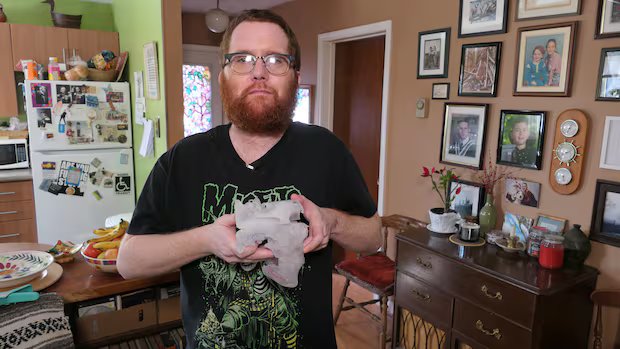

Listen to this article
Estimated 4 minutes
The audio version of this article is generated by AI-based technology. Mispronunciations can occur. We are working with our partners to continually review and improve the results.
A Winnipegger who spent years on a waitlist for a surgery that was not performed in Manitoba says he’s mostly back to normal, and finally able to eat solid foods, after undergoing a final jaw procedure in Saskatchewan two months ago.
Daniel McClelland says it’s been a long journey since he first sought treatment for a bone growth that stopped his right jaw joint from functioning properly five years ago.
“I have some screws in my mouth and I’m doing exercises … [to] get my jaw aligned, and the pain is pretty much, like, minor now,” McClelland said Wednesday.
“I’m still on a few painkillers, but not like I was.”
Winnipeg physicians had used a portion of his rib to replace a jaw joint that had fused to his upper jaw and skull. But that bone also fused to his skull, creating two anchor points that prevented him from fully opening his mouth.
McClelland said he was in constant pain for years, and was unable to eat solid foods.
“I was drinking most of my meals through a straw,” he said. “I couldn’t get a job. Couldn’t go out and do lots of things.”

McClelland was referred to an Ontario doctor who specializes in oral surgery in June 2021. But it wasn’t until Dr. Christopher Ward, a Saskatchewan-based maxillofacial and oral surgeon, reached out to him following a 2024 CBC story that he was able to get the treatment he needed.
He underwent the first of four surgeries in Regina about two months later. His final surgery was in December.
“I had to keep going back [because of] a really bad bone infection,” said McClelland, but if all goes according to plan, he’s about three weeks away from being fully healed.
Lack of specialists: surgeon
Ward said McClelland’s case was probably one of the most difficult he’s ever dealt with.
“He initially had bone fusion in a very irregular region,” the surgeon said. “Having to go through … a previously operated surgical site [can also] skew anatomy and make it much more difficult to go into a second time.”
Only a handful of specialists can perform that kind of procedure in Canada, said Ward, and about 20 per cent of his patients come from Manitoba.
A lack of specialists “creates a scenario where a patient in Manitoba has to come to our clinic to be assessed, to be further worked up and treatment planned, and then be added to our surgical waitlist,” he said.
Limited resources in the health-care system also mean doctors have few opportunities to train for specialties like his, said Ward, who is originally from Manitoba.
He says he wanted to return to the province to teach, but faced “significant roadblocks,” including a lack of resources like operating room time and the lack of provincial coverage for custom prosthetic procedures.
Those challenges “make it difficult for surgeons to provide the standard of care these patients deserve,” said Ward.
“My ultimate goal is to help train people … to provide the skill set, given that the current era of surgeons doing this are starting to get close to retirement.”

A Manitoba Health spokesperson said Friday that as of this January, surgeons in the province are now able to perform temporomandibular joint replacements — a surgical procedure for jaw disorders that involves replacing damaged joints with a prosthesis.
Three patients are still mid-treatment and will finish their surgeries outside Manitoba, the spokesperson said, but there are no outstanding referrals or waitlists for the procedure through Manitoba’s out-of-province program.
Eight patients have gone out of province over the past three fiscal years, he said.
McClelland blamed the delay in his treatment on lack of communication in the health-care system, saying staff at Winnipeg’s Health Sciences Centre had previously told him only one doctor in Canada could do the procedure, even though that was not the case.
“Why did I have to wait so long because someone didn’t know what … they were doing?” he said. “This could have been solved … two or three years ago.”
A Shared Health spokesperson said last week the health authority doesn’t comment on specific cases.

A man who spent years on the waitlist for a highly specialized surgery to replace his jaw joints can now eat solid foods again after a series of surgeries in Saskatchewan.