dailynewsnblog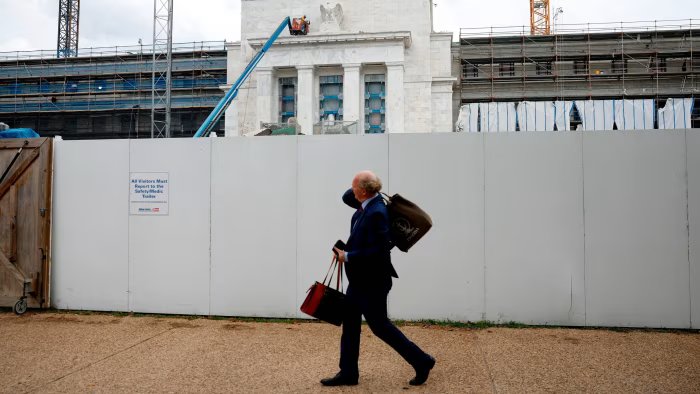
Stay informed with free updates
Simply sign up to the Global Economy myFT Digest — delivered directly to your inbox.
An interest rate cut from the Federal Reserve next week is seen as all but a certainty in markets, so investors will be focused on the US central bank’s economic forecasts.
Futures traders now assign a roughly 90 per cent chance of a quarter-point cut on Wednesday — the Fed’s third this year — following evidence of a slowing labour market and recent dovish comments from rate setters.
New York Fed president John Williams said in late November that borrowing costs could fall “in the near term” without jeopardising the Fed’s inflation goals.
Labour market data published by private companies in recent weeks has also suggested that hiring in the US has slowed. Private-sector payrolls decreased by 32,000 in November, the most since 2023, according to ADP data released this week.
The Fed will also on Wednesday release its latest projections for inflation, growth and interest rates in the coming years. That survey will give investors a sense of what policymakers see as the path forward for rates next year. Jay Powell’s term as Fed chair ends in May 2026 after which he will be replaced by a candidate picked by President Donald Trump. That is currently expected to be Kevin Hassett, a Trump loyalist who is anticipated to advocate for slashing rates in the coming year.
Investors will also be watching closely for any discussion of the Fed’s balance sheet. The central bank this month ended its two-year-long quantitative tightening programme, under which it shrank the quantity of Treasuries it holds. Kate Duguid
Are Xi Jinping’s ‘anti-involution’ policies helping to fight deflation?
Investors will be closely watching China’s November inflation figures on Tuesday for the latest signs of how the government is faring in its campaign of so-called anti-involution.
Chinese policymakers have been grappling with a problem of excess production and overcapacity in the economy, something Beijing has dubbed “involution”, and which has fed persistent deflation in the world’s second-largest economy.
The government this year mounted a campaign to tackle the problem, warning against over-investment, wasted development and aggressive price competition. Early signs of success were seen in October inflation data, which showed it going above zero for the first time since June, with a year-on-year reading of 0.2 per cent.
Economists polled by Reuters expect the consumer price index to have risen further to 0.9 per cent in November. The producer price index is expected to be stuck in negative territory at minus 2.1 per cent.
Lynn Song, chief economist for Greater China at ING, said she expects the figures to show a continuation of the return to positive territory for CPI, rising to 0.5 per cent year on year.
“The drag from food prices is starting to fade, which should combine with the recent upward momentum from non-food prices to boost overall inflation,” Song said.
While inflation undoubtedly remains low, Song pointed out that these incremental positive data points are crucial for the Chinese markets. “Preventing a deflationary mindset from settling in is important to keep the long-term consumption and investment trajectory healthy,” she said. Emily Herbert
Did the UK return to growth in October?
Friday’s UK GDP figures will give investors a clearer indication of the health of the economy in the run-up to last month’s nervously awaited Budget.
Economists polled by Reuters expect economic output to have grown by 0.1 per cent in October, an improvement from September, when it unexpectedly shrank by the same amount. They expect GDP growth in the year to October to be 1.4 per cent, up from 1.1 per cent the previous month, and flat in the three months to October, a fall from slight growth of 0.1 per cent in the three months to September.
“Survey data suggested that the economy slowed somewhat ahead of the budget . . . [but this] could just be a function of poor sentiment, rather than a real slowdown in activity. Next week’s real GDP data will provide key information to better understand whether the economic slowdown is genuine,” said Tomasz Wieladek, chief European macro strategist at T Rowe Price.
While the Bank of England is expected to cut interest rates — currently at 4 per cent — at its meeting later this month, stronger than anticipated GDP figures could make further cuts in 2026 less likely, Wieladek added.
Traders are pricing in a roughly 90 per cent chance of a quarter-point rate cut at the central bank’s meeting later this month, according to levels implied by swaps markets, as well as a second cut by April or June. Rachel Rees