dailynewsnblog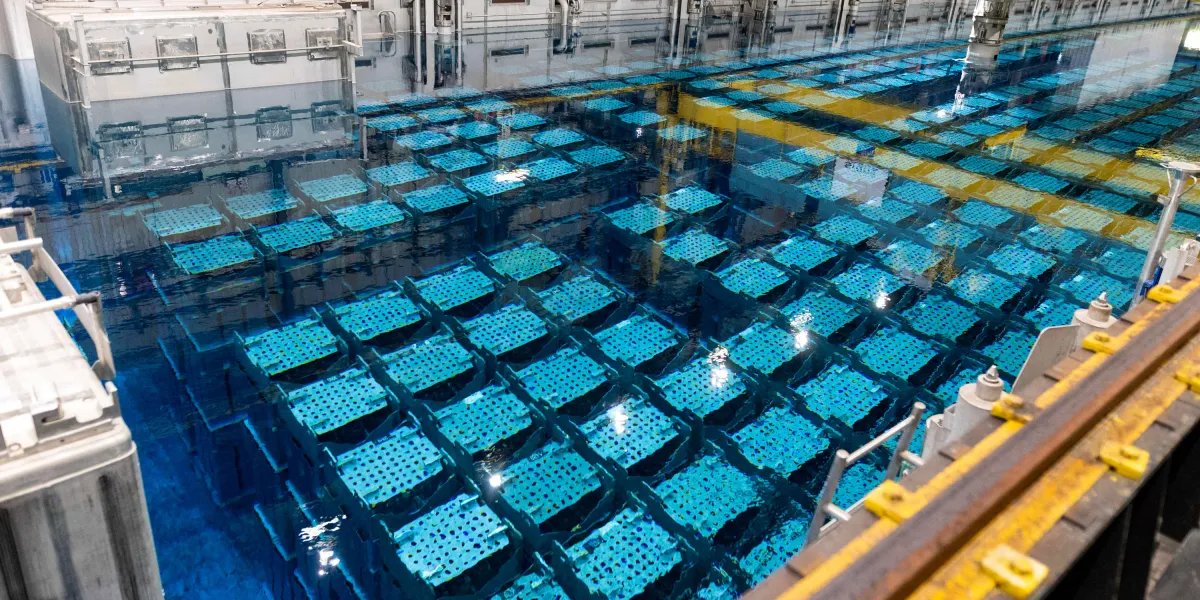
My reporting also helped answer another question that was lingering in my brain: Why doesn’t the world recycle more nuclear waste?
There’s still a lot of usable uranium in spent nuclear fuel when it’s pulled out of reactors. Getting more use out of the spent fuel could cut down on both waste and the need to mine new material, but the process is costly, complicated, and not 100% effective.
France has the largest and most established reprocessing program in the world today. The La Hague plant in northern France has the capacity to reprocess about 1,700 tons of spent fuel each year.
The plant uses a process called PUREX—spent fuel is dissolved in acid and goes through chemical processing to pull out the uranium and plutonium, which are then separated. The plutonium is used to make mixed oxide (or MOX) fuel, which can be used in a mixture to fuel conventional nuclear reactors or alone as fuel in some specialized designs. And the uranium can go on to be re-enriched and used in standard low-enriched uranium fuel.
Reprocessing can cut down on the total volume of high-level nuclear waste that needs special handling, says Allison Macfarlane, director of the school of public policy and global affairs at the University of British Columbia and a former chair of the NRC.
But there’s a bit of a catch. Today, the gold standard for permanent nuclear waste storage is a geological repository, a deep underground storage facility. Heat, not volume, is often the key limiting factor for how much material can be socked away in those facilities, depending on the specific repository. And spent MOX fuel gives off much more heat than conventional spent fuel, Macfarlane says. So even if there’s a smaller volume, the material might take up as much, or even more, space in a repository.
It’s also tricky to make this a true loop: The uranium that’s produced from reprocessing is contaminated with isotopes that can be difficult to separate, Macfarlane says. Today, France essentially saves the uranium for possible future enrichment as a sort of strategic stockpile. (Historically, it’s also exported some to Russia for enrichment.) And while MOX fuel can be used in some reactors, once it is spent, it is technically challenging to reprocess. So today, the best case is that fuel could be used twice, not infinitely.