dailynewsnblog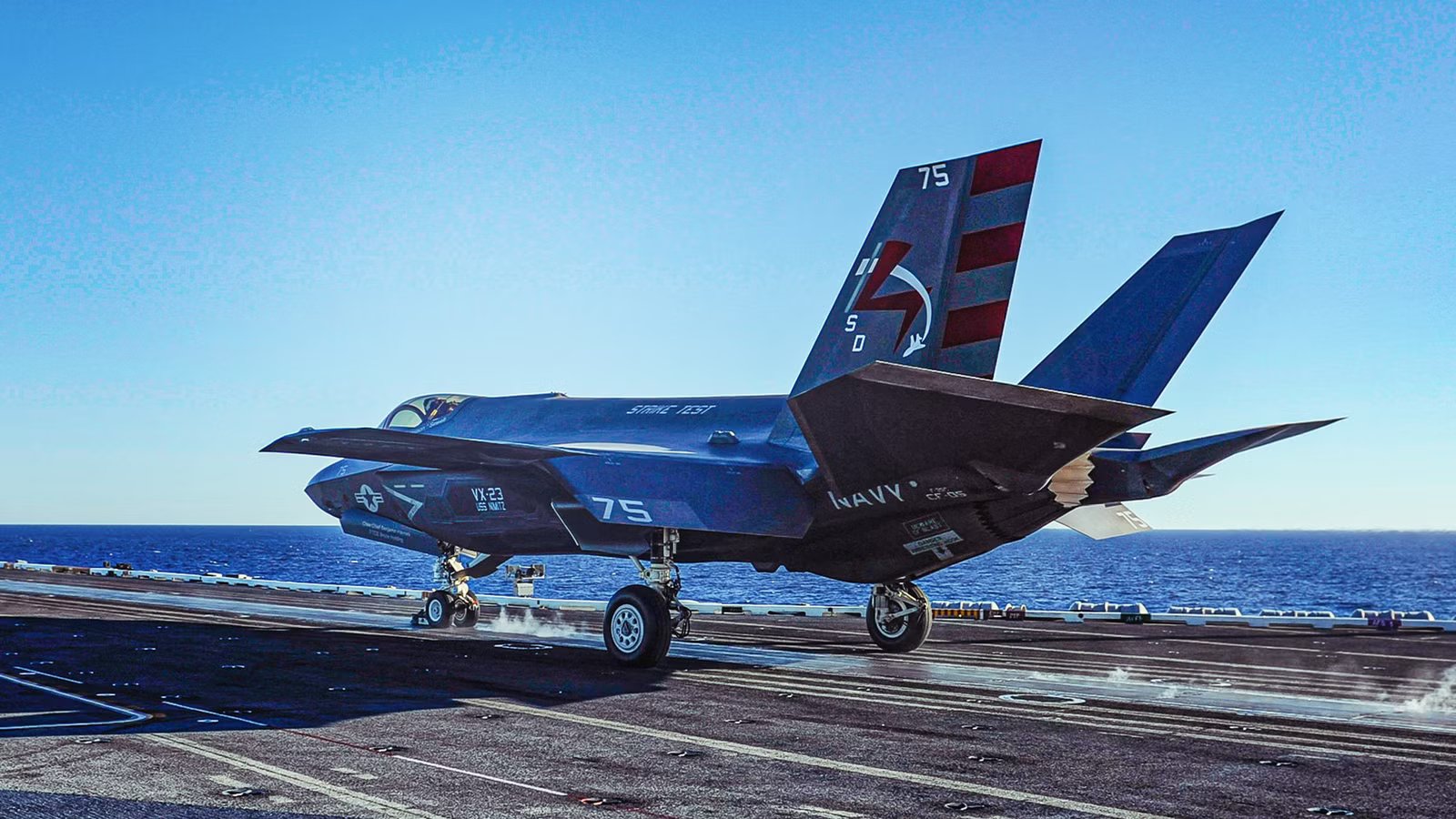
The USS Kearsarge Wasp-class amphibious assault ship has now achieved its first flight with the fifth-generation F-35B Lightning II fighter jet. It is emerging from two years of scheduled retrofits and is about to take its place as a refreshed, modernized amphibious assault ship equipped with the world’s most powerful fighter jet. The F-35B is the only STOVL fighter jet currently in production.
The USS Kearsarge was commissioned in 1993 and displaces around 40,500 tons at full load, around the same as some of the world’s smaller aircraft carriers. It was built to operate the Marine Corps’ MV-22B Ospreys and AV-8B Harriers, but now it has bid farewell to the aging Harriers and transitioned to the F-35Bs. The Kearsarge re-entering service marks bringing the Marines’ full transition to the F-35 much closer.
US Navy Ships Need F-35 Retrofits

The Marine Corps’ F-35B and F-35Cs are intended to operate from the US Navy’s amphibious assault ships and aircraft carriers. However, the F-35 differs from legacy carrier-based tactical aircraft including by having a hotter exhaust. This means that older ships built before the requirements of the F-35 were known to need to be retrofitted to operate them. The retrofits are carried out as the ships are cycled through their scheduled maintenance regimes.
Ironically, the newest US Navy aircraft carrier in service, the USS Gerald R. Ford (CVN-78), will be the last US carrier to operate the jet. This is because it was the final aircraft carrier built when the F-35’s requirements had not been finalized. As it is the newest carrier, its scheduled deep refit is later than the other carriers. Starting with the USS John F. Kennedy (CVN-79), now in sea trials (expected to be commissioned in 2027), all future carriers will be delivered able to operate F-35s.
Something similar is true of the Navy’s Wasp-class amphibious assault ships. The Navy has seven of these ships remaining in active service, as the USS Bonhomme Richard LHD-6 was decommissioned in 2021 after a massive fire. Their flight decks are being upgraded for the F-35B operations as they go through their retrofit cycles.
F-35B Retrofits Of The Wasp-Class
![997502 - F-35B phase II testing aboard USS Wasp [Image 7 of 11]](https://static0.simpleflyingimages.com/wordpress/wp-content/uploads/2024/10/997502.jpg?q=49&fit=crop&w=500&dpr=2)
With the USS Kearsarge Wasp-class amphibious assault ship now having completed its upgrade, the program is nearing its completion. The USS Wasp (LHD-1), USS Essex (LHD-2), USS Kearsarge (LHD-3), and USS Boxer (LHD-4) have now completed their upgrades. Meanwhile, the newer USS Makin Island (LHD-8) was given partial built-in capability. The USS Makin Island was the final Wasp-class ship and was commissioned in 2009.
This leaves two more Wasp-class ships awaiting the capability to operate F-35Bs. The USS Bataan (LHD-5) and USS Iwo Jima (LHD-7). The USS Bataan entered its two-year maintenance and modernization availability in the spring of 2024. Work is currently ongoing, and it is expected to wrap up in the coming months and will become certified for F-35B operations, perhaps later this year. That will leave only the USS Iwo Jima (LHD-7) as the final Wasp-class to operate F-35Bs.
|
US Navy amphibious assault ships’ F-35 certification status (per F-35.com, Army Recognition) |
|
|---|---|
|
Built with F-35B-capability |
4 ships (USS Makin Island, USS America, USS Tripoli, USS Bougainville) |
|
Retrofitted with F-35B-capability |
3 ships (USS Wasp, USS Essex, USS Boxer) |
|
Completing/working up F-35B capability |
1 ship (USS Kearsarge) |
|
Currently under F-35B retrofit |
1 ship (USS Bataan) |
|
Remaining ships to start F-35B capability retrofit |
1 ship (USS Iwo Jima) |
And here, work is also soon to be underway. In early 2026, the USS Iwo Jima (LHD-7) was deployed to the Caribbean and took part in the operation to capture Venezuela’s Maduro. As of the time of writing, it appears that Iwo Jima remains deployed, but it is expected to return to port later and begin its retrofit program in June 2026. This will be another two-year program, and so the transition of the Wasp-class to being an all-F-35 capable fleet will be complete around 2028.

Why Can’t An F-22 Raptor Land On An Aircraft Carrier?
Discover why the world’s first fifth-generation fighter will never be deployed from a carrier.
The America-Class Built With F-35B Capability

The America-class amphibious assault ships were built specifically to operate the F-35B Lightning II, and the lead ship, the USS America (LHA-6), was commissioned with that capability. The America was delivered in April 2014, and it carried out its first major F-35B operations in 2019. However, adjustments had to be made to the America to reduce damage from the F-35B’s excessive heat.
It was found that the F-35B engine gives off much more heat than the older AV-8B Harriers. Additionally, the work compensated for the damage to the flight deck caused by the Marines’ MV-22 Osprey’s heat exhaust. The USS America was laid down in 2009 and commissioned in 2014, and the USS Tripoli followed, being laid down in 2014 and commissioned in 2020.
The next ship in line is the USS Bougainville, which was laid down in 2019 and is expected to be commissioned sometime in 2026. The USS Fallujah was laid down in 2023 and is not expected until 2030. With the USS Kearsarge about to reenter active service and the USS Bougainville soon to join the fleet, the US Navy will have nine F-35-capable amphibious assault ships with only one more pending.
The Retirement Of The AV-8B Harrier

The return of the USS Iwo Jima (LHD-7) to port for its extended retrofit not only heralds the finalization of a new era of US Navy and Marine Corps capability, but it also marks the end of an old one. The US Marine Corps is set to retire its remaining AV-8B Harriers in June 2026 as the ship returns. This suggests that Operation Absolute Resolve will be the last hurrah of the venerable Harrier in US service.
The F-35B represents a major generational leap over the Harrier. Not only is it massively more advanced and a stealth fighter, but it also has a much longer combat radius. The Harrier may still be useful in low-end operations where the environment is largely permissive, but it is now considered too vulnerable in a high-end conflict. Ships are also more at risk than before, forcing them to operate further out, something that the Harrier’s limited range struggles with.
The Italian Navy is also working to retire its fleet of Harrier jump jets as it likewise transitions to the F-35B. There is talk that these old Harriers could be transferred to Indonesia, but that remains unclear. Otherwise, this will leave the Spanish Navy as the final AV-8B Harrier operator, and the service wants to hold onto these aging jets for longer. It is unclear how Spain will replace these; it has previously ruled out the F-35B, even though this is the only STOVL option on the market.

What US Air Force Bases Have F-35s?
Ten air force bases are listed as bases for the USAF F-35A, although they can operate from many more bases.
Which Retrofits Are Needed For F-35B Operations?

Modifications the Wasp-class flattops need to operate the F-35B are centered around accommodating the F-35B’s high-heat exhaust, its increased size, and its vertical landings. Other modifications include repositioning of lights and marking, and the addition of intercostal structural supports under key landing spots. On the flight deck, the ships get a heat-resistant, thermally sprayed-on-skid coating to prevent damage.
In the ship’s hangars, the spaces are enlarged for the bigger aircraft, and the aviation fuel and ordnance storage facilities are enlarged. The ship also gets upgrades to its sensors, radars, combat systems, and command-and-control systems to allow for better data fusion with the F-35Bs. For the Iwo Jima, Forbes reported that “BAE Systems was awarded an initial $204.1 million contract to perform the work, which could increase to $255.8 million if all options are exercised.”
It should be noted that while some ships, like the Iwo Jima, haven’t had their upgrades to operate the F-35B, that doesn’t mean they can’t or don’t handle the F-35B if required. During Operation Absolute Resolve, the US operated land-based F-35A and F-35B Lightning IIs, but it is unclear if any operated from the Iwo Jima. Separately, the USS Ford aircraft carrier was also deployed to the Caribbean for Absolute Resolve, but its airwing was limited to F/A-18s.
Fighter Jets Phase In / Phase Out

In military aviation, new fighter jets do not enter service with a bang, and old fighter jets go out with a whimper. When new fighter jets enter service, they are typically first used timidly in combat as they are not yet combat-tested and the programs are still maturing. They are also normally available in limited numbers, which means they are normally used alongside older fighter jets for years in combat, and even there, they are not used for the more demanding missions they eventually evolve to complete.
At the same time, militaries do not typically retire their old aircraft all at once or withdraw them from service dramatically. Their numbers start to fall, and the number of missions they carry out becomes more restricted. The new aircraft take over the most risky roles, while the old aircraft tend to get safer, supporting roles in secondary theaters. Something similar was likely seen with Iwo Jima, with its AV-8B Harriers, as its final mission was to the low-threat Caribbean.
It is unlikely the US Navy would commit its aging AV-8B Harriers in a high-end conflict. Even in the Caribbean, the Harriers played a supporting role, with the land-based F-35 doing more of the heavy work. The Ford’s F/A-18 Super Hornets were also quite active. In a few months, it seems the Harrier will go out with a whimper, while the F-35 gradually completes its takeover of F/A-18 Hornet and AV-8B Harrier roles, and more of the F/A-18 Super Hornet roles.