dailynewsnblog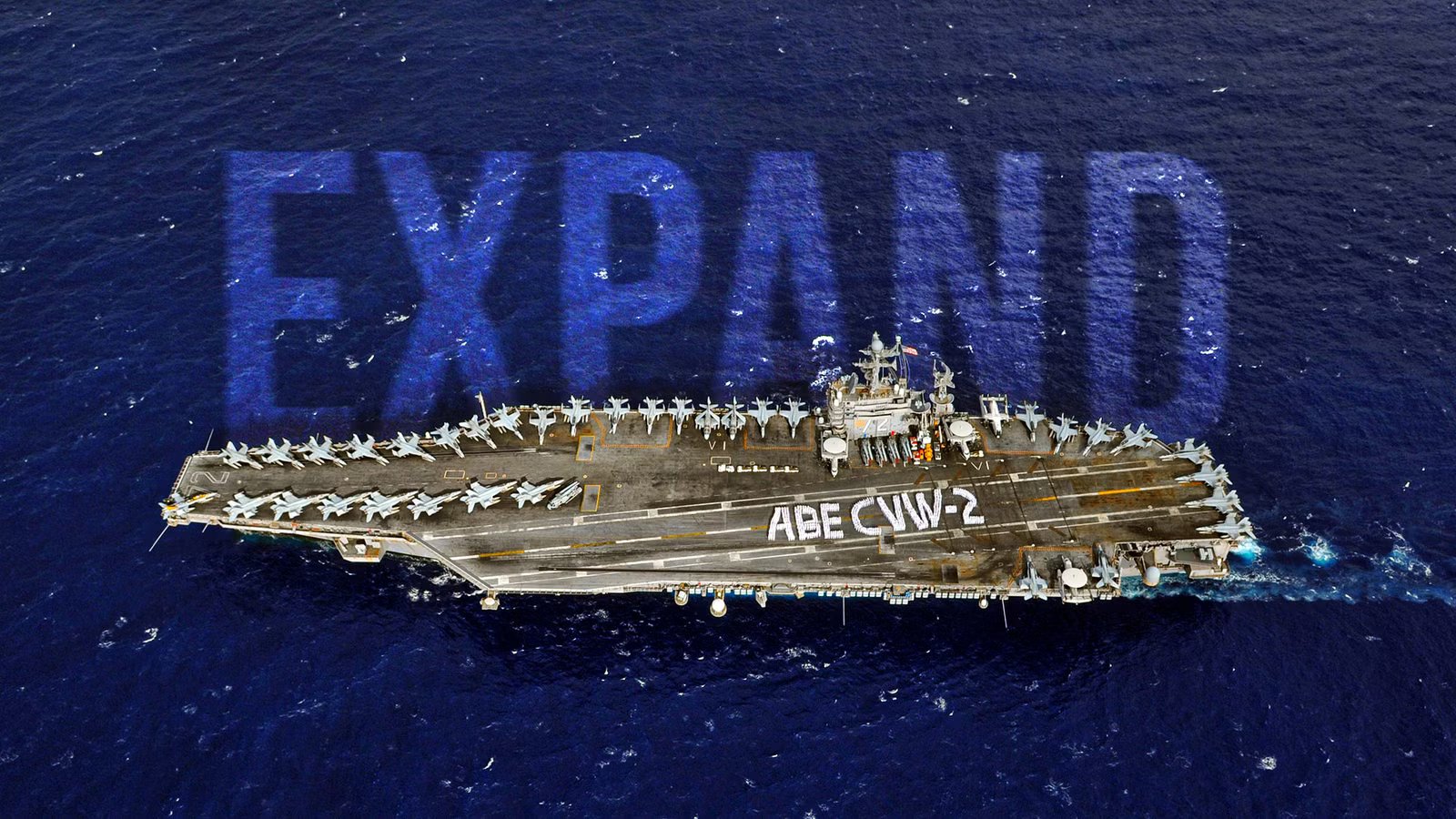
The United States Navy has the largest fleet of aircraft carriers in the world, yet in order to meet the future challenges posed by advancing near-peer weapons technology, the US Navy is working towards adding a 12th supercarrier to its fleet. At the same time, the service is increasing the application of unmanned systems to free up both manned fighter jets and significantly reduce the proving requirements for its nuclear-powered supercarriers.
The addition of another Ford-class carrier would raise the Navy’s capacity to project air power immensely by significantly improving the number of ships that are combat-ready at any time. Although it is unclear if the total number of fighter jets will be increased, plans to acquire a significant number of unmanned, carrier-based, aerial tanker drones are confirmed. The combination of adding another ship, optimizing its manning requirements, and freeing up the fighters by adding drones to the air wing will dramatically improve the fleet’s readiness and combat effectiveness.
American Aircraft Carriers: A 12-Ship Fleet

In a strategic decision to increase fleet readiness and capability, the USS Nimitz (CVN-68) will not be retired this year and is being retained in active service until at least 2027, according to the US Naval Institute. This extension ensures the Navy stays at 11 carriers until the next Ford-class ship arrives. Simultaneously, the Navy is currently in the process of coordinating with the Department of Defense and US Congress to increase the fleet from 11 to 12 aircraft carriers.
The Navy’s growth is currently slowed by integration delays on the newest Ford-class technology. The Navy is trying to add carriers faster and cheaper by purchasing them in pairs rather than one at a time, as USNI explains. This strategy provides Newport News Shipbuilding with a steady workload, which reduces engineering hours by up to 55% on follow-on ships.
|
Hull Number |
Name |
Class |
Status |
|---|---|---|---|
|
CVN-68 |
USS Nimitz |
Nimitz |
Active (Extended to 2027) |
|
CVN-69 |
USS Dwight D. Eisenhower |
Nimitz |
Active |
|
CVN-70 |
USS Carl Vinson |
Nimitz |
Active |
|
CVN-71 |
USS Theodore Roosevelt |
Nimitz |
Active |
|
CVN-72 |
USS Abraham Lincoln |
Nimitz |
Active |
|
CVN-73 |
USS George Washington |
Nimitz |
Active |
|
CVN-74 |
USS John C. Stennis |
Nimitz |
Mid-life Refueling |
|
CVN-75 |
USS Harry S. Truman |
Nimitz |
Active |
|
CVN-76 |
USS Ronald Reagan |
Nimitz |
Active |
|
CVN-77 |
USS George H.W. Bush |
Nimitz |
Active |
|
CVN-78 |
USS Gerald R. Ford |
Ford |
Active |
|
CVN-79 |
USS John F. Kennedy |
Ford |
Under Construction (Estimated Delivery 2027) |
|
CVN-80 |
USS Enterprise |
Ford |
Under Construction (2019 Block) |
|
CVN-81 |
USS Doris Miller |
Ford |
Under Construction (2019 Block) |
The Navy saved roughly $4 billion by contracting the USS Enterprise (CVN-80) and USS Doris Miller (CVN-81) together, according to Breaking Defense. High-level Navy officials and Congress are currently negotiating a similar block buy for the next two ships: USS William J. Clinton (CVN-82) and USS George W. Bush (CVN-83). However, continuing to extend the decommissioning of Nimitz-class carriers is currently the only option to achieve a 12-strong carrier fleet.
USS John F. Kennedy (CVN-79) is now expected to be delivered in March 2027. Because the Nimitz is nearing its absolute limit and the Kennedy has faced years of delays, the Navy faces a high risk of temporarily dropping to ten carriers if any further setbacks occur. Under the current long-term shipbuilding plan, the Navy projects it will only consistently maintain a 12-carrier fleet for a brief window unless funding is significantly increased to allow for another block buy in the very near future.
A New Era in Naval Aviation: Carrier-based Drones

The Navy is transitioning to a hybrid force with its 12-carrier fleet, aiming to have ships that are 60% uncrewed by 2030. Simultaneously, the air wing is integrating unmanned systems like the MQ-25 Stingray and eventually even the Collaborative Combat Aircraft (CCA) to increase mission capacity. The Navy is moving away from the idea of drones as accessories and making them the backbone of the Carrier Air Wing of the Future (CVW-F), according to USNI.
The Navy strategy for the CVW-F goes far beyond a simple hardware upgrade and fundamentally rewrites the doctrine of Naval Aviation. The strategic approach of distributive maritime operations moves the carrier from being an air strike ‘delivery platform’ to a floating command hub for a massive carrier strike group with autonomous sensors and weapons platforms. Similar to the evolution taking place in the US Air Force, the Navy’s doctrine is evolving to a hybrid autonomous and manned platform strategy where human pilots and ship-based operators serve as battlefield managers.
This approach uses drones as a ‘hedge’ to increase fleet mass quickly and affordably. Instead of building more expensive stealth jets, the Navy is investing in Collaborative Combat Aircraft (CCA) that can be lost in combat without losing a pilot. By 2030, the Navy aims to have uncrewed systems perform the ‘dull, dirty, and dangerous’ tasks like tanking, persistent surveillance, and electronic jamming. This will leave manned F-35Cs and future F/A-XX fighters to focus on decision-making and executing the most crucial strikes as needed.

F-47 & F/A-XX Delays: US Air Power Faces Critical ‘Fighter Gap’ Until 2035
Both platforms are experiencing delays likely to persist into the next decade.
The MQ-25 Stingray: The Air Wing’s Airborne Gas Station

The MQ-25 Stingray is capable of fully autonomous taxi, take-off, and landing on a moving carrier deck, integrated with standard catapult and arresting gear systems. While it is primarily a refueling tanker, it serves as the technological pioneer that will pave the way for the fully mature CVW-F transition. The first squadrons, VUQ-11 and VUQ-12, will deploy smaller teams of MQ-25s to individual carriers as needed, similar to how E-2D Hawkeye or MH-60 helicopter detachments operate today, as per Seapower Magazine.
The MQ-25 can nearly double the range of the existing fourth and fifth-generation fighter platforms flown by the Navy. It is designed to deliver 15,000 to 16,000 pounds of fuel to multiple aircraft at a range of 500 nautical miles from the carrier. The F-35C and F/A-18 Super Hornet can improve range from 450 nautical miles to more than 700 nautical miles thanks to the Stingray serving as a flying gas station above the carrier strike group.
The most important function of the Stingray is to free up the 20 to 30% of manned fighter jet sorties currently performing this mission, called buddy tanking, but it is constantly evolving into a platform capable of more missions as well. First off, while not a true stealth jet, it features a low-profile, wing-body-tail design to reduce its radar cross-section (RCS). Pairing that stealthiness with an electro-optical sensor ball, the MQ-25 can autonomously gather and relay real-time battlefield data to the fleet as well as providing air-to-air refueling for strike fighters.
Collaborative Combat Aircraft (CCA): The Loyal Wingmen

The CCA program will bring autonomous firepower to the future carrier air wing. While the Air Force is moving faster with its own CCA program, the Navy’s effort is specifically tailored to the brutal demands of carrier-based operations. The future air wing is estimated to have a hybrid split that will see the number of unmanned aircraft slowly increase until they outnumber manned platforms. While that point may be in the distant future, it is very likely that there will be a 60-40 split or potentially even greater proportion of drones on the flight deck one day.
The Navy’s CCA doctrine shifts away from traditional, expensive multi-role fighters toward a model of quantity and expendability. Unlike manned jets built for decades of use, these CCAs are designed to fly for only a few hundred hours. They are attritable, meaning they can be lost in high-risk missions without a massive strategic or financial loss. To accommodate 12 carriers and a 60% uncrewed air wing, the Navy is redesigning everything from the physical layout of the ships to the digital nervous system that connects them. It’s a shift from a floating airport to a floating data center.
Carriers are being physically reconfigured to handle drones that don’t need a cockpit but do need high-bandwidth data connections to operators at sea, pilots in the air, and commanders on the ‘boat.’ As the US Air Force is also working towards, the Navy is crafting its ‘tactical cloud’ that allows a drone to be launched from one carrier before being digitally handed off and controlled by a pilot from another carrier, or even an Air Force commander on the ground.
Since CCAs are designed to be missile trucks, the weapon elevators and magazines are being optimized to quickly reload drones between sorties. The Navy is also installing JPALS (Joint Precision Approach and Landing System), which uses GPS and data links to guide drones onto a moving deck with centimeter-level accuracy, even in pitch-black or stormy conditions.

The Arsenal Of Epic Fury: Every US Aircraft Taking Part In The Strikes On Iran
Breaking down the staggering airpower massed in the Gulf.
Floating Air Warfare Command: Tomorrow’s Supercarrier

The physical and digital infrastructure of the aircraft carrier is being redesigned to support this high ratio of drones. The Navy is installing dedicated control hubs on all Nimitz and Ford-class carriers. The USS George H.W. Bush (CVN-77) was the first to receive a full suite, which includes the Ground Control Station with a full operator ‘cockpit’ for carrier-based drones.
The traditional 75-aircraft air wing is being broken down and rebuilt for the hybrid era. The goal is to reach a ratio where uncrewed systems outnumber manned aircraft. The Unmanned Carrier Aviation Mission Control System is the underlying software architecture that allows a single operator to command multiple platforms, from the MQ-25 Stingray to future CCAs, using a common control interface.
In a 12-carrier fleet, this allows the Navy to maintain a persistent presence in contested areas, like the South China Sea, without the crew fatigue associated with constant manned patrols. CCAs will be integrated directly into fighter squadrons, where F-35C pilots use tablet-like interfaces to command a flight of multiple loyal wingmen drones as part of their standard tactical formation.
Training the Next Generation of Sailors And Airmen

Integrating drones on a large scale requires a radical change in how the Navy recruits and trains its personnel. The Navy has already established its first Fleet Replacement Squadron specifically for unmanned carrier aviation. Its mission is to train a new breed of Air Vehicle Pilots and mission operators who may not be traditional naval aviators but serve alongside as specialists in remote systems.
Initial Operational Capability of the MQ-25 is currently targeted for late 2027, with the USS Theodore Roosevelt (CVN-71) expected to be the first ship to deploy with an operational squadron. To maintain these complex robotic systems, the Navy is identifying source ratings like Electronics Technicians and Fire Controlmen who will receive specialized training for drone-specific maintenance and ordnance handling.