dailynewsnblog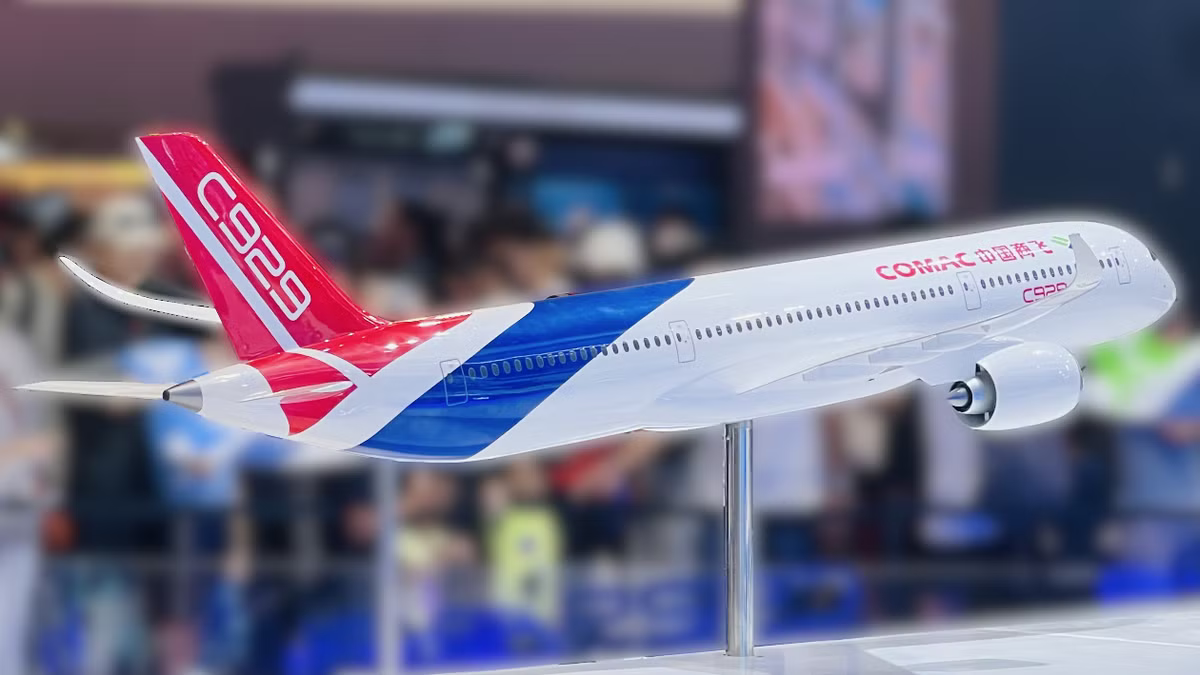
China’s COMAC C929 is now well into its design phase. Full-scale mock-ups have appeared at shows around China, while an OSINT account, Hurin, has reported that China has successfully test-run its prospective CJ-2000 engine. Some analysts are now expecting the aircraft to have its maiden flight around 2030 before entering service in the mid-2030s.
On the face of it, this should give the United States, and particularly Boeing, cause for concern. However, the situation is much more complicated and is happening against the backdrop of deepening geopolitical competition. Boeing is in a comparatively weakened position from its MAX crashes, certification delays, and production bottlenecks. Even so, arguably, the C929 doesn’t pose an immediate threat to Boeing and only a measured threat in the medium term.
The C929 Widebody Is Part Of A Larger Ambition

China’s state-run COMAC (Commercial Aircraft Corporation of China, Ltd) is working on developing the COMAC C929, which is to be a Boeing 787 Dreamliner challenger. The aircraft is expected to occupy the smaller widebody market, roughly the same as the Boeing 787 and A330neo. It will have a seating capacity for 280 to 400 passengers, depending on its configuration.
Early estimates put its range at around 6,500 nautical miles. If this holds, the C929 would compete more directly with the 787-10 and A330neo rather than the longest-range 787-9 or A350 variants. Regardless, this is enough range to fill most of the world’s long-haul routes. The aircraft is also expected to use over 50% lightweight composite materials, which is also lower than the A350 and 787, although better than the updated 777X and A330neo.
The C929 is the next stage for COMAC after it built the regional C909 (formerly ARJ21) and narrowbody C919. Beyond the C929, COMAC has plans to build the larger C939 widebody to take on the A350 and 777, and it plans to build the supersonic C949 to compete with aircraft like the upcoming Supersonic Boom Overture. In short, a more or less complete lineup of commercial aircraft.
The Issue Of Engines

The aviation industry cannot be separated from geopolitics. For now, China is unable to produce its own engines to power its growing family of commercial aircraft. The regional COMAC C909 is powered by the US-made General Electric CF34-10A, while the narrowbody C919 is powered by the Franco-American CFM International LEAP-1C. China is well aware of this critical dependence and is working to develop its own domestic engines.
These Western engines are seen as something of an interim or stopgap measure. However, it does not appear to be the route China is taking with the upcoming C929. Here, China is developing its own high-bypass turbofan to power the engine and does not appear to be looking to use an existing Western engine. China has recently run the upcoming CJ-2000 turbofan at 77,600 lbf (35.2 tons of thrust), putting it in the same bracket as the Dreamliners’ Rolls-Royce Trent 1000 and GEnx.
|
Widebody ranges (per Airbus, Boeing, COMAC) |
Nautical miles (advertised range) |
|---|---|
|
COMAC C929 |
6,500 (early estimates) |
|
Boeing 787-8 |
7,305 |
|
Boeing 787-9 |
7,565 |
|
Boeing 787-10 |
6,330 |
|
Airbus A330-800 (neo) |
8,100 |
|
Airbus A330-900 (neo) |
7,350 |
|
Airbus A350-900 |
8,500 |
|
Airbus A350-1000 |
9,000 |
But developing bespoke high-bypass engines is hard. It will likely take some time before the CJ-2000 is ready. The test is a milestone, but it’s unlikely the engine will be ready before at least 2030. It should also be noted that while the CJ-2000 is apparently being developed for the C929, COMAC has not yet officially selected an engine for its upcoming widebody. Pivoting to another engine remains a possibility.

COMAC C919 Delays Could Drive More Orders For Boeing
The manufacturer slashed its production targets from 75 aircraft this year to 25!
Cutting Russia Out

Russia (and Ukraine) benefits from its Soviet inheritance, but it is a country losing its relevant ground in the aerospace domain. Before 2022, Russia had developed the regional Sukhoi Superjet and the MC-21 narrowbody, but it did so using around 70-90% imported (mostly Western) components, including the engines. Russia is now russifying these aircraft with its own domestic components, but the resulting aircraft are heavy, underpowered, shorter-ranged, more maintenance-intensive, and essentially different aircraft.
Until recently, one area where Russia did still manage to have a technological advantage over China was with engines. Russia’s engines may not have been as reliable, efficient, lightweight, or maintenance-light as their Western counterparts, but they are usable if Western engines are not an option. But this is also changing. China is breaking its dependence on Russian engines, and now its fighter jet engines are built with Chinese engines. A final hurdle seemed to come in 2025 when Chinese carrier-based jets were seen with Chinese engines, suggesting Chinese engines are now good enough for carrier operations.
China started developing the C929 in cooperation with Russia, leaning on its relative still-present edge in large turbofan designs. The plan was to develop a version of the Russian Aviadvigatel PD-35 engine for the C929, which Russia is now exploring using on the An-124 Ruslan airlifter upgrades. However, after the West imposed sanctions on Russia in 2022, China quietly cut Russia out of the program and went its own way to develop the CJ-2000 for the C929. China also has programs to replace Russian engines on its military airlifters with its own domestic engines.
The Chinese Model

It appears China is following a similar path in developing its commercial aircraft as it has with other sectors, like automobiles. China has a massive domestic economy that is not a free market economy in the Western sense. The new commercial aircraft does not need to be better than the 787 or A330neo; it needs to be good enough. China can then ensure that its domestic airlines order the jet in large numbers. Air China has already become the first airline to say it will order and eventually launch the C929.
This guarantees the C929 a large market so that it can be produced en masse and matured. This is somewhat similar to how European countries prioritized Airbus aircraft in the early days and helped the manufacturer get on its feet. As COMAC aircraft mature in China, they become ever more appealing on the export market, potentially for China-friendly nations like Cambodia or Indonesia. Chinese airlines are believed to have placed hundreds of orders for the smaller C919, with some estimates going as high as 1,000 examples.
China is the world’s second-largest aviation market and has the capacity to support a large Airbus and Boeing competitor. As these programs are quasi-government programs, typical free markets and competition do not have the same effect. China is well-positioned to have a state-aided large airplane manufacturer if that’s something the Chinese government wants and is willing to commit the resources to supporting it. That said, competing on the international market is another issue.

Airbus Vs Boeing Vs COMAC: How The Plane Makers’ Market Share Compares In Asia
There are many factors that could influence COMAC’s ability to challenge Airbus and Boeing’s duopoly in Asia.
FAA’s (& EASA) Certification

During the brief Sino-American trade war in 2025, the US revoked the license to export LEAP-1C engines. If the US wanted to, it could shut production of the C919 down, similar to how it shut down the production of Superjets and MC-21s in Russia. However, in time, likely sometime in the 2030s, China will develop its own domestic systems, and a future Sinicized version of the aircraft would emerge free of US export controls.
But the US has another powerful tool that is especially potent for the C929: FAA type certification. If the US refuses to issue the type certification to the C929, then this dramatically impacts where the aircraft can fly. This becomes much more acute if the European EASA likewise withholds its type certification. This is not as powerful a tool for the smaller C919, as it is primarily for short-haul domestic routes, but the C929 is specifically for long-haul international routes.
Chinese airlines would still be able to acquire the aircraft and fly it on available routes, like to select destinations in Asia, to Russia, some destinations in Africa, etc., but many of the key routes will be closed off. The same is true of Russia’s MC-21; when it enters service, it will not be able to fly to destinations that require EASA or FAA certification. An aircraft like the C929 may be attractive to some export countries, particularly sanctioned countries like Iran, but they, too, would be limited in where they can use it.
A Fracturing Of The Aerospace Market

The world has entered a new era of Great Power Competition. The US is actively slowing the development of COMAC aircraft, but it cannot stop it. If China wants a large aerospace sector producing commercial widebody passenger airlines, it has the capacity to develop it. But that doesn’t mean these aircraft can take Airbus and Boeing toe-to-toe without regulatory approval, something seemingly unlikely in an era of Great Power Competition.
Instead, what seems likely is that Airbus and Boeing will lose much of the Chinese market and face growing competition in select third markets. This will have them worried, but not overly so. It is reasonable to expect airlines like Emirates, Qatar Airways, Ethiopian Airlines, etc., to be lukewarm on Chinese aircraft even if they are more available and cheaper. Without FAA/EASA approval, even with their home nations providing the type certificate for the C929, it would represent an aircraft they wouldn’t be able to use on a large share of their routes.
This starts to look more like the Soviet Union’s commercial passenger manufacturers, like Ilyushin and Tupolev, and their Il-96 and Tu-204 airliners during the Cold War. That said, China and its potential market are much greater than the Soviet bloc ever was. This is a scenario of bifurcation of the aerospace sector, where Airbus and Boeing are no longer a duopoly globally, but remain a de facto duopoly in their share of the global market. That is concerning, but within limits.