dailynewsnblog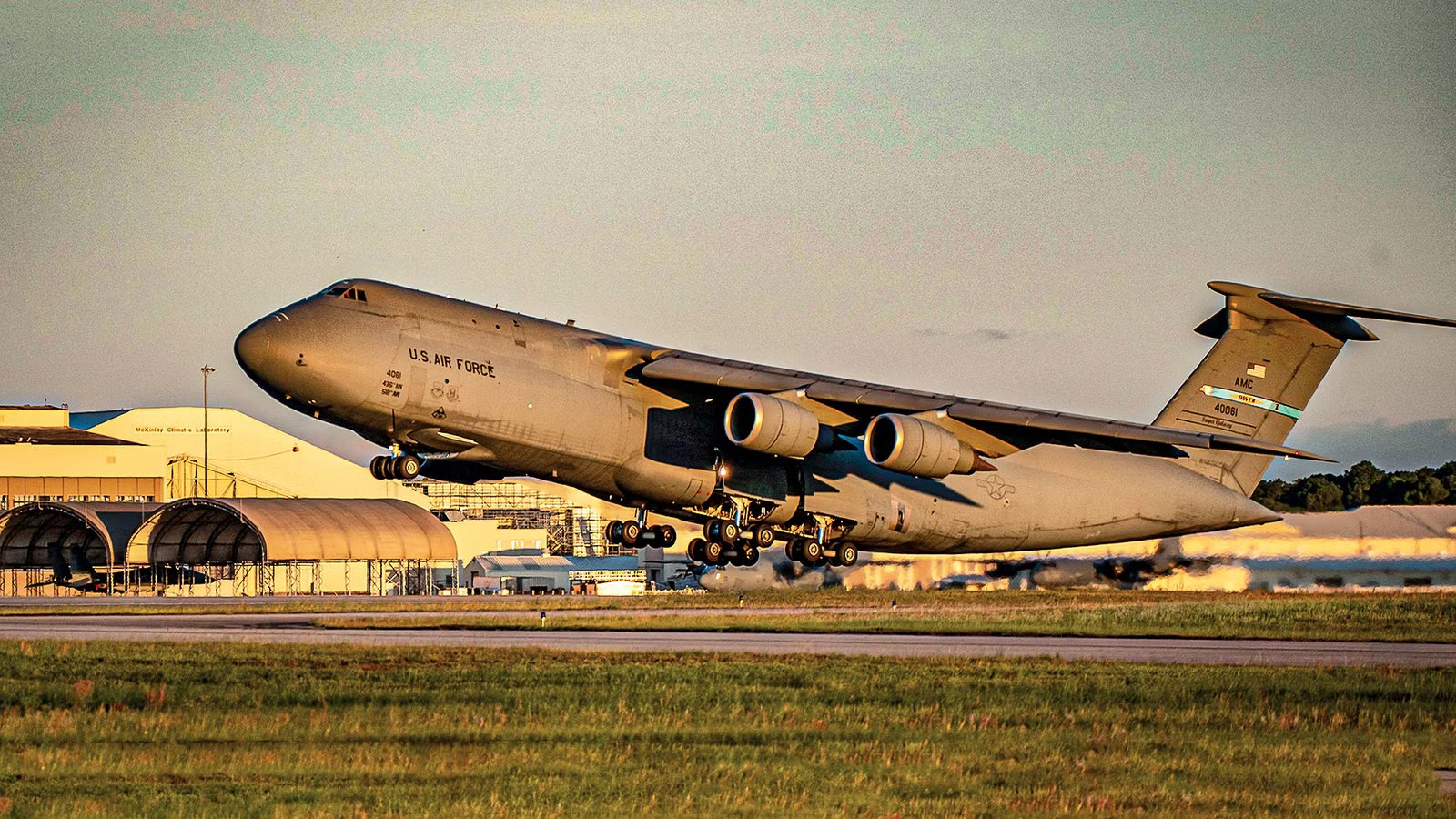
The Lockheed C-5M Super Galaxy requires its 28-wheel landing gear system, which comprises four main units with six-wheel bogies, to rotate 90 degrees horizontally before retraction because the assemblies are physically too wide to fit into the fuselage bays in their ground position. This design, documented by The Aviationist, allows the aircraft to maintain a high wheel count for weight distribution while still achieving a streamlined aerodynamic profile in flight. Without this rotation, the aircraft would require a wider fuselage or sacrifice cargo capacity, both of which were deemed unacceptable trade-offs for a strategic airlifter.
Based on technical specs and operational footage, each of the four main landing gear units, arranged in tandem pairs and featuring a two-forward, four-aft wheel configuration, must pivot during retraction to reduce their footprint. As shown in the video, hydraulic actuators rotate the bogies perpendicular to the aircraft’s longitudinal axis before they retract into compact bays. This mechanism is not unique in concept, but at this scale, while supporting one of the largest aircraft in the United States Air Force(USAF), it represents a highly specialized engineering solution.
For US military logistics, where the C-5M remains a backbone of global airlift operations alongside aircraft like the Boeing C-17 Globemaster III, this design directly impacts mission capability. The ability to operate from a wide range of runways while carrying outsized cargo is critical to rapid deployment. We will break down three key factors behind the 90-degree rotation requirement: spatial constraints within the fuselage, aerodynamic efficiency during flight, and operational flexibility on the ground.
The Engineering Challenge Behind 28 Wheels

The sheer scale of the C-5’s landing gear begins with a simple requirement for all huge planes: weight distribution. As one of the heaviest aircraft ever to enter operational service, the Super Galaxy must spread its mass across a large surface area to avoid overstressing runways. This is why it uses a total of 28 wheels, far more than conventional widebody aircraft, including giants such as the Boeing 747, and organizes them into a complex tricycle configuration with multiple main gear assemblies.
Each of the four main landing gear units is arranged in tandem pairs along the fuselage, creating a long footprint that helps stabilize the aircraft during ground operations. Every unit carries a six-wheel bogie, configured with two wheels at the front and four at the rear. This staggered layout allows the aircraft to better absorb landing forces and maintain balance even when cargo is unevenly distributed within its cavernous hold.
What makes this system particularly effective is its adaptability. The multiple wheel sets allow the aircraft to operate from semi-prepared airfields, a critical capability for military logistics missions. Instead of concentrating weight on a few points of contact, the C-5 spreads the load across many wheels, reducing ground pressure. However, this advantage comes at a cost: the landing gear assemblies become extremely large, creating a new problem when it comes time to retract them into the aircraft.
Why The Wheels Must Rotate 90 Degrees

The need for a 90-degree rotation arises from a fundamental geometric constraint. When the aircraft is on the ground, each six-wheel bogie is aligned lengthwise with the fuselage, maximizing stability and load distribution. In this orientation, however, the bogie is too wide to fit into the landing gear bay without modification.
As the aircraft lifts off and the gear begins to retract, hydraulic systems initiate a carefully controlled rotation. Each bogie pivots horizontally, turning perpendicular to its original alignment. This motion effectively reduces the width of the gear assembly, enabling it to fit into a narrower fuselage compartment.
The process is a precise mechanical sequence. Multiple actuators and linkages coordinate the movement, ensuring the bogie rotates at the exact right moment during retraction. If the timing is off, the gear could collide with structural elements or fail to lock into place. This level of precision highlights the sophistication of the system and the engineering challenges involved in its design.
Another important consideration is redundancy and reliability. Military aircraft must operate in demanding environments, and their systems must function flawlessly under a wide range of conditions. The C-5’s landing gear mechanism is built with multiple safeguards to ensure that the rotation and retraction process can be completed safely even if one component fails.

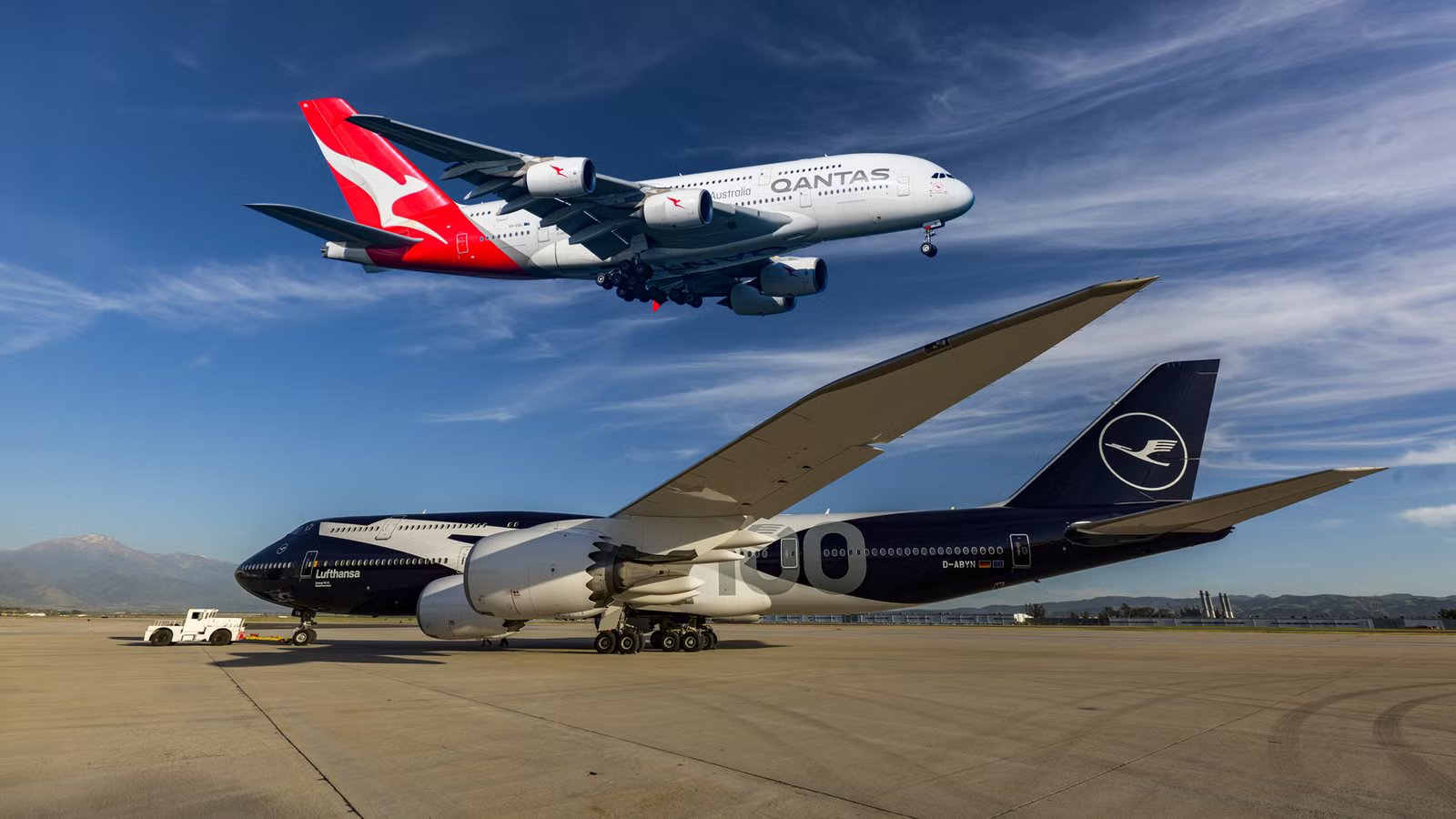
Why The Airbus A380’s Main Landing Gear Needs 20 Tires
From mass to mechanics: why the A380 needs more wheels than a semi-truck.
Balancing Size, Strength, & Aerodynamics

Once airborne, the aircraft’s priorities shift dramatically. The landing gear, which was essential for ground operations, becomes a source of drag that can significantly impact performance. For an aircraft designed to fly long distances with heavy payloads, minimizing drag is crucial.
The rotating retraction mechanism plays a key role in achieving this goal. By allowing the gear to fold into compact, streamlined bays, it reduces the amount of exposed surface area. This, in turn, lowers aerodynamic drag and improves fuel efficiency, enabling the aircraft to carry more cargo over longer distances.
This balance between structural strength and aerodynamic efficiency is an important aspect in aircraft design. Engineers must ensure that the landing gear is robust enough to withstand extreme loads while also being compact enough to fit within the aircraft’s structure when not in use. The C-5’s rotating bogies represent a creative solution to this challenge, combining strength with space-saving efficiency.
Historically, earlier large aircraft often struggled with bulky landing gear that compromised aerodynamic performance. If you look at another big cargo aircraft, such as the Antonov An-22, which was designed in the Soviet Union during the 1960s, the difference is enormous. It akes a very different approach to landing gear design compared to the C-5M, and that difference is immediately visible in how thick and bulky its gear appears. Instead of relying on a complex rotating bogie system, the An-22 uses multiple large-diameter wheels mounted on robust, closely spaced struts that retract more directly into fairings along the fuselage. This results in a visually “thicker” landing gear assembly because the structure must absorb enormous loads without the benefit of advanced folding geometry.
Thus, the C-5’s design reflects decades of progress in engineering, demonstrating how innovative mechanisms can overcome seemingly insurmountable physical constraints.
Steering Capability & Operational Flexibility

While the rotation mechanism is primarily about retraction, the C-5’s landing gear was also designed to enhance its performance on the ground. Each main gear unit on the A-models was originally designed to be steerable up to 20 degrees left or right, providing essential maneuverability for such a large aircraft.
This steering capability allowed pilots to maintain better control during taxiing and crosswind landings. By adjusting the angle of the main gear, the aircraft can align more effectively with the runway, reducing lateral forces and improving safety. This is particularly important when operating in challenging weather conditions or on narrow runways, which can happen quite frequently during military operations and where a failure is not an option.
The combination of multiple wheels and steerable gear units also distributes stress more evenly during turns. Instead of placing excessive strain on a single point, the load is shared evenly across the entire system. This not only improves handling but also reduces wear and tear on both the aircraft and the runway.
Compared with smaller aircraft, which often rely primarily on nose-wheel steering, the C-5’s system provides a more comprehensive solution. It allows precise control of a massive airframe, ensuring the aircraft can operate effectively across a wide range of environments.

How The C-17 Globemaster Stacks Up Against The C-5 Galaxy In 2025
In 2025, the C-5 still leads in raw payload and range, while the C-17 dominates in flexibility and access, two giants that shape modern air mobility.
What Happens If The Rotation Does Not Exist?

Removing the 90-degree rotation from the C-5’s landing gear design would create a cascade of problems. The most immediate issue would be spatial: without rotation, the bogies would require significantly wider bays to fit inside the fuselage. This would either reduce available cargo space or force designers to increase the aircraft’s size, both of which would undermine its efficiency.
Another option would be to reduce the number of wheels, simplifying the system and making it easier to store. However, this would increase the load on each wheel, raising ground pressure and limiting the types of runways the aircraft could use. Such a change would directly conflict with the C-5’s mission of operating from diverse airfields worldwide.
C-5 Galaxy Landing Gear Key Specifications
|
Feature |
Specification |
|---|---|
|
Total wheels |
28 |
|
Main gear units |
4 |
|
Wheels per bogie |
6 (2 front, 4 rear) |
|
Rotation for retraction |
90 degrees |
|
Steering capability |
±20 degrees |
Engineers could also attempt to redesign the gear geometry entirely, but this would introduce new complexities and potential failure. In comparison, the rotating bogie system offers a relatively simple and effective solution that addresses multiple challenges simultaneously.
Finally, the 90-degree rotation is a clever and necessary feature. It allows the aircraft to maintain its high wheel count, preserve cargo space, and achieve the aerodynamic efficiency required for long-range missions.
An Engineering Solution That Defines The Aircraft

The rotating landing gear of the C-5M Super Galaxy is one of the defining elements of its design, illustrating how innovative engineering can solve complex problems. By enabling massive gear assemblies to fit inside compact bays, the system supports the aircraft’s dual requirements of strength and efficiency.
This design also highlights the importance of adaptability in military aviation. The ability to operate from a wide range of airfields, carry diverse cargo, and maintain high performance in flight is critical to mission success. The landing gear system plays a central role in achieving these objectives.
The principles demonstrated by the C-5’s design continue to influence modern aircraft development. As engineers will eventually work to create more capable aircraft, they will face similar challenges related to space, weight, and performance. The solutions pioneered by the Super Galaxy provide valuable insights into overcoming these challenges when needed.