dailynewsnblog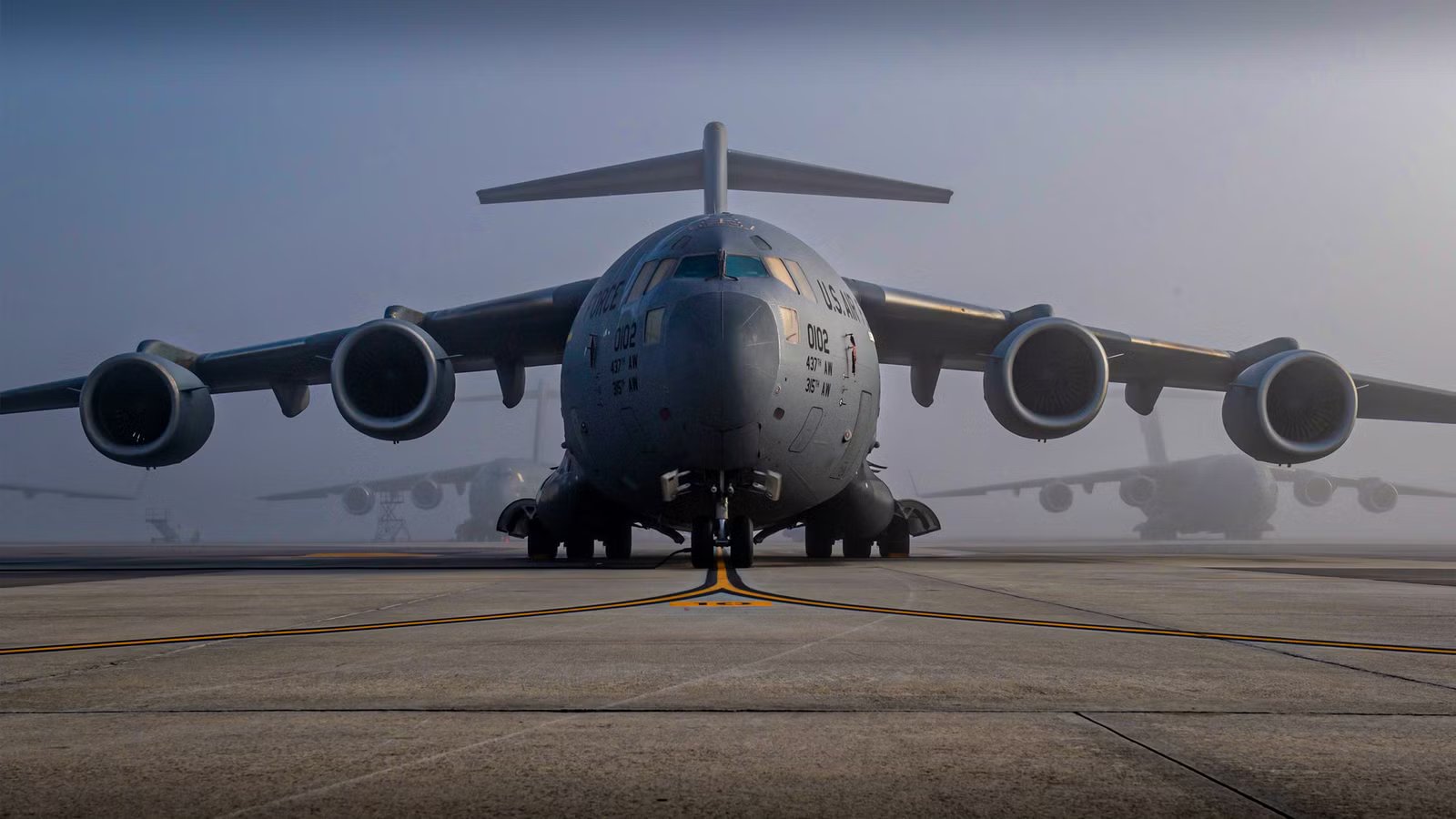
The C-17 Globemaster III remains a unique aircraft in the world of strategic airlift, despite 34 years passing since it first took flight from the McDonnell Douglas plant in Long Beach, California. Evolving from a troubled development program, the Globemaster III enjoyed two decades of continuous production and became one of the most successful tactical airlift platforms ever made. To this day, nothing truly matches its unique combination of performance and ruggedness.
There are certainly aircraft that are more efficient, carry heavier payloads, fly faster, or have longer ranges. Yet, there is no single aircraft that can do all the things that a C-17 can do. That is why it remains one of the most important platforms in the entire fleet of the United States Air Force. It is also an integral platform of numerous air forces around the world.
Because of its unmatched capabilities, the United States Air Force plans to keep the C-17 fleet flying until at least 2075, roughly 80 years after its introduction. Celebrating over three decades of active service with no sign of slowing down, let’s dive into the story behind the Boeing C-17 and how it stacks up in 2025 against the latest and greatest around the world.

In 2025, there remains no single direct competitor that fully replicates the C-17 Globemaster III’s specific “hybrid” profile of massive strategic payload and extreme tactical agility. There are far newer platforms around the world that have come to take flight since the C-17 began its military career. The Airbus A400M took its first flight nearly two decades after the C-17 in 2009. Even more recently is the Chinese Xian Y-20, taking its maiden voyage in 2013.
At a glance, each of these platforms looks to be a close competitor to the C-17. The A400M may be turboprop; however, it can actually maintain a higher cruise speed than the C-17 on some profiles. Meanwhile, the Y-20 looks like a virtual carbon copy with a Chinese style of the C-17. Despite those superficial similarities, the Globemaster III remains very different in terms of capability.
The Air Force is heavily investing in keeping the C-17 Globemaster III fleet of 275+ aircraft operational and modern through significant sustainment contracts, technology upgrades like microvanes, and integration into new concepts like Agile Combat Employment (ACE). Boeing secured a major multi-billion-dollar contract modification in 2025 for C-17 sustainment, extending support through 2027 and including foreign military sales.
How The Competition Stacks Up In 2025

The C-17’s primary advantage is its ability to perform both long-range strategic “hauls” and short-range tactical “deliveries” in a single mission. It can fly intercontinental distances and land directly at small, forward-operating bases, eliminating the need for intermediate cargo transfers. Despite its size, it can land on runways as short as 3,500 feet (roughly 1 km) and only 90 feet wide, including rough fields made of dirt and sand.
Below is a quick snapshot of the immediate contrast points between the key competitors to the C-17 Globemaster III:
|
Competing Aircraft |
Key Comparison To C-17 |
|---|---|
|
Airbus A400M Atlas |
Payload of 37–40 metric tons, less than half of the C-17’s 77-ton maximum capacity. The A400M can operate from even shorter and rougher airstrips (as short as 1,800 ft) than the C-17. |
|
Xi’an Y-20 |
Current estimates place its payload between 60 and 66 tons, which is closer to the C-17 than any other aircraft but still slightly lower. Early versions relied on less powerful Russian engines, though newer indigenous WS-20 engines are narrowing the performance gap. |
|
Lockheed C-5M Super Galaxy |
Offers far greater raw payload (135 tons) and range but lacks the C-17’s ability to land on short, austere runways. |
|
Ilyushin Il-76 |
A rugged strategic lifter with similar airfield performance, but it has a narrower cargo bay that cannot accommodate many Western outsized vehicles. |
|
Kawasaki C-2 / Embraer C-390 |
Modern jet-powered tactical lifters that match the C-17’s agility but have a significantly smaller payload. |
The C-17 can carry nearly any heavy equipment in the US inventory, many of which are too large for its competitors. It has a maximum payload of 170,900 pounds (77.5 tons) and is the only aircraft in its class that can transport an M1 Abrams main battle tank (70 tons) directly to forward airfields. Its cargo hold can be rapidly reconfigured to carry up to 102 paratroopers, 36 litter patients for medical evacuations, or oversized helicopters like the CH-47 Chinook.

Which Country Has The Most Superior Military Transports In The World?
Of all the world’s air forces, which one has the best cargo haulers?
C-17: Made For The Fight

The C-17 Globemaster III’s enduring capability in 2025 is defined by several specialized engineering features that allow a 265-ton aircraft to perform like a much smaller tactical transport. The C-17 is not just a “muscle car” of an airlifter, although it is; numerous unique engineering features allow it to accomplish its mission in a way that no other airplane in the world can equal.
One of the most important features is the in-flight thrust reversers. Pilots can deploy thrust reversers while still in the air to execute extremely steep tactical descents—four to five times steeper than a standard airliner. Its thrust reversers direct air upward and forward, allowing it to back up on its own and perform a “three-point star turn” on narrow runways where other large planes would be trapped.
The C-17 uses a “powered lift” system where engine exhaust is directed directly onto large, double-slotted titanium flaps. When flaps are extended into the exhaust stream, the high-velocity air is deflected downward, creating a massive amount of extra lift. This allows the aircraft to fly stable, steep approaches at exceptionally low speeds, enabling it to land a full payload in less than 3,000 feet.
The C-17 was an early adopter of technologies that allow just two pilots to safely handle complex tactical missions. A quadruple-redundant electronic flight control system manages the aircraft’s stability, making the massive plane feel responsive and agile during extreme maneuvers. Two full-time HUDs (heads-up displays) provide critical flight data directly in the pilots’ line of sight, which is essential for low-visibility, short-field “assault” landings.
The Globemaster III By The Numbers

The C-17 Globemaster III’s history is a dramatic turnaround story, evolving from a program nearly canceled due to $1.5 billion in losses into the backbone of global airlift. It was created as a replacement for the C-141 Starlifter. By 1993, the program was at an impasse, with nearly $1.5 billion in losses and legal disputes between the government and McDonnell Douglas over “requirements creep.“
The program would be massively reorganized and rapidly course-corrected, leading to the first operational squadron being established in 1995. This was not enough to save the company that created it, with McDonnell Douglas being acquired by Boeing in 1997. This merger has been notoriously maligned as a toxic business move that led to the detriment of Boeing, but at the time, the military program that was acquired was extremely valuable.
Below is a quick technical snapshot of the C-17 Globemaster III, based on specifications from the United States Air Force online:
|
Specification |
McDonnell Douglas C-17 Globemaster II |
|---|---|
|
Engine |
Four Pratt & Whitney F117-PW-100 turbofan engines |
|
Thrust |
40,440 pounds, each engine |
|
Wingspan |
169 feet 10 inches (to winglet tips) (51.75 meters) |
|
Length |
174 feet (53 meters) |
|
Height |
55 feet 1 inch (16.79 meters) |
|
Cargo Bay |
Length, 88 feet (26.82 meters); width, 18 feet (5.48 meters); height, 12 feet 4 inches (3.76 meters) |
|
Speed |
450 knots at 28,000 feet (8,534 meters) (Mach .74) |
|
Ceiling |
45,000 feet at cruising speed (13,716 meters) |
|
Range |
Global with in-flight refueling |
McDonnell Douglas was producing the F-15 Eagle, F/A-18 Super Hornet, and the C-17, all of which are major platforms for the US Air Force and US Navy. This dramatically boosted the defense side of the Boeing house at the time. The C-17 would also end up being one of the final aircraft ever produced at the Long Beach factories of both companies.

US Air Force Eyes Next-Generation Airlifter Entry To Service By Early 2040s
The NGAL program is still in the early stages of defining its requirements.
The Airlifter Of Tomorrow

Because no direct replacement exists, the United States Air Force is developing the Next-Generation Airlifter (NGAL) under the “Airlift Recapitalization Strategy.” This program aims to field a single platform by the late 2030s that combines the massive volume of the C-5 with the short-field agility of the C-17. Until then, the C-17 remains in a class of its own.
The NGAL is envisioned as a platform that will incorporate both high-speed performance and low observability (stealth) features for the modern battlefield. In order to increase survivability, the plane is expected to also be able to rapidly unload, load, and refuel to minimize the amount of “exposed” time it spends on the tarmac.
While not confirmed as the final NGAL design, the USAF is testing a BWB technology demonstrator (built by JetZero) to explore designs that offer massive internal volume and short-runway capability with higher fuel efficiency. The Air Force plans to retire the C-5M first on a one-for-one basis as new NGAL units arrive. Once the C-5 fleet is replaced, the Air Force will move to a one-for-one swap for the C-17A.
This groundbreaking new aircraft is not expected to take to the sky for at least another decade or two. Making this concept a reality will require numerous groundbreaking new technologies and innovative engineering that have never been realized in a production aircraft today. Until then, the C-17 will remain one of the most vital and uniquely capable aircraft in the fleet of the US Air Force.