dailynewsnblog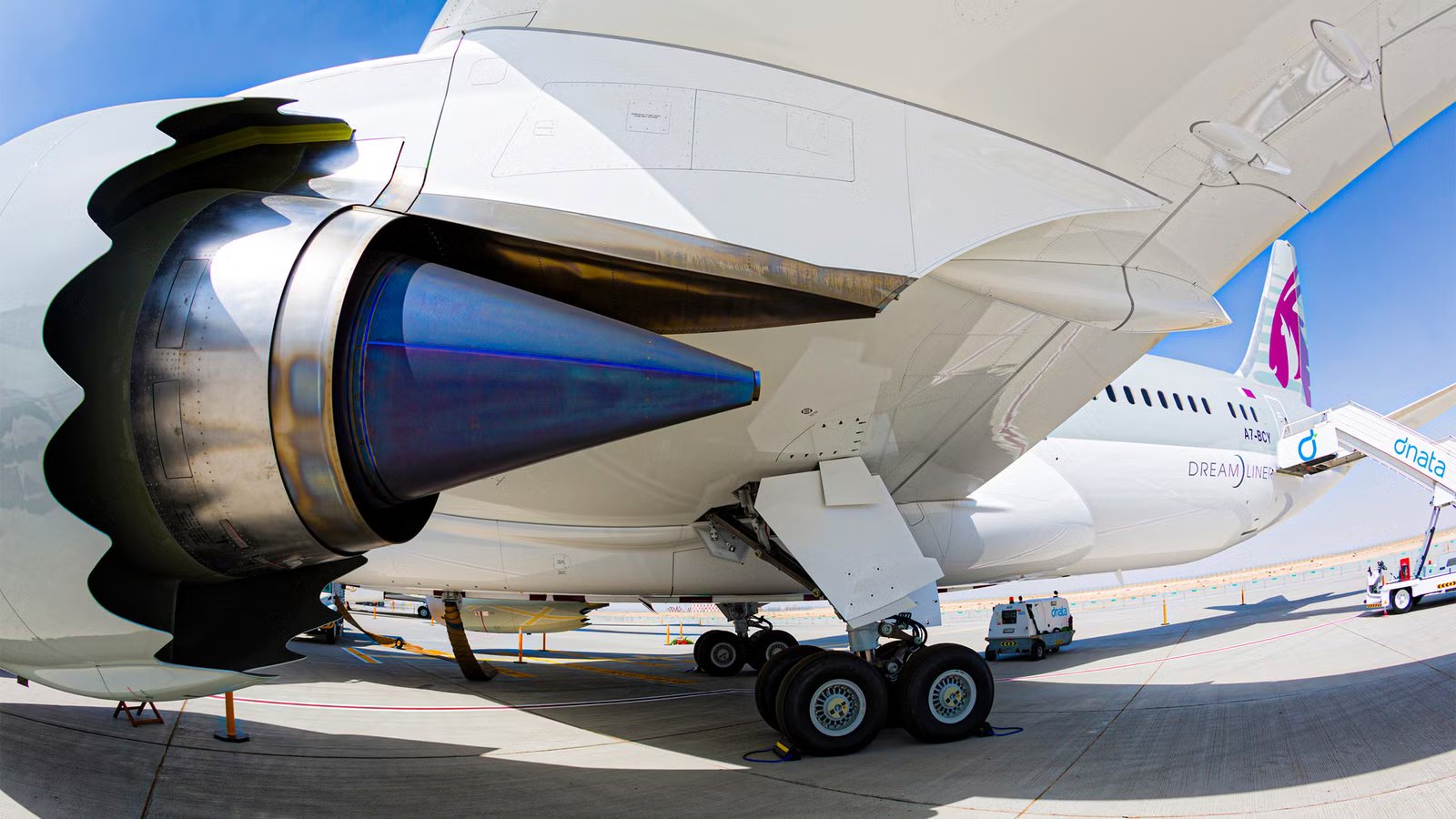
Thanks to the cutting-edge technology of its carbon fiber airframe and enormous composite wing, even the largest and heaviest Boeing 787 Dreamliner needs just eight wheels on its main landing gear. If that doesn’t sound impressive at first, it is a third less than the Boeing 777 that came before it, which uses 12 main tires. For a more dramatic comparison, the 787 has half the number of wheels as the legacy 747, with its four sets of four-wheel bogies for a total of 16 wheels.
The 787 achieves this because it is significantly lighter than legacy widebody jets. It even beats Airbus’ next-gen A330neo and A350 on the scale, making it one of the nimblest twin-aisles in the sky. For the largest variant, the 787-10,  Boeing also introduced semi-levered gear. This technology allows the aircraft to ‘tiptoe’ on its rear wheels during takeoff, providing extra tail clearance for its longer fuselage without needing to redesign the entire gear assembly with more tires.
A New Era In Airliner Technology

The incredibly low weight of the 787 Dreamliner is made possible due to its unique construction method, which was invented during the development process with help from NASA. Large robotic arms ‘weave’ the jet’s monocoque fuselage by placing carbon fiber tape onto a spinning cylindrical mold. The carbon fiber epoxy glue is poured by robotic equipment and then cured in enormous ‘autoclaves.’
The Dreamliner’s key innovation was the manufacturing progression from aluminum to composite construction. Boeing was able to go from a fuselage made of thousands of aluminum sheets to a one-piece barrel fuselage. This significantly reduced weight, as well as potential points of failure by removing between 40,000 and 50,000 fasteners per aircraft. Compared to the aircraft it replaced, the new design is 20% lighter, allowing it to also gain a 20–25% improvement in fuel consumption.
The 787-10 (the largest variant) has an MTOW of approximately 560,000 lbs, whereas the A350-1000 exceeds 700,000 lbs. Because the 787 is lighter, its two four-wheel trucks provide a sufficient ‘footprint’ to stay within standard airport pavement loading requirements without adding more wheels. Fewer tires and axles also reduce the aircraft’s overall weight and complexity, which improves fuel efficiency and lowers maintenance costs by reducing the number of tires, brakes, and hydraulic components that need regular servicing.
Lighter, Stronger, And Smoother

Composites handle tension exceptionally well, making them ideal for the fuselage and wings, while aluminum is retained for areas where its compression handling is superior. Composite does not corrode, while aluminum is also extremely resistant to corrosion. Composite is also far less susceptible to fatigue. So not only does the carbon fiber cut down on labor, potential weaknesses, and overall weight, but it also significantly reduces wear and tear, which saves on maintenance over the plane’s lifetime.
To make the various aerostructures of a 787, epoxy resin is ‘pre-impregnated’ into the carbon fiber. The Dreamliner’s wings are likewise made of sophisticated composite materials. In addition to assisting engineers in achieving the aspect ratio and wingtip vortices that boost fuel efficiency, the composite also makes the wings incredibly flexible, which at the same time increases their durability, safety, and aerodynamic efficiency.
It’s not just Boeing and the operators that benefit from these enhancements. The exceptionally strong single-piece composite fuselage allows Boeing to pressurize the cabin to a higher level, which in turn decreases the simulated altitude inside from 8,000 feet to 6,000 feet. That has a significant impact on passenger fatigue, as well as the aftereffects of jet lag, which makes the flying experience much more enjoyable on long-haul itineraries.

How Much Does A Boeing 787 Dreamliner Cost?
The aircraft is powered by General Electric GEnx or Rolls-Royce Trent 1000 high-bypass turbofan engines.
The Nagoya Connection

The Japanese manufacturer, Toray, is responsible for creating ‘prepreg’ epoxy resin that made the 787 possible. The unique carbon fiber blend acts as the matrix for the fibers in the composite that made the 787 possible. To honor this partnership, Boeing donated its first-ever 787 prototype (ZA001) to Nagoya’s airport. It is now the centerpiece of Flight of Dreams, an aviation-themed park where visitors can explore the aircraft.
Toray achieved the breakthrough necessary to create the material Boeing needed by refining its technology through a myriad of consumer goods like fishing rods, golf shafts, and tennis rackets. The main structural components of the 787, such as the fuselage and wings, are now exclusively produced with Toray carbon fiber composite materials.
Boeing flies the enormous 747-400 ‘dreamlifters’ to Chubu Airport (NGO) in Nagoya, where it picks up the main wings and the composite wing boxes made at Nagoya Aerospace Systems Works by Mitsubishi Heavy Industries. Kawasaki Heavy Industries also manufactures the forward fuselage, main landing gear wheel, fixed trailing edges of the wings, and Subaru even builds the center Wing box. These sections are flown directly from Nagoya to Boeing’s final assembly lines in Everett, Washington, and North Charleston, South Carolina.
Head-To-Head: The Boeing 787 Dreamliner Trio

Regardless of the model that a carrier chooses, all three of the 787’s variations are made to meet the needs of operators in an era of commercial aviation where flexibility and adaptability are crucial qualities. Boeing developed a family of aircraft that enables carriers to ‘right-size’ their fleet for high-density regional and transcontinental operations as well as lower demand, ultra-long-haul ‘thin’ routes.
The 787-9 has proven to be the most popular variant as it offers the family’s best range and fuel efficiency relative to capacity. It features a strengthened airframe compared to the -8, allowing for a higher Maximum Takeoff Weight (MTOW) and increased fuel capacity to fly further while also carrying more passengers. All three variants share a common cockpit and similar handling to allow pilots to fly any version with minimal additional training, for maximum flexibility in crew scheduling.
The 787-8 is optimized for fuel efficiency on long-range routes where demand is not high enough to fill a larger jet to have the lowest operating cost possible. The 787-10 is the biggest variant after being stretched 38 feet longer than the 787-8. It can carry significantly more passengers and cargo, but it uses the same fuel tanks as the 787-9, which sacrifices 1,250 nautical miles of range compared to its smaller sibling.

787-8 Vs 787-9 Vs 787-10: How The Dreamliner Variants Differ
The three 787 variants are tailored to different market segments to fill niches and offer a placement for different previous-generation aircraft.
The World’s Best-Selling Widebody

Airbus was developing the A330neo upgrade based on its existing twinjet widebody when the 787 debuted with such a strong market response that the European planemaker shifted its focus and invested in a clean-sheet design. The resulting A350XWB (eXtra Widebody) is an equally impressive jet but has never caught up to the Dreamliner in terms of sales due to the years-long head start that the American maker held.
The 787’s versatility has made it the highest ordered widebody in the history of commercial aviation. In 2025 alone, Boeing booked roughly 350 new Dreamliner orders. Carriers like United Airlines expect record widebody deliveries in 2026 to fuel international network expansion. Still more carriers are adding the advanced jet to expand or establish intercontinental networks.
Delta Air Lines, the only major US legacy carrier to hold out, made a big order in January 2026 for a firm 30 and up to 60 787-10s to update its global fleet. Delta was the only one of the ‘Big Three’ to not adopt 787s during its modernization efforts in recent years. The airline had opted for Airbus A350 and A330neo widebody aircraft to replace its phased-out 777 and 747 fleet until just this year.
Successor To The Four-Engine Giants

For nearly 50 years, the 747 was an iconic symbol of intercontinental air travel. Yet, the 747, Airbus A380, and A340 quadjets are all being decommissioned today due to a combination of technological, economic, and regulatory advances that have changed the landscape of commercial flying. The fall of the four-engine giants began in the 1980s when new high-thrust, high-bypass twinjets proved capable of safely transporting 300 to 400 fliers between the same cities.
More than three decades after the first 747 in 1969, Boeing’s latest variant, the 747-8, debuted in the late 2000s with a lengthened fuselage and upgraded GEnx engines. By 2020, Boeing reported that the last 747-8F would leave the Everett factory as the ‘dash eight’ line was phased out, with the final aircraft delivered in 2023. The 787 has since taken up the mantle as Boeing’s premier twin-aisle jet for long-distance flying.
Following a similar fate, the Airbus A380 was launched in 2000 with the expectation that traffic between the world’s major hubs would overrun available landing and takeoff slots, forcing carriers to fly larger jets. By 2012, airlines showed that they preferred the lower fuel cost per seat of twins like the 777-300ER. Airbus was forced to shutter the assembly line in 2021 and the new, composite construction A350 is now its halo product.