dailynewsnblog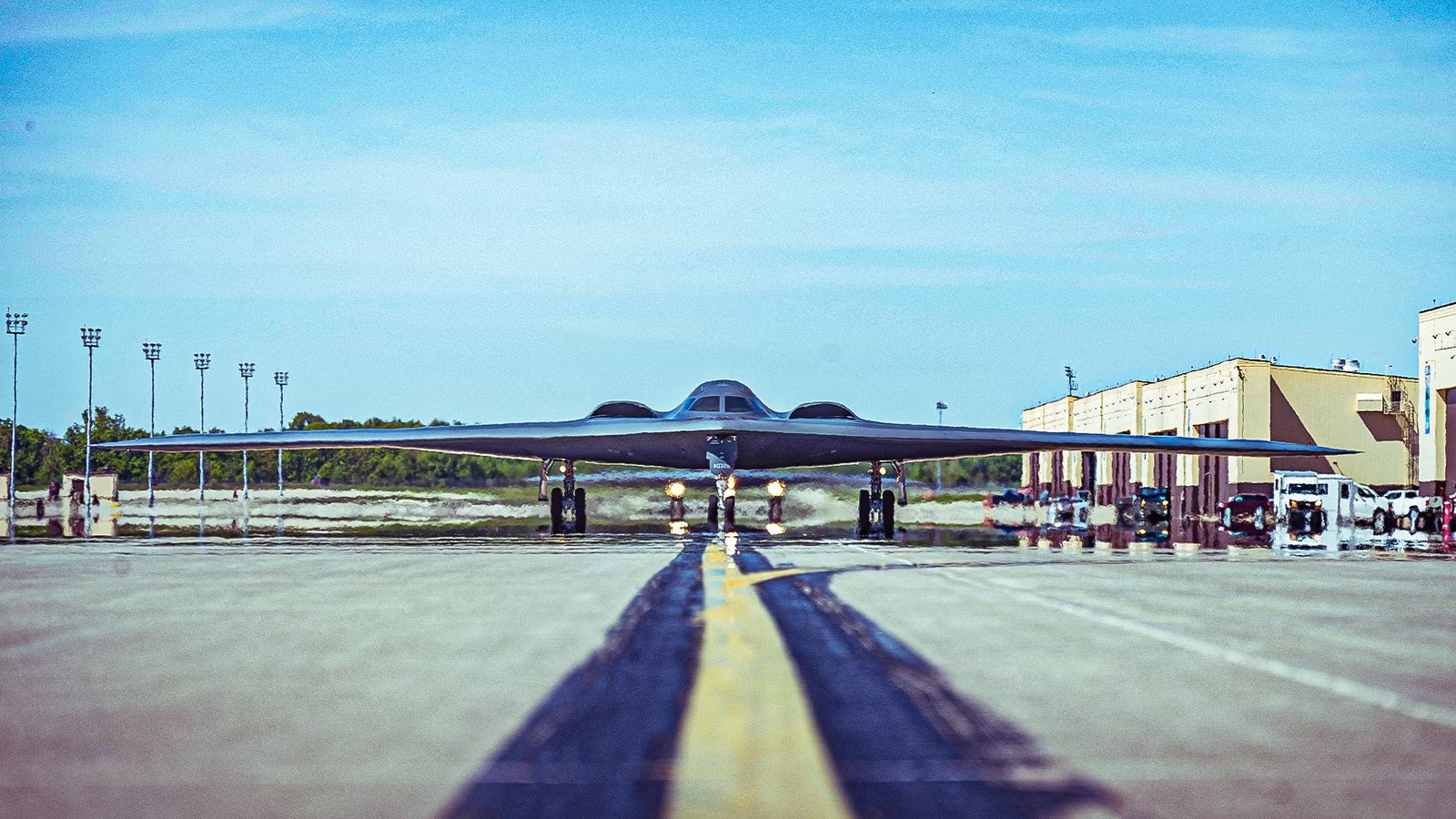
The B-2 Spirit stealth bomber is one of the most extraordinary aircraft ever created, and its silhouette alone inspires awe. Unlike traditional bombers with airliner-like noses, tails, and protruding wings, the B-2 looks like a sleek flying wing, resembling futuristic alien technology. This “flatness” is the product of decades of aerodynamic theory, stealth physics, and strategic doctrine. We will explore how engineers got here, from early 20th-century flying-wing experiments to one of the most advanced bombers ever built, and even look ahead to its successor.
At its core, the B-2’s design answers a basic question: how do you build an aircraft that can slip into fierce air defenses without being seen? The answer lies in minimizing its interaction with radar and radar-seeking weapons — and the result is a flat, curved wing with no obvious fuselage or tail, engineered with obsessive precision. In this article, we’ll study the history, physics, engineering choices, and future of flying wing stealth aircraft, weaving in explanations and examples that make sense even if you’re not an aerospace engineer.
The Flying Wing’s Century-Long Journey

Interestingly, the concept of a flying wing predates even the jet age. Long before the B-2 became the frightening “missing pixels in the sky”, designers wondered whether eliminating the fuselage and tail could make an aircraft simpler and more efficient.
In the 1930s, German designers introduced one of the earliest jet-powered flying-wing prototypes, the Horten Ho 229. Designed to meet high-speed tactical requirements during World War II, the Ho 229 used twin jets embedded in its wing — an early hint that reduced external features could improve performance. Although only prototypes were built, the configuration showed how eliminating conventional aircraft structures could reduce drag and improve range.
Meanwhile, in the United States, visionary engineer Jack Northrop began experimenting with flying wing designs in the late 1930s. Northrop believed that removing fuselages and tails could dramatically improve lift-to-drag ratios, potentially enabling long-range bombers. His early work yielded prototypes such as the Northrop YB-49 Flying Wing Bomber, a radical bomber design of the late 1940s. Though it never entered production (the Air Force preferred more conventional designs like the Convair B-36 at the time), the YB-49 cemented Northrop’s reputation as the flying wing pioneer.
These early experiments demonstrated something that would echo decades later: a flying wing could be extraordinarily efficient aerodynamically, but without modern control systems, like computers, it could be hard to fly. Early flying wings lacked vertical stabilizers for yaw control, making them difficult to handle without active electronic stabilization.
Early flying wings fascinated designers, so research into making functional planes never stopped. In a conventional aircraft, the fuselage and tailplane are for stability and control, not lift. They add drag and mass without contributing much to the aircraft’s primary job of producing lift. A flying wing, by contrast, distributes lift evenly across its entire surface. Less drag, simpler structure, and higher efficiency, in theory, it was a revolution.
But the tradeoff was unstable flight dynamics. Before digital control, pilots often fought the plane’s tendency to drift. These challenges halted early flying-wing projects — until computers finally matured enough to manage flight stability.
By the 1970s and 80s, advances in computation and flight-control computers made Northrop’s early dreams a reality. The B-2 bomber revived the flying wing concept, combining it with stealth technology and digital flight controls that continuously corrected the inherently unstable design. What took decades of trial and error ultimately produced one of the most iconic aircraft in history — a flat, tailless bomber that remains hidden in plain sight.
The Flat Shape Factors

When most people ask why the B-2 looks flat, they mean its flying wing shape and lack of vertical structures. But there’s a deeper reason behind such a shape: radar cross-section reduction.
Imagine radar waves as beams of light. A traditional bomber with vertical tails, noses, and cylindrical fuselages acts like a hall of mirrors — surfaces send strong radar returns right back to the emitter. The fewer surfaces that bounce energy back to the source, the smaller the radar signature becomes.
Basically, flying wing design reduces radar cross-section. The B-2’s flying wing shape acts like an “infinite flat plate” from many angles — a geometry that lacks clear right angles for radar waves to bounce straight back. Its low-drag flying wing configuration significantly lowers its radar profile, with a reported radar cross-section (RCS) of about 0.1 m² — roughly the size of a small bird on radar, as noted by the War Wings Daily. Designers intentionally aligned leading edges, trailing edges, and surfaces so radar energy is more likely to scatter sideways or be absorbed, not reflected back to the radar receiver.
Early stealth aircraft like the F-117 used simple, flat facets to control radar reflections. By the time the B-2 was designed, computing power had advanced enough to allow smooth curves instead of hard-facet edges. This means the B-2 features seamless curves that still deflect radar energy but with less aerodynamic impact. These precise curves were calculated using advanced simulation tools, marking a significant advancement over earlier stealth designs.
Stealth Reduction Factors Built into the B-2
|
Feature |
Role in Signature Reduction |
|
Flying wing shape |
Minimizes perpendicular reflective surfaces |
|
Embedded engines with S-ducts |
Blocks radar from compressor face |
|
RAM coatings |
Absorbs radar energy instead of reflecting |
|
Smooth curves, aligned edges |
Diffuse radar returns |
In addition to its shape, the bomber uses radar-absorbent materials (RAM) and coatings that absorb radar waves. These materials must be carefully maintained — this is one reason the B-2 spends so much time in climate-controlled hangars after flights.
Another stealth trick embedded into the flat form factor is the integration of the engines into the wing. The four turbofan engines are buried in S-shaped ducts inside the wing, which block direct radar lines of sight to the engine compressor faces — one of the strongest radar reflectors on any aircraft. The exhausts are also shielded and mixed with cooler air to reduce the infrared signature.
All of this is part of a holistic stealth strategy: reduced radar boosts, thermal signatures, and acoustic footprints. The result is a bomber that can transit hostile airspace with minimal chance of detection, partly thanks to its iconic flat wing.

How Crew Rest & Sleep On B-2 Spirit Bomber Flights
Staying sharp on the stick.
More Than Just Stealth: Aerodynamics And Long-Range Performance

While stealth is the primary feature, the B-2’s flat design also enhances aerodynamic efficiency — crucial for a bomber capable of striking targets worldwide without support.
The flying wing planform reduces parasite drag by eliminating non-lift-producing surfaces such as fuselages or tail booms. This helps extend range and boost fuel efficiency, allowing the bomber to fly farther without refueling than a similarly sized conventional aircraft.
In a flying wing, the entire structure contributes to lift, meaning the lift-to-drag ratio improves compared to a tube-and-wing plane. Fewer separate components mean fewer intersections and less airflow disruption. That seamless, blended body reduces flow separation and drag, which is especially valuable for long endurance missions.
Weapon configuration is also crucial. Unlike earlier bombers that carried munitions externally, the B-2 stores all weapons internally, up to 40,000 lb, according to Encyclopedia Britannica. This maintains aerodynamic smoothness and stealth. Whether nuclear or conventional JDAMs and bunker-busting bombs, they’re all hidden behind doors that sit flush with the wing’s surface.
Even without high speeds, the B-2 excels at long-range penetration. Its design enables missions spanning intercontinental distances, often supported by aerial refueling to extend further endurance.
Digital Flight Control That Keeps A Flat Giant Stable

A natural question is: if a flat flying wing has no tail, how does it steer? Traditional aircraft use vertical tails and elevators to control yaw and pitch. The B-2 instead uses digital magic. Let’s take a closer look:
Quadruple Redundant Fly-by-Wire: Without a conventional tail, the bomber relies on computer-controlled flight systems to remain stable. A quadruple redundant fly-by-wire system constantly tweaks elevons (combined elevator and aileron surfaces) and split drag rudders to balance the aircraft. These corrections happen hundreds of times per second, keeping the flat wing stable in pitch, yaw, and roll.
Control Surfaces Across the Wing: Split drag rudders on wingtips act as yaw control and air brakes; elevons near the trailing edge provide pitch and roll authority. The computers interpret pilot inputs and environmental data, turning them into precisely coordinated surface adjustments. This turns what would otherwise be a difficult-to-fly shape into a practical combat aircraft.
Thanks to these systems, the B-2 can perform normal maneuvers and maintain stability even without visible stabilizers, illustrating how the flat architecture works in practice.

Why Is The US Air Force So Reliant On Stealth Technology?
The US Air Force relies on stealth to survive modern defenses, evolving from Cold War lessons as speed, altitude, and numbers became insufficient.
Structural Integration And Engineering Challenges

Building a bomber so flat was not trivial. Engineers had to integrate fuel, payload, avionics, engine ducts, landing gear, and pressurized crew compartments into a single wing.
Fuel tanks are distributed across the wing structure; weapons bays sit deep within the center, and crew cabins are embedded into a thickened central portion of the wing. This integration optimizes internal volumes but also forces tradeoffs: shape constraints, equipment placement, and access all had to work within strict stealth and aerodynamic guidelines.
The B-2’s coatings, like radar-absorbent and anti-reflective paints, are very delicate. Keeping them in good shape requires hours of careful inspection and repair after each flight. Mission success relies on these coatings working as they should, which is why B-2 maintenance is so specialized, expensive, and time-consuming. This level of engineering shows that the flat architecture was a core requirement that affected all aspects of B-2, from materials to mission planning.
Legacy And The Future: The B-21 Raider And Beyond

However, the B-2 isn’t the end of the flying wing line — it’s one of the first and biggest milestones that influenced other designs. Its successor, the Northrop Grumman B-21 Raider Advanced Stealth Bomber, continues the flying wing lineage with next-generation technologies. Smaller, lighter, and even stealthier, the B-21 is designed to operate in 21st-century threat environments and replace legacy bombers, including the B-2 and B-1.
The Raider’s extended stealth, likely achieved with smoother surfaces, fewer panel edges, and updated RAM, is based on decades of B-2 operations and current threats. Its flat, blended planform follows the design principle: fewer edges reduce radar reflections, and integrated systems enhance survivability. In essence, flat architecture has evolved but not disappeared, because physics hasn’t changed.
What’s particularly striking is how the B-2’s architectural philosophy is now influencing unmanned systems. Modern stealth drones increasingly adopt flying-wing configurations for the same reasons: reduced radar cross-section, efficient lift distribution, and internal payload carriage. Aircraft such as the Northrop Grumman X-47B demonstrated that an unmanned flying wing could autonomously operate from aircraft carriers while maintaining a low observable profile. Similarly, the BAE Systems Taranis and other classified programs showcase how flat, blended bodies remain central to stealth drone development.
Stealth flying wing drones may push the concept even further than the B-2 or B-21 ever could. Without the need for a cockpit, life-support systems, or crew visibility requirements, designers can produce even smoother, more aerodynamically pure shapes. Removing the human factor also allows for more aggressive control algorithms, exploiting inherently unstable designs that computers can easily manage. In many ways, the B-2 Spirit represents both a culmination and a bridge — the aircraft that proved the flying wing could dominate modern warfare, and the foundation upon which the next generation of stealth bombers and unmanned combat aircraft will be built.