dailynewsnblog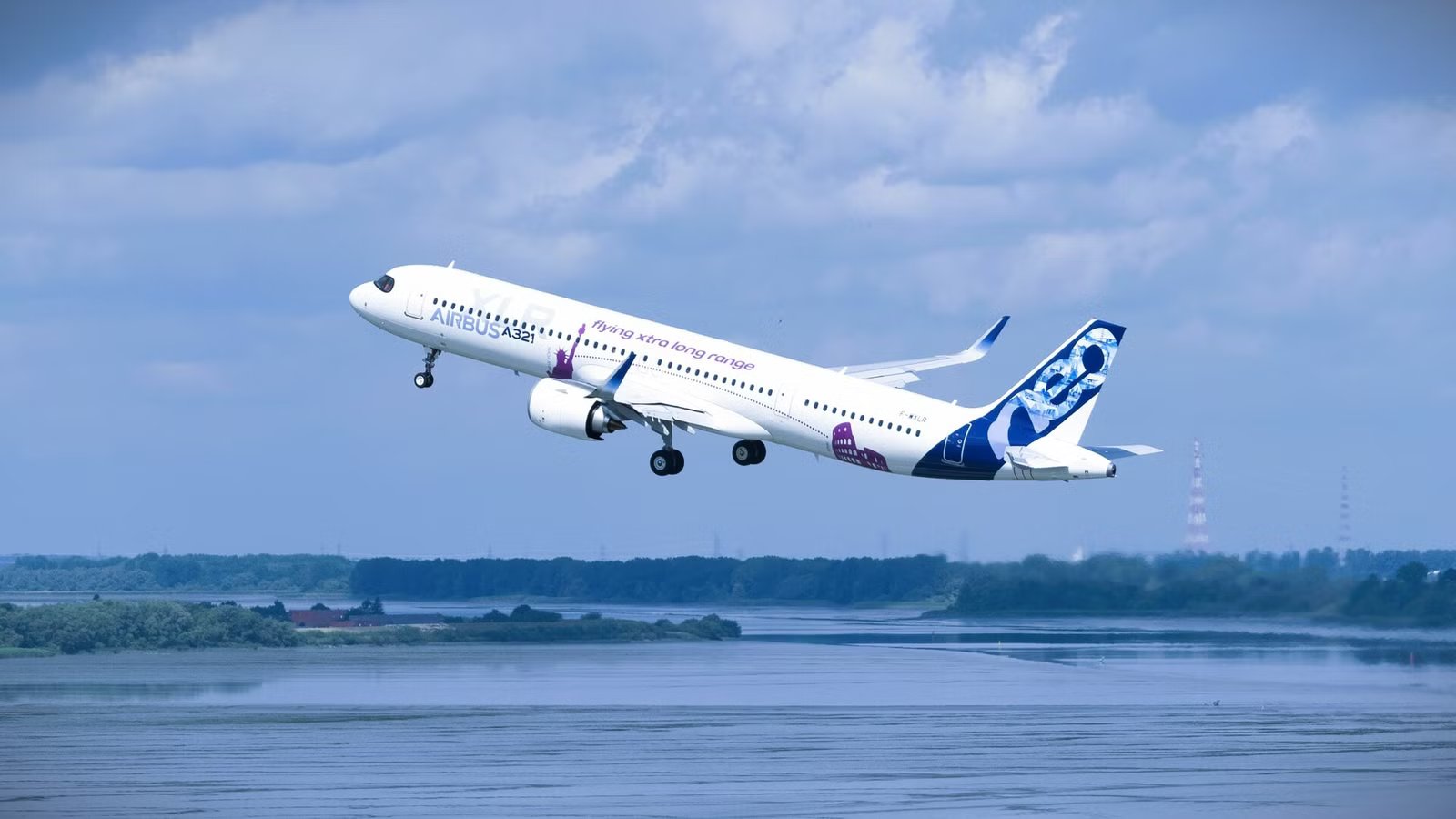
 Boeing has long maintained a leading position in the commercial narrowbody aircraft market largely due to the success of its Boeing 737 family. The 737 is the second-best-selling aircraft family ever, with over 17,000 orders and 12,000 deliveries completed since the first 737-100 made its debut in 1968. However, the program was eventually caught up by Airbus’ popular narrowbody family, the Airbus A320, which has since exceeded the 737 in both orders and deliveries.
The A320 family looks set to give Boeing a further headache with the arrival of the Airbus A321XLR (eXtra Long Range), opening up longer narrowbody route possibilities for airlines, including many lucrative transatlantic pairings. Adding an extra 700 NM (1,300 km) to the already-enhanced Airbus A321LR, the XLR promises to be a game-changer for many operators and also threatens interest in Boeing’s rival products.
Enter The Airbus A321XLR

Featuring a new integrated rear center fuel tank, Airbus states that the A321XLR has a maximum range of 4,700 NM (8,700 km), which is an impressive 1,200 NM (2,200 km) longer than the Airbus A321neo. The XLR can theoretically fly with a full load of passengers for over 11 hours, with its current longest scheduled route clocking in at nine hours and 40 minutes.
The A321XLR entered service in November 2024 with a flight from Madrid to Boston, which has a block time exceeding eight hours. It is the A321XLR’s ability to operate these transatlantic routes that makes it such a credible threat to Boeing. Capable of delivering up to 30% lower fuel burn per seat compared to previous-generation competition, the XLR is a natural successor to the Boeing 757, particularly its suitability for long, thin routes where widebody aircraft are not as economical.
As it stands, only a handful of airlines have taken delivery of an A321XLR, including launch customer Iberia, Aer Lingus, and Wizz Air. However, there are some prominent airlines with XLR orders awaiting, including American Airlines (which has taken its first examples already) and United Airlines. With its development originating in 2018, the A321XLR completed its maiden flight in 2022.
Why Boeing Should Be Worried

By pairing long-haul capabilities with narrowbody operating economics, the A321XLR fills a gap within Boeing’s portfolio now that the 757 is out of production. Given the XLR’s vastly superior efficiency, operators can fly the same routes at a much lower cost, and Airbus had to spend very little in development costs to get the plane on the market.
The most worrisome thing for Boeing is that it doesn’t have any direct competitor in the works, with no recent progress announced regarding its New Midsize Airplane (NMA) concept. Its 737 MAX is still more than capable of handling the shorter transatlantic routes, and it is currently operating dozens of these services, but even the longest-range variant, the MAX 7, has a range that only extends to 3,800 NM (7,040 km).
|
Aircraft |
Maximum Seating |
Range |
|---|---|---|
|
Airbus A321XLR |
244 |
4,700 (8,700 km) |
|
Boeing 737 MAX 8 |
210 |
3,550 (6,570 km) |
|
Boeing 737 MAX 9 |
220 |
3,300 (6,110 km) |
|
Boeing 737 MAX 10 |
230 |
3,100 (5,740 km) |
Much like the MAX 7, the highest-capacity MAX 10 is still bogged down by certification problems delaying its entry into service. It will only have a range of around 3,100 NM (5,740 km). Nonetheless, with the MAX’s enhanced capabilities compared to the 737NG, scheduled 737 routes between North America and Europe have risen dramatically in the past decade. However, while the MAX is still very limited in the number of medium-to-long-haul routes it can handle, the A321XLR can feasibly handle routes accustomed to widebody service.
How Popular Will The A321XLR Be?

While the A321XLR has already received orders from several leading carriers, demand is likely to grow as the aircraft proves itself in the field. Airbus says it has taken over 500 orders for the aircraft, which costs an estimated 10% more than the A321LR due to its better capabilities. The jet has arrived at an opportune time as the global Boeing 757 is nearing its end.
Airlines will use the A321XLR to serve longer routes where demand for seats isn’t quite high enough to justify the use of a widebody, or routes where premium demand is below average. For example, an airport like Germany’s Düsseldorf has recently spoken out in favor of the A321XLR, which it sees as a future connector for flights to the US. Growing low-cost airlines will also see the aircraft as an ideal way to expand their network reach, opening up intercontinental markets that typical narrowbody aircraft cannot ordinarily serve.
While the world’s largest operator of the 757, Delta Air Lines, has yet to make any commitment for the A321XLR, United Airlines already has an order for 50 aircraft. Carriers on a growth trajectory have also invested in the XLR to expand their network possibilities, one of which is IndiGo. The Indian low-cost carrier has received its first example, and holds the largest commitment for the A321XLR with an order for 68 more aircraft.
Boeing Rues Missed Middle Market Development

Given Boeing’s lack of progress on its NMA, often referred to as the 797, airlines only have one feasible option for a long-haul narrowbody today, and that is the XLR. Boeing has been pondering a middle-market aircraft since the 1990s and has long concluded production on the 757, with the last airframe rolling off the production line in October 2004. Boeing’s market research suggested that around 2015 would be the optimal time for the NMA to enter the market, given the lifecycle of competing aircraft.
The planemaker envisioned two variants of the 797: a 225-seater that could fly up to 5,000 NM, and a stretched 275-seat version with a shorter range of 4,500 NM. However, the COVID-19 Pandemic hindered Boeing’s progress on a new clean-sheet design, and the company has yet to revive its attempts.
Given that Airbus developed the A321XLR on its existing A321neo platform, Boeing considered something similar with a stopgap Boeing 757/767 successor, but this didn’t progress well either. Despite strong suggestions that Boeing was gearing up to build ‘a new aircraft’ at its Everett facility in Washington, nothing official has been announced.
Comparing The A321XLR With The 737 MAX 10

The Boeing 737 MAX 10 will not be a direct competitor to the A321XLR, but it is the closest thing Boeing has in terms of capacity and range. The MAX 10 falls well short in its range at 3,100 NM (5,740 km), which is over 34% less than the XLR, making it the shortest range MAX family aircraft. Nonetheless, this range is still respectful and will allow it to handle any route the 737NG could.
Its capacity will also be lower than the A321XLR, and it is in this field that the MAX 10 was primarily designed to compete in. Boeing saw the huge success Airbus had enjoyed with the A321neo, which has gone on to become the best-selling A320-family variant by a considerable distance. So the MAX 10 was developed to deliver high narrowbody capacity and win over some of the A321 demand.
|
Feature |
Airbus A321XLR |
Boeing 737 MAX 10 |
|---|---|---|
|
Maximum Seating |
244 |
230 |
|
Range |
4,700 NM (8,700 km) |
3,100 NM (5,740 km) |
|
Maximum Takeoff Weight |
101 tonnes |
90 tonnes |
|
Engines |
CFM LEAP-1A or PW1100G |
CFM LEAP-1B |
|
Flight Time Capability |
Over 11 hours |
Over seven hours |
While the A321XLR will be incredibly useful for longer routes, operators will find the MAX 10 to be more efficient on shorter connections. As the lighter aircraft, it will be more economical on shorter routes, and there will always be strong demand in such markets. This is reflected in the MAX 10’s superior sales numbers, with over 1,200 commitments for the type compared to over 500 for the A321XLR.
How The A321XLR Achieves Its Long Range

With its A321LR already ahead of the narrowbody competition, Airbus extended the platform’s range by almost another 20% to deliver the A321XLR. The most crucial alteration is the aircraft’s new rear center tank, which Airbus designed as a permanently integrated part of the fuselage structure to hold more fuel in less space.
This is unlike the A321LR’s configuration, which has removable auxiliary tanks. Its efficient design allows operators to keep hold of valuable cargo space without having to remove any tanks, maintaining both the aircraft’s range and load capacity. Airbus explains that:
“The aircraft features an entirely new centre fuselage incorporating a conformal 12,900 litre ‘rear centre tank’ (RCT), a dedicated new fuel system, new fibre-metal laminate materials with fire-retardant properties on its lower shell, and a new larger and reinforced belly-fairing.”
With its additional fuel capacity, the A321XLR’s Maximum Takeoff Weight was boosted up to 101 tonnes, allowing more fuel to be held with the same quantity of passengers and cargo. This change necessitated reinforcements in the main landing gear as well as design tweaks to the wing trailing edge, while Airbus also made other key adjustments to the flight control system and cabin heating system.