dailynewsnblog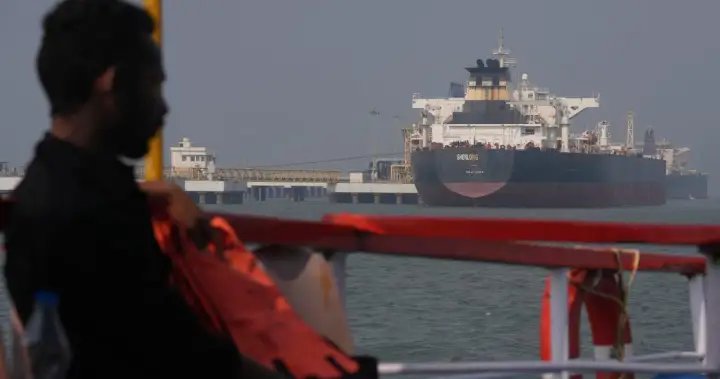
As Iran allows some ships but not others to travel through the Strait of Hormuz, a vital shipping chokepoint, the arrangements amount to what one expert calls a form of geopolitical “ransom.”

The Strait of Hormuz normally sees about 20 per cent of the world’s crude oil supply pass through, in addition to other vital resources. Since the war began, the price per barrel of oil has spiked worldwide, and economists expect that to drive up inflation very soon, including in Canada.
“If you allow anyone to block an international waterway and select who goes through based on favourable policies or outright ransom, you will always pay that ransom,” says Aurel Braun, a professor of international relations and political science at the University of Toronto.
On Monday, U.S. Treasury Secretary Scott Bessent said that they were aware some ships were getting through in recent days.
“We are seeing more and more of the fuel ships start to go through. The Iranian ships have been getting out already, and we’ve let that happen to supply the rest of the world. We’ve seen Indian ships go out now … we believe some Chinese ships have gone out,” he told CNBC in an interview.
“That should start ramping up before there are any of the flotillas or protective armadas in the Gulf. So we think that there will be a natural opening that the Iranians are letting out. And for now, we’re fine with that. We want the world to be well supplied,” Bessent said.
But who benefits and who does not when only certain ships are allowed to pass through?

Why block the Strait of Hormuz?
Blocking the Strait of Hormuz may be one of Iran’s most powerful leverage tools in the war because it allows the nation to do economic damage to other nations, including the U.S. and Israel, by forcing oil prices higher and making virtually all other goods and services more expensive.
Oil isn’t just used to make fuel for vehicles, machinery and other equipment: it is also a critical component in making dozens of other industrial materials, from rubber to plastic, industrial solvents and waxes, and even textiles like fabric for clothing.

Get breaking National news
Get breaking Canada news delivered to your inbox as it happens so you won’t miss a trending story.
To transport just about anything requires fuel in some capacity, too. Higher oil prices lead to more expensive fuel, and if it’s more costly to move products to customers and businesses because of those higher fuel costs, then sticker prices usually rise too.
Purposely causing economic damage is part of Iran’s bigger pattern of using what’s known as asymmetrical warfare.
“They don’t have the conventional military power to take on the United States and Israel. So what they have done is they’ve engaged asymmetrically in a sense, they’ve used their missiles and their drones, their proxy militias in Iraq and in Lebanon,” said Joseph Varner, a senior fellow at the Macdonald-Laurier Institute.
“And, they’ve threatened to mine and close the Strait of Hormuz, which is kind of really their only real leverage at this point.”

Blocking the Strait has clearly sent ripples through global economies, but Iran may not be immune to those negative impacts. This means countries that can offer Iran something in return may be able to negotiate safe passage for their ships.
“Some countries will do whatever they can to try to make it easier,” says Varner. “But Iran doesn’t have the leverage that I think they think that they do.”
This may be why Iran is making supposed deals or arrangements with other nations, especially those that rely heavily on oil from the Middle East and Iran in particular.
“China is actually far more dependent on Iranian oil, so it has a very, very large interest to see that Strait be open. Same with India and Pakistan and other countries that were mentioned there. So there’s a strong interest,” says Kevin Budning, director of scientific research at the Conference of Defence Associations Institute.
Varner said Iran’s goal with China is “to keep the trade open and hopefully get some form of military assistance from the Chinese, whether it’s intelligence or something else.”
Iran has also asked India to release three tankers seized in February as part of talks seeking the safe passage of Indian‑flagged or India‑bound vessels out of the Gulf via the Strait of Hormuz, three sources with knowledge of the matter told Reuters.

“On Pakistan, Pakistan has threatened Iran that if they continue to strike Saudi Arabia, that is an ally of Pakistan, that Pakistan will become involved in the conflict,” says Varner.
Pakistan was also able to get at least one oil tanker through the Strait over the weekend, data tracking shows.
The Kpler data provider, MarineTraffic, said the Karachi was “the first non-Iranian cargo to transit the chokepoint while broadcasting its AIS signal, suggesting that select shipments may be receiving negotiated safe passage” in a post on X.
Budning says if anyone comes out a winner in all of this, it may be other oil-producing countries, like Canada.
“There are always winners. So if you are producing oil, if you are in the Canadian oilsands, for example, and you’re a large exporter of oil and the global price of oil has gone up and you’re not particularly affected directly from the conflict in the Middle East, then probably there will be some that will make some serious money out of all of this.”
Although Canada and other oil producers may be able to help offset some of the oil supply lost from having the Strait of Hormuz blocked, nations that choose to negotiate with Iran to continue getting oil and other resources from the Gulf region are still taking a major risk.
“A number of countries are saying that they’re negotiating with the Iranians to try and get safe passage for their vessels in and out of the Persian Gulf,” says Varner.
“Making a deal with the devil is never a good thing. And I don’t think that that’s going to work or help anyone.”
– With files from Reuters
© 2026 Global News, a division of Corus Entertainment Inc.