dailynewsnblog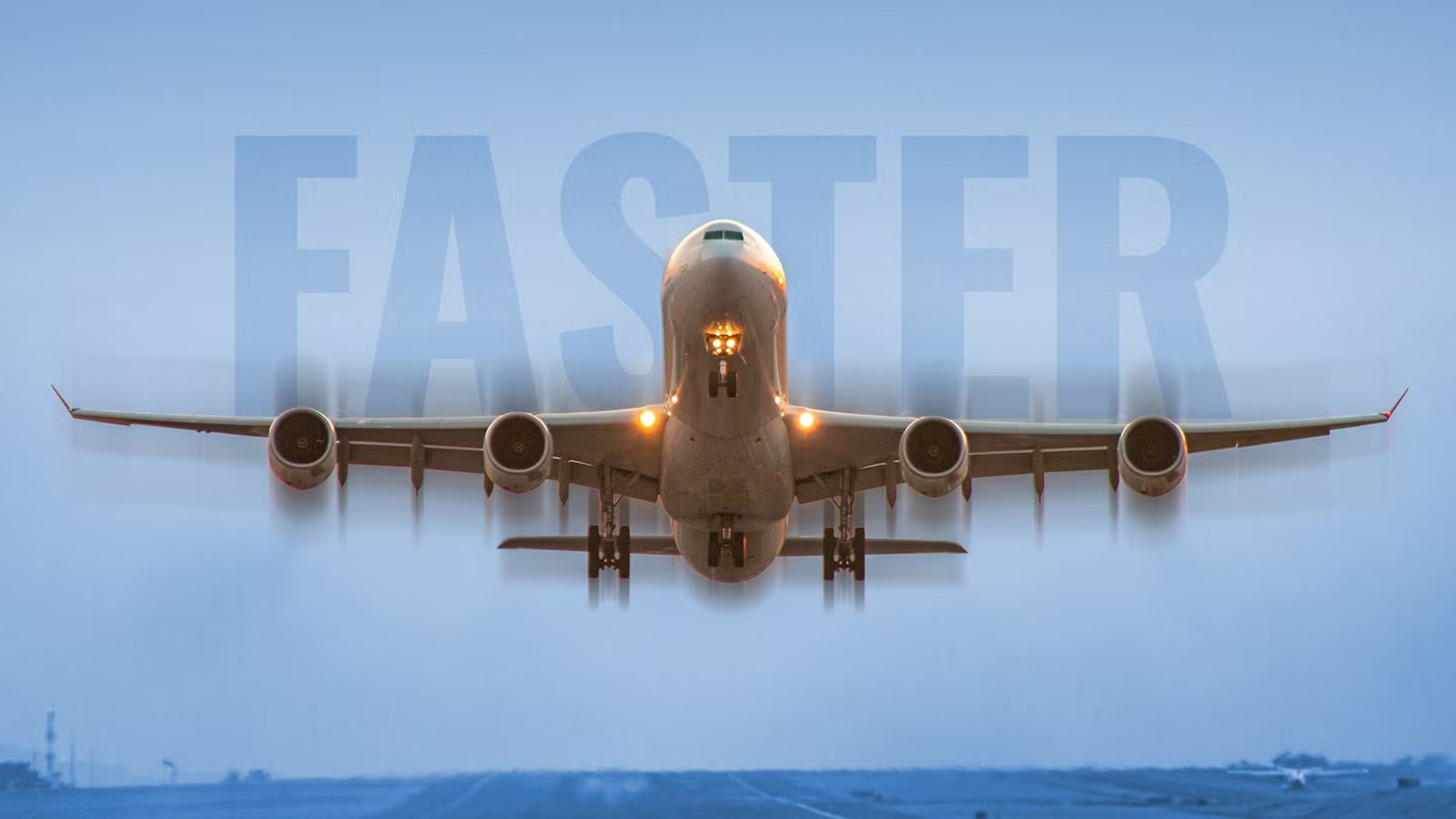
One would think that with all the advances in aircraft manufacture and technology, that aircraft would now be faster than ever before. However, perhaps surprisingly, the speed of commercial aircraft has not really changed over the last fifty years, apart from Concorde, being the standout. So why don’t planes fly faster?
Now, flight times are often longer than they were previously listed as they are not just the point-to-point flight time, but allow for delays and congestion at airports too. Aircraft can fly almost anywhere in the world within 24 hours at a fast enough speed already, without the need for speed. Aircraft need to be cost-effective for airlines and keep their operating costs low and this is possible with newer, more fuel-efficient engines.
Aircraft Have To Be Cost-Effective

The focus of travel now is cost and not speed, for both passengers and airlines, and airlines still have to make a profit at the end of the day. So, manufacturers and airlines work to bring down the cost of travel instead of the time it takes. Speed is not part of the equation. Traveling faster requires a different aircraft design and uses more fuel. If time is important for the privileged few, then private jets are an option compared to regular airlines.
Aircraft today are much more fuel-efficient than they used to be and have more range and passenger capacity. For the airlines, this means making more money. So much so, that some airlines can offer transatlantic flights for around $400 and still make a profit. Most people would rather pay less for a longer flight. More speed generally means more drag, which reduces fuel economy, so faster flights are not really a good idea for airlines.
Today, the key focus compared to aircraft of the past is fuel efficiency and the newer aircraft types are ten times more fuel efficient than they were in the 1950s, in terms of fuel used per passenger per kilometer. Aircraft are larger now with more capacity, but the advances in engine technology are a huge factor in saving the airlines’ money.
Comparing Engines

There are three basic engine types: the turboprop, the turbofan and the turbojet, and they have a range of speeds at which they are most efficient. The turboprop engine is mostly featured in regional aircraft, and they are cheaper to operate. Thrust comes from the propeller, so it is slower than other aircraft and best at a speed of 325 to 375 mph. The turbofan engine used by most commercial aircraft works most efficiently at between 400 to 620 mph. In comparison, the turbojet engine used on supersonic aircraft is efficient at between 1,300 and 1,400 mph.
The bypass ratio is the amount of air that passes through the bypass duct to the amount that passes through the engine core. The higher the bypass ratio, the more efficient the engine is. Let’s compare some engines. The General Electric GEnx engine, which is used on the Boeing 787 and the Boeing 747-8i, is super-efficient. The fan is much larger than the turbine itself and has a bypass ratio of 10:1, so it has ten times more air going around the turbine than through it.
|
Engine |
AIrcraft |
Bypass Ratio |
|---|---|---|
|
General Electric GEnx |
Boeing 787, Boeing 747-8i |
10:1 |
|
CFM International CFM56 |
Airbus 320, Boeing 737 |
5.9:1 |
|
Pratt & Whitney JT8D |
Boeing 727, Boeing 737 |
0.96: 1 |
|
Rolls-Royce Snecma Olympus 593 |
Concorde |
0:1 |
Data: Wendover Productions
In comparison, the CFM International CFM56 engine is older and less efficient and is often used on the Airbus A320 and Boeing 737. There is less fan relative to the turbine, and it has a bypass ratio of 5.9:1, which is still efficient, but not as much as the GEnx. Compared to the Pratt and Whitney JT8D, with a bypass-ratio of 0.96:1, making it inefficient, but it is more efficient than the Rolls-Royce Snecma Olympus 593, which was a turbojet engine used on Concorde. The bypass ratio is 0:1, so all the air from the fan goes through the turbine; therefore, the fuel consumption is higher than the previously mentioned engines.

Why Private Jets Are Faster Than Commercial Planes
The fastest planes in the world today are business jets.
Why Concorde Did Not Work

Concorde had the zero-bypass Rolls-Royce Snecma Olympus 593 turbojet engines, and it burned 46.85 pounds (21.25 kilograms) of fuel per mile flown. When you compare that to the Boeing 787 GEnx engine, which burns 18.7 pounds (8.5 kilograms) of fuel per mile flown, the difference is considerable. Concorde was a much smaller aircraft than the Boeing 787 and seated only 100 passengers compared to 291 on the Dreamliner. The per-person fuel economy was 14 miles per gallon compared to 104 miles per gallon on the Dreamliner.
With the fuel economy figure so high, both  British Airwayss and Air France could no longer afford to keep Concorde in the skies. It was meant to be the most efficient way to cross the Atlantic, but passengers did not want to pay for it and preferred to fly out on Concorde from the UK, during the day, and fly back at night from the US in business class on another aircraft at significantly less cost. Concorde was unique and that was its selling point, but it wasn’t economic or luxurious. It was narrow, noisy and cramped, compared to other aircraft. Concorde traveled at Mach 2.02 (1,340 miles per hour) and could cross the Atlantic in just over three hours.
Today, it would cost a minimum of $7,500 to fly from London to New York in three hours on Concorde. Back when it was still operating, it cost $12,000 for a round trip, which most people could not afford. It was rarely full of full-fare paying passengers, with people upgrading from first class and using points. First class was much more luxurious than the economy-style Concorde seating, and lie-flat beds in business class and first class were also being introduced on similar routes. November 26, 2003, saw the final flight of Concorde and the last commercial supersonic flight.
Airlines And Economics

The cost of an aircraft is relatively small compared to its operating costs. The lifespan of an aircraft is measured in cycles from each take-off to landing. Therefore, airlines will not fly an aircraft faster to use the aircraft more, instead relying on its lifespan. For example, the Dreamliner is rated for 44,000 cycles and has a list price of $224.6 million, so the cost of the aircraft per flight is around $5,000, whereas the cost of fuel from New York to London would be around $15,000. The speed of a flight is no longer important for airlines.
Airlines fly their aircraft at the most fuel-efficient speed, at between 500 and 550 miles per hour (800 to 885 kilometers per hour). So one might ask, why do aircraft not fly just below the speed of sound at Mach 1 or 767 miles per hour? Between Mach 0.8 and Mach 1.2 lies the transonic range and airflow is neither subsonic nor supersonic. After Mach 0.8, some airflow becomes supersonic, which increases drag considerably, uses more fuel, and can destabilize the aircraft. Commercial jetliners typically fly between Mach 0.78 to Mach 0.86.
Therefore, it is better to fly well above or below the speed of sound; 613.8 miles per hour (987.8 kilometers per hour) is the speed limit for commercially viable subsonic jets. Military jets can fly above the speed of sound, but supersonic flight creates shockwaves and sonic booms, which commercial aircraft are just not built for. They are designed for efficiency at subsonic speeds of around Mach 0.8-0.9. Aircraft like Concorde can be designed and built, but with increased speed, wind resistance also increases, and fuel consumption is considerably higher. For the airlines, from an economic standpoint, it is not worth traveling faster.

Boom Vs Concorde Vs Tupolev: Supersonic Passenger Jets Compared
Both blazed a supersonic trail that Boom’s Overture now aims to surpass, but how do they compare?
Aircraft Of Yesteryear In Comparison To Today

In 1957, the Boeing 707 had a cruise speed of 600 miles per hour or Mach 0.78 (966 kilometers per hour). Compare that to a 2009 Boeing 787, with a cruise speed of 650 miles per hour or Mach 0.85 (1,046 kilometers per hour). The figures are relatively similar over a gap of fifty years. Again, looking at the Boeing 707, the aircraft consumes 6,800 kilograms of fuel per hour compared to the Boeing 787, which consumes 5,000 kilograms of fuel per hour, yet carries 140 extra passengers, according to data here.
Mirage News suggests that the average cruise speed of the Dreamliner is 560 miles per hour (901 kilometers per hour). The decrease in speed between the two aircraft is not huge, but the savings in fuel costs are significant over long distances. The reduction in speed has been gradual over the decades, and flying at slower speeds is an effective way to reduce fuel consumption and save money against the rising prices of aviation fuel.
In a technologically advanced world, we might well expect aircraft to be faster than ever before. The likes of the Boeing 747 and Concorde revolutionized transatlantic and long-haul travel. In the 1970s, the oil crisis hit and fuel prices were at an all-time high. Airlines had to look for ways to reduce fuel costs and, in turn, reduce cruising speeds. Manufacturers looked for ways to make aircraft more aerodynamic and fuel-efficient at a lower speed with lower fuel costs.
Will Commercial Aircraft Fly Faster In The Future?

Although Concorde was unique and offered an unparalleled experience, it didn’t make enough money in comparison to its operating costs. Therefore, after the Air France Flight 4590 accident, both British Airways and Air France retired the aircraft. Since then, there have been talks to introduce a new supersonic aircraft by Boom Supersonic and Aerion, but so far, it has not been achieved.
Environmental concerns have also put airlines under pressure to reduce their footprint and emissions and commit to sustainability. This has also resulted in new aircraft being more fuel-efficient and less noisy. Modern aircraft can fly at a higher altitude than they used to, where there is less drag and less fuel consumption is required, and therefore are more economical to operate.
The reason why planes don’t fly faster is not down to technology, but pure economics. It is more important to have fuel-efficient aircraft, with better engines and more capacity with lower operating costs, than to fly faster. Airlines have to make money, but passenger comfort and safety are also strictly prioritized. Will we even see the likes of Concorde and supersonic travel again? Although it’s possible, priorities have changed for passengers and airlines, so only time will tell.