dailynewsnblog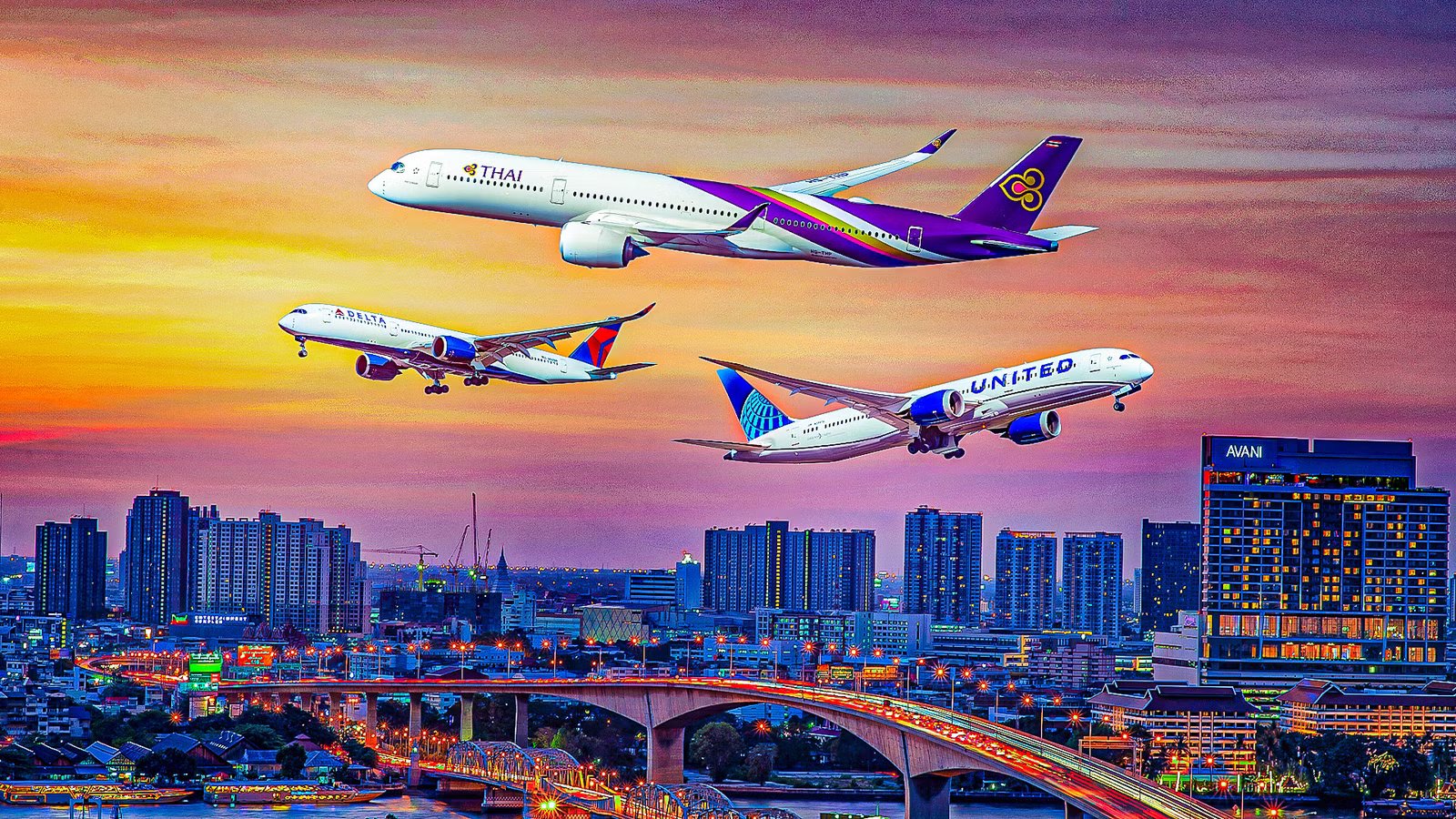
Thailand is one of the world’s most popular tourist destinations, welcoming over 35 million international visitors in 2024. The largest source markets for visitors to Thailand include China and India. Still, the country is slowly growing in popularity among US travelers looking to explore its culture, cuisine, and tropical scenery at reasonable prices.
However, there are currently no nonstop flights between the US and Thailand. In this article, we examine the reasons behind the lack of nonstop flights between the US and Thailand, explore alternative travel options, and discuss potential future nonstop services.
Thailand’s Category 2 Safety Rating

Following an audit that highlighted non-compliance with International Civil Aviation Organization safety standards in 2015, the US Federal Aviation Administration downgraded Thailand’s air safety rating to Category 2. This effectively banned Thai carriers from flying directly to the US. Last year, Thailand’s Deputy Prime Minister and Transport Minister, Suriya Jungrungreangkit, expressed confidence that the country would soon regain its Category 1 rating, and this did indeed take place in April 2025.
In April 2025,  United Airlines announced a one-stop service from its hub at Los Angeles International Airport (LAX) to Bangkok Suvarnabhumi International Airport (BKK), via Hong Kong International Airport (HKG), which launched in October 2025 with the carrier’s Boeing 787-9 aircraft. At the same time, the carrier revealed new services to Ho Chi Minh City Tan Son Nhat International Airport (SGN) and Adelaide Airport (ADL). At the time of the announcement, United Airlines’ SVP of Global Network Planning & Alliances, Patrick Quayle, said:
“At United, we’re changing the way people think about where they travel – by offering the greatest access to see and explore the world, whether it’s for relaxation, adventure or business. We offer more than the best schedule and travel options – we connect customers to sought after destinations and opportunities to explore new, vibrant cities.”
Now that Thailand’s Category 2 safety rating has been lifted, are we likely to see more and more services between the two countries being added? Non-stop services still seem a long way off – let’s take a look at some of the reasons why.
Low-Yielding Traffic & Ultra-Long-Haul Routes

One of the primary reasons for no US carriers operating nonstop flights to Thailand is that it is generally considered a low-yielding route. Other destinations in Southeast Asia, such as Singapore Changi Airport (SIN), have a significant amount of business traffic, which attracts a premium for any nonstop service. Any route to Thailand, however, would be mostly for leisure traffic and those visiting friends and relatives, both of which tend to be price-sensitive markets where guests are happy to save money by taking a longer, one-stop routing.
Using Los Angeles as an example, which is home to the largest Thai diaspora in the US, the distance between  Los Angeles International Airport (LAX) and Bangkok Suvarnabhumi International Airport (BKK) is 8,269 miles, putting the route firmly in the ultra-long-haul category. It is challenging for airlines to make a profit on ultra-long-haul flights, as fuel and staffing costs are high, and the aircraft is away from base for an extended period.
Ultra-long-haul services are generally only viable between major business hubs, which provide an ample supply of high-paying premium passengers. A famous examples of an ultra-long-haul route that works well is Singapore Airlines’ Airbus A350-900ULR service between  Singapore Changi Airport (SIN) and John F. Kennedy International Airport (JFK). Qantas’ also operates nonstop flights between Perth Airport (PER) and London Heathrow Airport (LHR), which are operated by the Boeing 787-9.
To combat the length of the route, services would need to attract more premium traffic. This may change in the future as Thailand’s popularity grows with US travelers seeking luxury leisure experiences, and the country has also gained greater exposure to a US audience thanks to TV series such as The White Lotus.

Up To 18-Hour Nonstop Flights: United Airlines’ 10 New Ultra-Long Routes In 2026
United is taking ultra-long-haul flying to new heights with its latest route plans. But which ten routes make the cut?
Previous Flights Between the US & Thailand

From its hub at Bangkok Suvarnabhumi International Airport (BKK), Thai Airways used to operate direct flights to both Los Angeles International Airport (LAX) and New York John F. Kennedy International Airport (JFK). These routes were operated by the carrier’s Airbus A340-500s, which offered extra legroom to all passengers, making the 18-hour journey surprisingly comfortable. However, the Airbus A340 was not the most fuel-efficient aircraft, and the carrier reportedly made a loss on every flight.
As such, Thai Airways ended its route to New York John F. Kennedy International Airport (JFK) in 2008, and in 2012, its route to and from Los Angeles International Airport (LAX) was rerouted to operate via Seoul Incheon International Airport (ICN). The route was subsequently canceled altogether in 2015. That said, Thai Airways today operates several much more fuel-efficient aircraft, such as the Airbus A350 and  Boeing 787, which would theoretically make such non-stop routes more viable.
|
Thai Airways Fleet (Per ch-aviation) |
||
|---|---|---|
|
Aircraft |
Number in Fleet |
Maximum Passenger Capacity |
|
Airbus A320 |
20 |
156 |
|
Airbus A321neo |
1 |
175 |
|
Airbus A330-300 |
6 |
294 |
|
Airbus A350-900 |
23 |
339 |
|
Boeing 777-200ER |
5 |
292 |
|
Boeing 777-300ER |
17 |
348 |
|
Boeing 787-8 |
6 |
264 |
|
Boeing 787-9 |
4 |
298 |
Thai Airways’ fleet is set to grow further over the coming years, with the carrier expecting to take delivery of more Airbus A321neos, Boeing 787-9s, and 787-10s over the coming years. The 787-9 would be a suitable aircraft to operate direct flights to the US, as would its existing Airbus A350-900s.
North America To Thailand

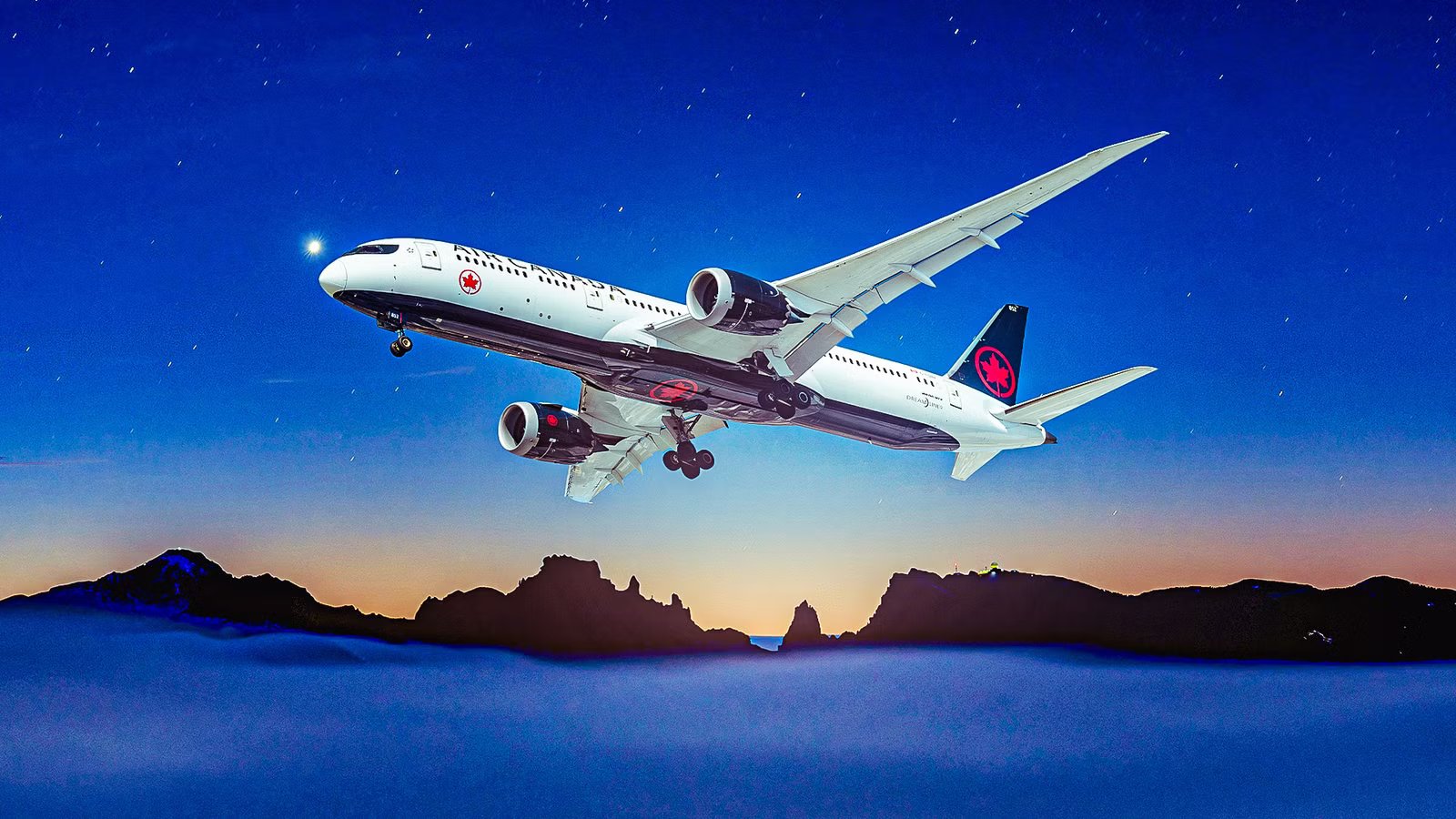
The only carrier currently offering a nonstop service between North America and Thailand is  Air Canada, with three summer flights per week between its transpacific hub at Vancouver International Airport (YVR) and Bangkok Suvarnabhumi International Airport (BKK). This service increases to five times per week during the peak winter season, and is operated by the carrier’s Boeing 787-9. The Canadian flag carrier currently operates a total of 32 787-8s, with the seating configuration detailed in the table below.
|
Business Class |
Premium Economy |
Economy Class |
Total |
|---|---|---|---|
|
30 |
21 |
247 |
298 |
Air Canada’s nonstop service from Vancouver, launched in December 2022, is still operational, indicating it is financially successful for the airline. One reason for this is likely the significantly shorter distance between Vancouver and Bangkok compared to Los Angeles, at 7,344 miles (almost 1,000 miles shorter).
There is also less competition on services to Southeast Asia as Singapore Airlines does not currently serve Vancouver International Airport (YVR). Indeed, it stopped serving the route in October 2023 in response to falling demand and financial difficulties.
Plenty Of One-Stop Options

As well as United Airlines’ upcoming flights between Los Angeles International Airport (LAX) and Bangkok Suvarnabhumi International Airport (BKK) via  Hong Kong International Airport (HKG), there are plenty of other one-stop options available for passengers looking to fly to Thailand. These range from full-service, premium carriers to low-cost, long-haul airlines.
Passengers can travel on numerous daily services via major East Asian hubs such as Tokyo Narita Airport (NRT) and Seoul Incheon International Airport (ICN) on the likes of All Nippon Airways, Japan Airlines, Korean Air, and Asiana Airlines. Philippine Airlines also offers competitive fares via its hub at Manila Ninoy Aquino International Airport (MNL), picking up the more price-sensitive end of the market.
When it comes to more premium services, Cathay Pacific, Singapore Airlines, and EVA Air all offer extensive links between the US and Thailand via their respective hubs. These are Hong Kong International Airport (HKG), Singapore Changi Airport (SIN), and Taipei Taoyuan International Airport (TPE).
Going the other way,  Emirates, Qatar Airways, and Etihad Airways all offer extensive services to Thailand via their respective hubs at Dubai International Airport (DXB), Doha Hamad International Airport (DOH), and Abu Dhabi International Airport (AUH). Meanwhile, most major European carriers also serve Bangkok Suvarnabhumi International Airport (BKK), as well as the low-cost, long-haul carrier Norse Atlantic Airways, which launched services to the Thai capital from London Gatwick (LGW) and Manchester (MAN) in 2025.

United Airlines Begins These 2 Very Long 1-Stop Boeing 787 Flights In 2 Weeks
It will return to two Asian cities after many years.
Will Nonstop Flights On A US Carrier Ever Materialize?

The most likely candidate for any nonstop services between the US and Thailand in the near future would be United Airlines. The carrier is a member of  Star Alliance, just like Thai Airways, meaning that it could offer plenty of onward connections throughout Thailand and the Southeast Asia region, operated by the Thai flag carrier.
If United Airlines were to launch direct flights to Thailand, they would likely originate from one of the carrier’s two major West Coast Hubs – Los Angeles International Airport (LAX) and San Francisco International Airport (SFO). Both would be viable options – Los Angeles is home to the largest Thai community in the US. At the same time, San Francisco is home to the bulk of the carrier’s transpacific services, and offers a wide variety of connections to and from destinations throughout the US.