dailynewsnblog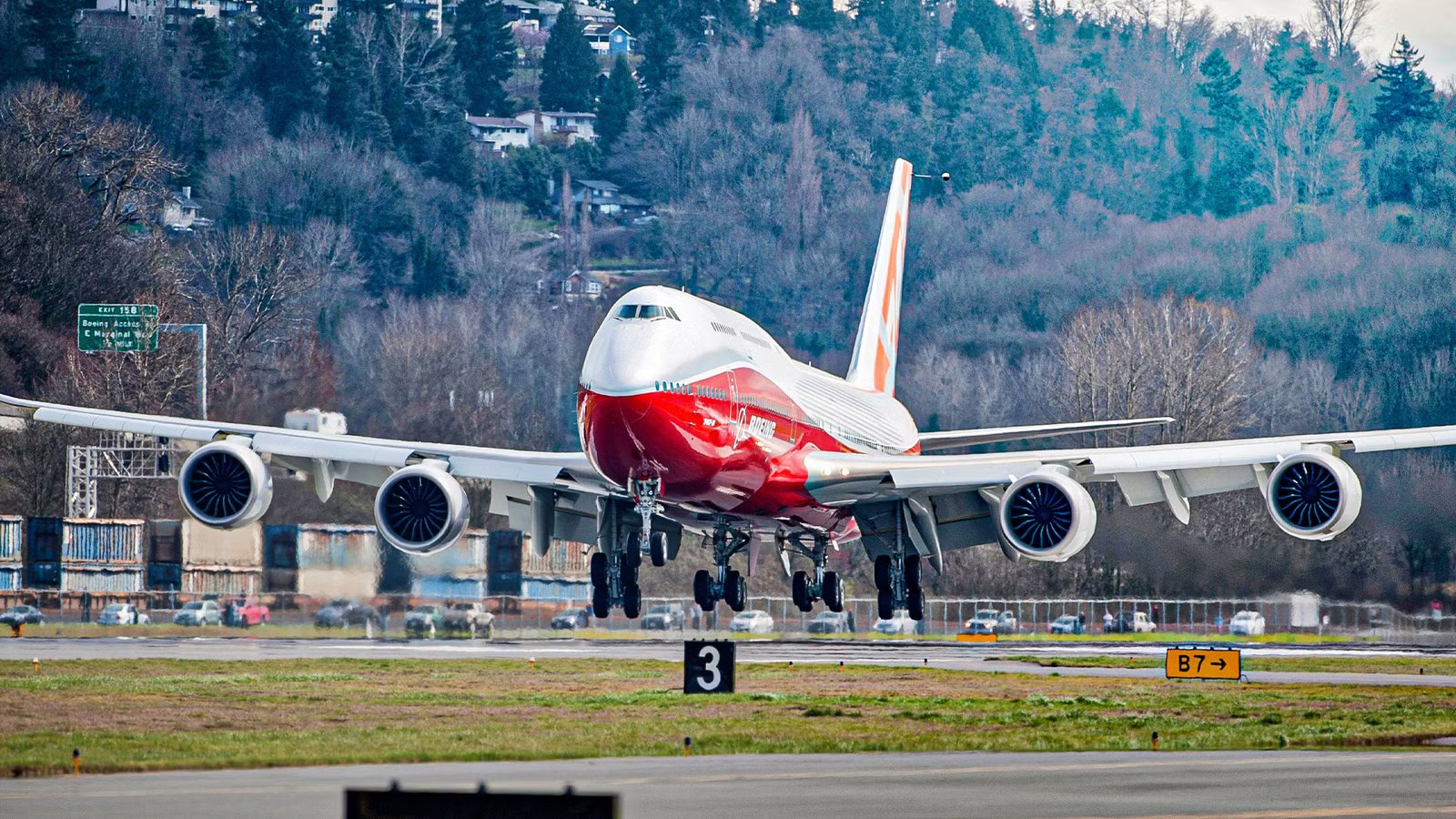
The Boeing 747-8 is the largest, newest, and most aerodynamically advanced 747. The aircraft has a wingspan stretching 224 feet 7 inches (68.4 m) and features redesigned airfoils and raked wingtips that reduce induced drag and improve fuel efficiency by up to 16% compared with the 747-400. Drawing on Boeing’s data, the 747-8 can carry 467 passengers in a typical three-class layout while maintaining Code F airport compatibility, enabling operation at major international hubs including Frankfurt Airport (FRA), Hong Kong International Airport (HKG), and Dubai International Airport (DXB).
This analysis compares the 747-8’s wing design, structural efficiency, and operational impact with those of the Boeing 747-400. By examining raked wingtips, span extensions, and improved lift distribution, we explain why Boeing opted for integrated aerodynamic solutions over traditional vertical winglets. For airlines worldwide, these improvements translate into longer nonstop routes, lower fuel burn per passenger or per mass of cargo, and greater flexibility for both passenger and cargo operations across intercontinental networks.
What Winglets Are Designed To Do

Winglets are vertical or canted extensions added to the ends of wings to reduce induced drag, an unavoidable byproduct of generating lift. Put simply, as a wing moves through the air, it creates a pressure difference; low pressure above and high pressure below. Air naturally tries to equalize this difference by flowing around the wingtip from high to low pressure, forming swirling currents called wingtip vortices. These vortices represent energy loss and tilt the lift vector slightly backward, so some of the lift is effectively turned into drag.
Winglets work by disrupting and reshaping this airflow. They act as a barrier that weakens the formation of vortices and smooths how air transitions off the wingtip. By reducing the strength of these vortices, winglets allow more of the aerodynamic force to act upward rather than backward, improving the aircraft’s lift-to-drag ratio. This leads to greater aerodynamic efficiency, particularly during cruise, where even small reductions in drag can have a meaningful impact over long distances and long flight times.
In practical terms, this improved efficiency results in lower fuel consumption, increased range, and in some cases better climb performance. However, winglets come with trade-offs: they add weight, increase structural stress at the wingtip, and can introduce additional parasite drag (the resistance an aircraft experiences as it moves through the air) at higher speeds. Because of these factors, their overall effectiveness depends on the aircraft’s design, intended mission, and operating conditions, making them one of several possible solutions rather than a universal fix.
Winglets As A Design Compromise

From an aerodynamic standpoint, one of the most efficient ways to reduce induced drag is to increase the aspect ratio of the wing. A longer wing, or a wing with a higher aspect ratio (span relative to chord), distributes lift more evenly across its span, which reduces the pressure difference at the tips and weakens the formation of wingtip vortices at their source. Gliders are a prime example of this principle: their long, slender wings minimize induced drag, allowing them to maintain lift with very low energy loss.
In practice, however, aircraft design is heavily constrained by real-world operational limits. Airports are built around standardized gate sizes, taxiway clearances, and runway spacing, all of which impose strict limits on how large an aircraft’s wingspan can be. If an aircraft exceeds these limits, it may not be able to access many airports, which significantly reduces its flexibility and commercial value. This is why aircraft are designed to fit within specific airport classification systems, balancing aerodynamic efficiency with infrastructure compatibility. For example, the Boeing 777X uses folding wingtips, allowing it to have a very high-aspect-ratio wing for aerodynamic efficiency in flight while folding the tips on the ground to fit existing airport infrastructure.
Winglets emerged as a clever engineering compromise within these constraints. Instead of extending the wing outward, they redirect airflow upward, partially replicating the aerodynamic benefits of a longer wing without increasing the actual span. This makes them particularly valuable for retrofitting older aircraft or for designs that must remain within strict size limits. In that sense, winglets are not just an aerodynamic feature; they are a solution shaped equally by engineering physics and the practical realities of global airport infrastructure.

Are Split Scimitar Winglets Really That Efficient?
How can split scimitar winglets help airlines and aircraft manufacturers achieve their ambitious sustainability goals?
The Boeing 747-8’s Larger Wing Design

The Boeing 747-8 represents a significant aerodynamic redesign compared to earlier Boeing 747 variants. One of the most important changes is its all-new wing, which is not just a refinement of the older design but a fundamentally updated structure. It features a greater wingspan, redesigned airfoil profiles for better lift distribution, and the use of more advanced materials to improve strength and efficiency while managing weight.
The wingspan of the 747-8 was increased enough to move it into the Code F airport category, the same classification used by the largest commercial aircraft. This shift gave Boeing engineers far more flexibility, allowing them to prioritize aerodynamic performance rather than being tightly constrained by legacy airport compatibility limits. Earlier 747 models had to balance efficiency improvements against stricter size restrictions, which limited how far their wing designs could evolve.
|
Feature |
747-400 |
747-8 |
|---|---|---|
|
Wingspan |
211 feet 5 inches (64.4 m) |
224 feet 7 inches (68.4 m) |
|
Wing Design |
Updated legacy wing |
Completely redesigned wing |
|
Wingtip Device |
Winglets |
Raked wingtips |
|
Airport Compatibility |
Code E |
Code F |
|
Aerodynamic Efficiency |
Improved (for its era) |
Significantly optimized |
Because the wing is both longer and more aerodynamically refined, it naturally produces less induced drag without relying on vertical winglets. Instead of adding devices to fix inefficiencies, the 747-8’s design minimizes those inefficiencies from the start. This results in a cleaner, more integrated aerodynamic solution that better suits the aircraft’s long-haul, high-efficiency mission profile.
Raked Wingtips Instead Of Winglets

Rather than using vertical winglets, the Boeing 747-8 employs raked wingtips, long, tapered extensions that sweep backward from the main wing. These tips effectively increase the wingspan while preserving a smooth, continuous aerodynamic surface. Instead of adding a distinct vertical structure, the wing itself is extended and refined, making the design more integrated and aerodynamically clean.
Raked wingtips reduce induced drag by allowing airflow to leave the wing more gradually, which weakens the formation and intensity of wingtip vortices. Because they extend the wing horizontally rather than redirect airflow upward, they more closely replicate the ideal aerodynamic solution: a longer, more efficient wing. This makes them particularly effective for large aircraft operating over long distances.
They are especially effective at high subsonic cruise speeds, where long-haul aircraft spend most of their flight time. Additionally, raked tips avoid the abrupt geometric transition of a vertical winglet, resulting in smoother airflow and reduced interference drag. This combination of aerodynamic efficiency and structural elegance is why raked wingtips are widely used on modern widebody aircraft designed for long-range performance.

Why Did Boeing Build The 777 Without Winglets?
We unravel the secrets of the 777’s wingtips.
Performance, Structural, And Efficiency Trade-offs

When comparing winglets and raked wingtips, the differences extend well beyond simple drag reduction. While winglets can be very effective at reducing induced drag, they act as vertical extensions at the wingtip, creating a lever effect that increases bending moments at the wing root. This additional stress requires structural reinforcement, which adds both weight and complexity to the wing. For aircraft designers, this trade-off must be carefully balanced against the efficiency benefits.
Raked wingtips, by contrast, distribute aerodynamic loads more smoothly along the wing because they extend backward and horizontally rather than purely vertically. This horizontal orientation reduces the lever effect and the associated structural stress, allowing the wing to achieve aerodynamic gains with less added weight. In practical terms, this can make a significant difference on very large aircraft, where even small structural savings translate into improved efficiency and payload capability.
There is also a speed-related consideration. At higher cruise speeds, vertical surfaces like winglets can generate additional parasite drag, reducing some of the efficiency gains achieved from induced drag reduction. Raked wingtips tend to perform better under these conditions, making them particularly well-suited for large, fast, long-haul aircraft like the 747-8. The result is a wing design optimized not only for efficiency, but for efficiency in the specific flight regime the aircraft is designed to operate in.
Why Earlier 747 Models Used Winglets

The Boeing 747-400, introduced decades earlier, incorporated winglets because its wing design and operational constraints limited options for reducing drag. The 747-400’s wings were based on an older design that could not be easily extended without significant structural redesign. Additionally, airport compatibility requirements at the time imposed stricter limits on wingspan, so any major extension could have restricted the aircraft from operating at many key airports around the world.
Winglets offered a practical, cost-effective solution. By redirecting airflow and reducing wingtip vortices, they improved fuel efficiency without requiring a complete redesign of the wing. During an era when fuel costs were rising sharply, even modest efficiency gains could translate into substantial operational savings for airlines. Winglets allowed the 747-400 to achieve these benefits while maintaining its existing footprint and performance characteristics.
The transition from the 747-400 to the Boeing 747-8 reflects a broader evolution in aerospace engineering: moving from add-on efficiency solutions to fully integrated aerodynamic optimization. Advances in computer modeling, new materials, and flexible airport infrastructure enabled Boeing to design wings that inherently minimize drag, reducing the need for retrofitted features such as traditional winglets. This evolution highlights how aircraft design has become more holistic, optimizing efficiency at the source rather than correcting it after the fact.