dailynewsnblog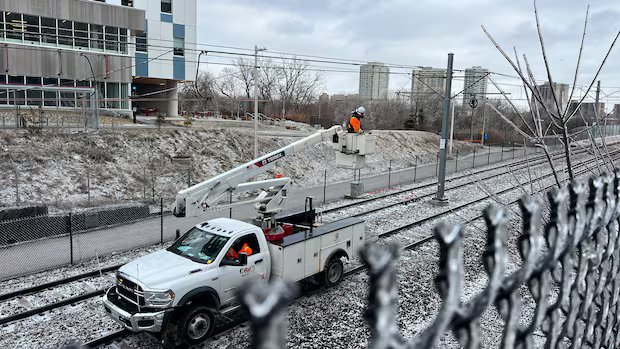
Ottawa’s LRT is again falling victim to blazing hot electric flashes that are snapping wires and sparking flashbacks to years of train shutdowns.
OC Transpo has blamed freezing rain. But it’s left transit officials wondering why fixes that worked for years, through storm after storm, suddenly failed three times last week.
Here’s what we know about the problem and what OC Transpo is planning to do about it.
What’s breaking the wires?
The LRT’s overhead catenary system (OCS) uses hanging wires to feed electric current that powers the trains, and those wires are breaking.
On Wednesday, just before spotting the first break, OC Transpo staff noticed “arcing” on trains between Hurdman and Lees stations — a phenomenon that a bystander captured on camera.

Jana Mghabghab was walking on the path next to the train line near Lees Station at around 1 p.m. when she filmed some sparking above a stopped train.
The video shows sparks flying from the area around a train’s pantograph, the arm mounted on its roof that’s supposed to connect to the wire.
What is arcing?
It’s a surge of electric current suddenly jumping through the air from one conductive surface to another.
On an electric train, that can happen when the pantograph loses contact with the wire, leaving a gap for the current to leap across.
Mohamed Youssef, a professor of electrical engineering at Ontario Tech University who previously worked in the rail industry, said the principle is a lot like lightning. The wire is the cloud, and the train’s pantograph is the ground.
“The current will go from the higher voltage surface to the lower voltage surface through the air … or through the ice,” he said.
“All of this energy is discharged in no time.”
The resultant flash can drive temperatures up to thousands of degrees Celsius, turning the air into a welding torch, which relies on the same principle.
It’s hot enough to melt metal: in this case, the overhead catenary wire.
Why is this happening now?
OC Transpo’s interim general manager, Troy Charter, said it’s the ice, as it can create an uneven surface that makes arcing more likely.
“When you have ice build up, the pantograph is bouncing off the wire and it creates that gap,” he said.
Is that what happened on Friday too?
Yes. Charter said “extreme arcing” caused two failures on Friday.
There was a broken wire near Blair Station and another issue near Tremblay Station that left a sagging wire. Charter described it as a deformation known as “burr.”
But how could it happen two days after the rain?

“What’s possible is that, although they did ice removal across the line, there might have been some residual ice up on the top part of the OCS that subsequently melted and then created an issue,” Charter said. “But all this is subject to the ongoing investigation.”
Has this ever happened before?
Electrical issues have shut down the LRT on numerous occasions, going all the way back to 2019, when arc flashes shut down trains on New Year’s Eve.
Broken wires stopped the trains in February and December 2022, while a lightning strike brought down the wires in July of that year.
Then, in January 2023, an ice storm triggered a series of failures that knocked the system out of commission for days.
OC Transpo also blamed ice accumulation and arcing in that case, saying that it released “a huge amount of energy” and melted the wire.
On Thursday, Charter told city councillors that what happened on Wednesday was “very similar to what happened in 2023.”
How similar?
It’s not just the arcing, or the ice buildup. It’s the location.
The 2023 breakdown centred on a stretch of track between Lees and Hurdman stations, where the ice was especially heavy.
At the time, officials mentioned a “microclimate” along the Rideau River, where the open water leads to greater humidity and makes it easier for heavy ice to build up on the wires.
Coun. Riley Brockington, who sits on council’s transit committee, speculated on Thursday that the same factor might be playing a role in the issue near Lees Station this time around.
“It’s a unique area compared to other points on the line,” he said.
So why hasn’t OC Transpo fixed it?
Charter and his team said OC Transpo did take action, like running trains more frequently to free ice before it has a chance to build up. There’s even a special vehicle with a rough carbon strip to scrape ice off the wires.
After the January 2023 outage, Rideau Transit Maintenance started treating the wires with glycol, a chemical related to alcohol that’s used in antifreeze.
Charter said they apply the glycol about once every two weeks or so, depending on conditions. But the most recent treatment came just a few days before Wednesday’s outage, leaving him stumped about what went wrong.

With the glycol coating, he said the system has been able to operate reliably through freezing rain several times since 2023.
“Obviously, something changed,” he said. “That is the question: why didn’t it function this time?
Are there any other solutions in the works?
OC Transpo has been looking at a “heat tracing” system, which Charter described as a heated wire that would run just above the catenary wire to keep it warm.
He said it could prevent ice from forming and “build resiliency in the system.” He said it would be expensive, but climate change might make it a better investment.
“We’re seeing more and more freezing-rain-type events, so it’s something that we want to look at doing,” Charter said.
Marko Kroenke, director of engineering services, said OC Transpo has finished a technical feasibility study and is now negotiating with a supplier before possibly moving ahead.