

 dailynewsnblog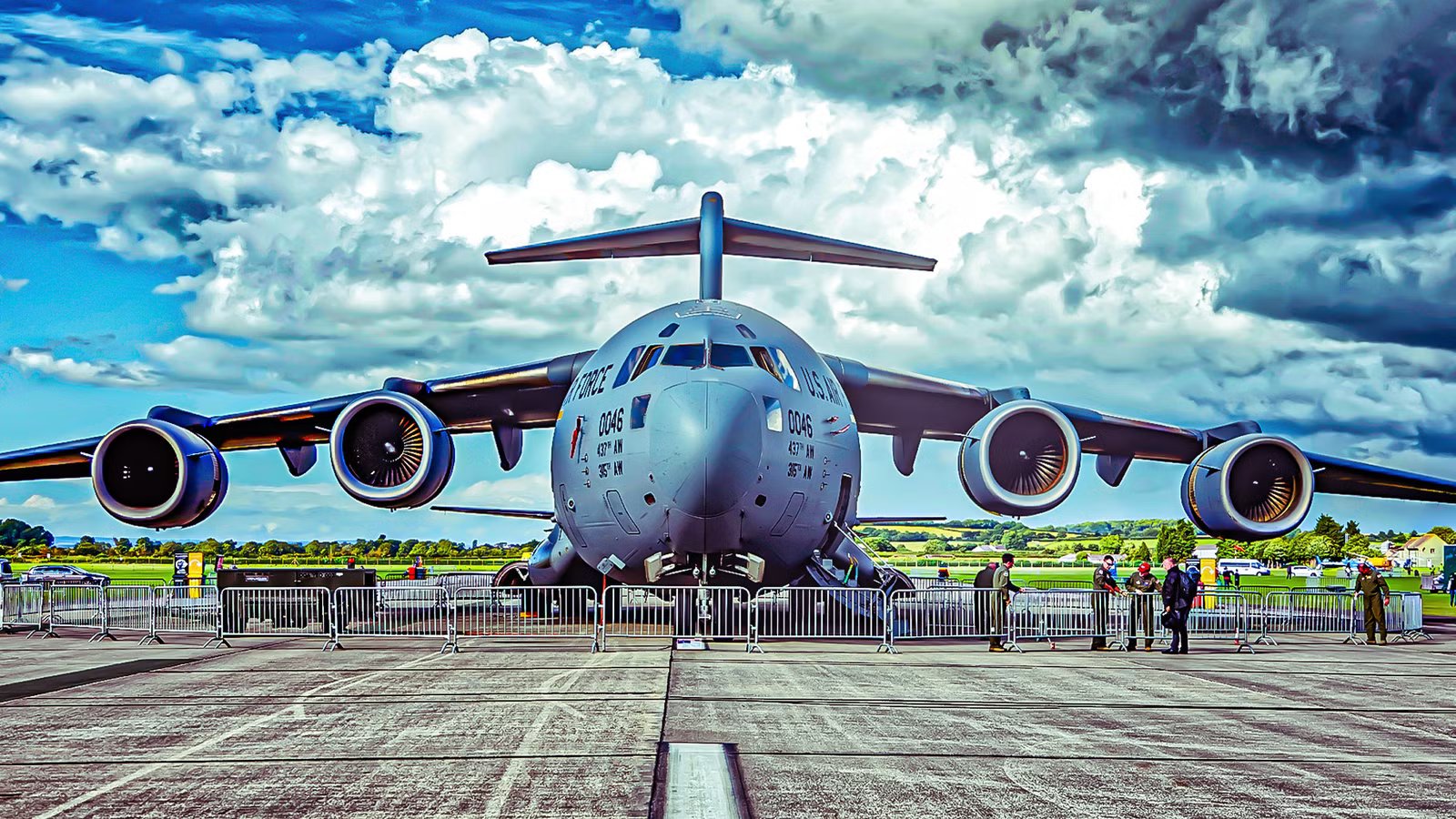
Why did McDonnell Douglas design the C-17 Globemaster III with four engines instead of two or three? This question goes beyond a simple engineering choice: rather, it touches on the aircraft’s mission profile, operational demands, and the strategic needs of the USAF. The C-17 is one of the most versatile and capable military transport aircraft in history, and its four-engine configuration is central to its performance. Understanding why this decision was made reveals much about military aviation priorities in the late 20th century.
The C-17 was developed in the 1980s and 1990s to replace the aging C-141 Starlifter and supplement the massive C-5 Galaxy. It needed to combine strategic range with tactical flexibility, flying intercontinental missions and landing on short, austere runways. This article will explore the technical, operational, and strategic reasons behind the four-engine choice, compare it to alternative configurations, and examine what experts have said about its design.
Why Does The C-17 Have Four Engines Instead Of Two?

The simple reason McDonnell Douglas gave the C-17 Globemaster III four engines is that the mission demanded it. The US Air Force wanted an aircraft that could haul enormous loads, up to 170,900 pounds (77,519 kg), yet still operate from runways as short as 3,500 feet, sometimes unpaved or damaged. Four Pratt & Whitney F117-PW-100 turbofans, each producing about 40,440 pounds of thrust, provided the muscle to make that possible.
There was also a question of survival. In combat zones or remote regions, an airlifter can’t always count on long, well-equipped runways or quick mechanical support. Losing an engine shouldn’t mean losing the mission. With four engines, the C-17 can keep flying on three, giving crews the confidence to push into high-risk areas and still bring people and equipment home safely. This wasn’t a break from tradition but a continuation of it.
The C-141 Starlifter and the older C-124 Globemaster II both relied on four engines. For decades, US heavy transports demonstrated that four engines struck the best balance between power, redundancy, and flexibility. What the C-17 did was pair that tried-and-true approach with modern high-bypass turbofan technology, producing an aircraft equally at home on a transatlantic strategic mission or dropping paratroopers onto a rough strip just behind the front line.
What Factors Led To The Four-Engine Design Of The C-17?

The decision to fit the C-17 Globemaster III with four engines came out of a blend of hard requirements from the US Air Force and the technological realities of the 1980s. To understand why four was the magic number, it helps to look at the main factors that shaped the design. The most obvious driver was weight. The C-17 was built to carry just about anything in the US Army’s inventory. That includes not only pallets of supplies and troops but also massive vehicles like the M1 Abrams tank.
To move that kind of load off the ground in less than 4,000 feet (1,219 m) of runway, you need serious thrust. Four Pratt & Whitney F117-PW-100 engines, gave the aircraft both the acceleration for short takeoffs and the climb performance to clear obstacles once airborne. Furthermore, heavy airlifters rarely operate in ideal conditions. They’re asked to fly into conflict zones, over remote terrain, and into bases where the nearest maintenance hangar could be hundreds of miles away.
In those situations, an engine failure cannot mean the end of the mission. With four engines, the C-17 retains three-quarters of its power even after losing one, which is enough to continue flying safely. In contrast, a two-engine design would lose half its thrust instantly, an unacceptable risk in combat or over rugged terrain. The Air Force also wanted the C-17 to be a ‘bridge’ aircraft, capable of strategic missions across oceans and tactical missions into improvised airstrips.
|
Requirement |
Why It Matters |
Four-Engine Advantage |
|---|---|---|
|
Heavy Payload |
Carry tanks, vehicles, troops |
More total thrust |
|
STOL |
Operate from 3,500 ft runways |
High thrust-to-weight ratio |
|
Range |
Intercontinental missions |
Efficient cruise with heavy loads |
|
Redundancy |
Engine-out safety |
Can continue the mission with three engines |
|
Versatility |
Strategic and tactical roles |
Balanced performance |
That meant combining the endurance of a big jet like the C-5 with the agility of the smaller C-130. Four engines gave designers the flexibility to balance these competing needs. The aircraft could haul enormous loads intercontinentally, yet still drop into a 3,500-foot (1,067 m) strip in the middle of Afghanistan or South Sudan and get back out again. It’s also important to remember what engine technology looked like in the 1980s.
Indeed, the giant, ultra-high-thrust turbofans we see today on the Boeing 777 or 787 weren’t mature enough then, especially for military use. At the time, no pair of engines could have delivered the same combination of thrust, reliability, and fuel efficiency as four mid-sized turbofans. The four-engine layout wasn’t just preferred: it was the only viable option to meet the Air Force’s requirements.
These design choices weren’t theoretical. In Afghanistan, for instance, C-17s regularly operated from dusty, high-altitude airstrips surrounded by mountains. The thin air in ‘hot and high’ conditions reduces lift and engine efficiency, but four engines gave the C-17 enough reserve power to take off safely with heavy loads. Pilots often speak of that extra margin as the difference between an aircraft that can complete its mission and one that would be forced to leave cargo and troops behind.
How Did The YC-15 Prototype Shape The C-17’s Engine Layout?

The C-17 was heavily influenced by McDonnell Douglas’s earlier YC‑15 prototype from the 1970s, which emerged from the US Air Force’s Advanced Medium STOL Transport program. The Air Force was particularly impressed with the YC-15’s capabilities, and the jet featured four engines, externally-blown flaps, and a supercritical wing enabled exceptional short-takeoff/landing performance and payload capacity.
Although the AMST program was canceled, the YC‑15 proved that a four‑engine STOL jet could deliver both tactical agility and strategic reach. When the USAF later issued requirements for what became the C‑17, they wanted an aircraft that could carry a main battle tank or over 100 troops directly to forward, unimproved runways, capabilities the YC‑15 had hinted at but on a smaller scale. McDonnell Douglas’s proposal for the later C-X program, an enlarged, refined evolution of the YC-15, effectively upscaled and modernized the design.
|
YC‑15 Feature |
Influence on C‑17 |
Engine Relevance |
|---|---|---|
|
Four-engine layout |
Retained for thrust & redundancy |
Ensured STOL with heavy loads |
|
Externally blown flaps |
Refined for better lift |
Allowed slower approach speeds |
|
Supercritical wing |
Adopted for efficiency |
Reduced drag at cruise |
|
STOL focus |
Expanded to heavier payloads |
Required more total thrust |
The organization leaned on proven technologies (like four turbofans and STOL-enhancing aerodynamics) to reduce risk while meeting ambitious heavy-lift and runway requirements. By scaling up the YC‑15’s proven concepts, McDonnell Douglas ensured the C‑17 could meet both strategic and tactical demands. The four‑engine choice was a direct continuation of this design lineage, balancing the need for raw power with the flexibility to operate almost anywhere.
How Does The C-17 Compare To Other Options Or Design Philosophies?

While the twin-engine designs that dominate the airline industry are generally more fuel-efficient and cheaper to maintain, they come with trade-offs for military transport roles. Two engines would require each to produce significantly more thrust, increasing stress and potentially reducing lifespan. More importantly, losing one engine on a twin-engine heavy transport would mean losing 50% of thrust, potentially catastrophic during short-field operations.
By contrast, four engines allow the C-17 to maintain high thrust-to-weight ratios, better distribute load, and ensure safer engine-out performance. The Airbus A400M, for example, uses four turboprop engines. This makes it very efficient at medium-lift missions and gives it excellent performance at low speeds, but it can’t match the C-17’s maximum payload or intercontinental reach.
At the other end of the spectrum, the KC-46 Pegasus tanker uses just two large turbofans, similar to its commercial cousin, the Boeing 767. That setup works for refueling and long-range logistics flights between established airfields, but it isn’t built for tactical, short-field operations. This is where the Embraer C-390 Millennium provides an interesting comparison. Unlike the C-17, it is powered by just two IAE V2500 turbofans, the same type used on the commercial Airbus A320.
The C-390 is more of a medium airlifter, with a payload of about 52,000 pounds (roughly one-third of the C-17). It’s faster than the C-130 Hercules and more efficient than a four-engine jet, making it attractive to air forces that don’t need the enormous lifting power of a C-17. However, the trade-off is clear: the C-390 can’t haul a main battle tank, nor can it operate with the same redundancy in hostile environments. Its two engines are sufficient for regional missions but wouldn’t give commanders the same confidence for global heavy-lift operations.
What Are The Drawbacks Of The C-17’s Four-Engine Design?
![3144811 - C-17 Lands at McMurdo Station [Image 1 of 2]](https://static0.simpleflyingimages.com/wordpress/wp-content/uploads/2024/12/3144811.jpg?q=49&fit=crop&w=500&dpr=2)
Of course, four engines come with trade-offs. They increase fuel consumption, maintenance complexity, and acquisition costs. In peacetime, when budgets are tight, these factors can be contentious. More engines mean more inspections, more spare parts to keep in inventory, and more work hours on the flight line.
They also burn more fuel than a comparable twin, making the C-17 more expensive to operate than commercial freighters. By the 2000s, twin-engine aircraft like the Boeing 777 proved that two massive engines could power an intercontinental heavy jet efficiently, but those technologies weren’t ready when the C-17 was designed.
For decision-makers, the lesson is clear: four engines bring unmatched capability, but at a price. Nations considering strategic airlift need to weigh up not just whether they want the ability to land a tank on a dirt strip halfway around the world, but whether they can afford the lifetime costs of maintaining such a fleet. For most, the answer is no, which is why only a handful of US allies operate the C-17. For the US Air Force, however, the trade-offs were considered worth it.
The Bottom Line

In short, the C-17’s four-engine design was the only configuration that could reconcile the competing demands of heavy payload, short-field performance, long-range reach, and safety through redundancy within the technological limits of the 1980s and early ’90s. Its lineage from the YC-15 anchored the design in proven aerodynamic and propulsion concepts, as the earlier prototype showed that a four-engine STOL jet could deliver on agility and lift, and scaling that idea up into the C-17 made both logical and technical sense.
Other layouts were considered, but none matched the unique balance of capabilities the Air Force required. Twin-engine designs promised efficiency, yet fell short on redundancy and thrust margins. Turboprop solutions offered economy, but couldn’t match the C-17’s global reach or heavy-lift performance. The Globemaster III’s success wasn’t about novelty: it was about creating an aircraft that could reliably fulfill a complex mission set.
Looking ahead, new generations of ultra-high-thrust engines may one day tip the scales back toward twin-engine heavy lifters. For now, though, the C-17 remains almost irreplaceable. For aviation and defense readers, the lesson is clear: design decisions, especially around engine count, must align with operational realities and technological maturity. The C-17’s enduring legacy underscores that when precision meets purpose, powerful solutions follow.


