dailynewsnblog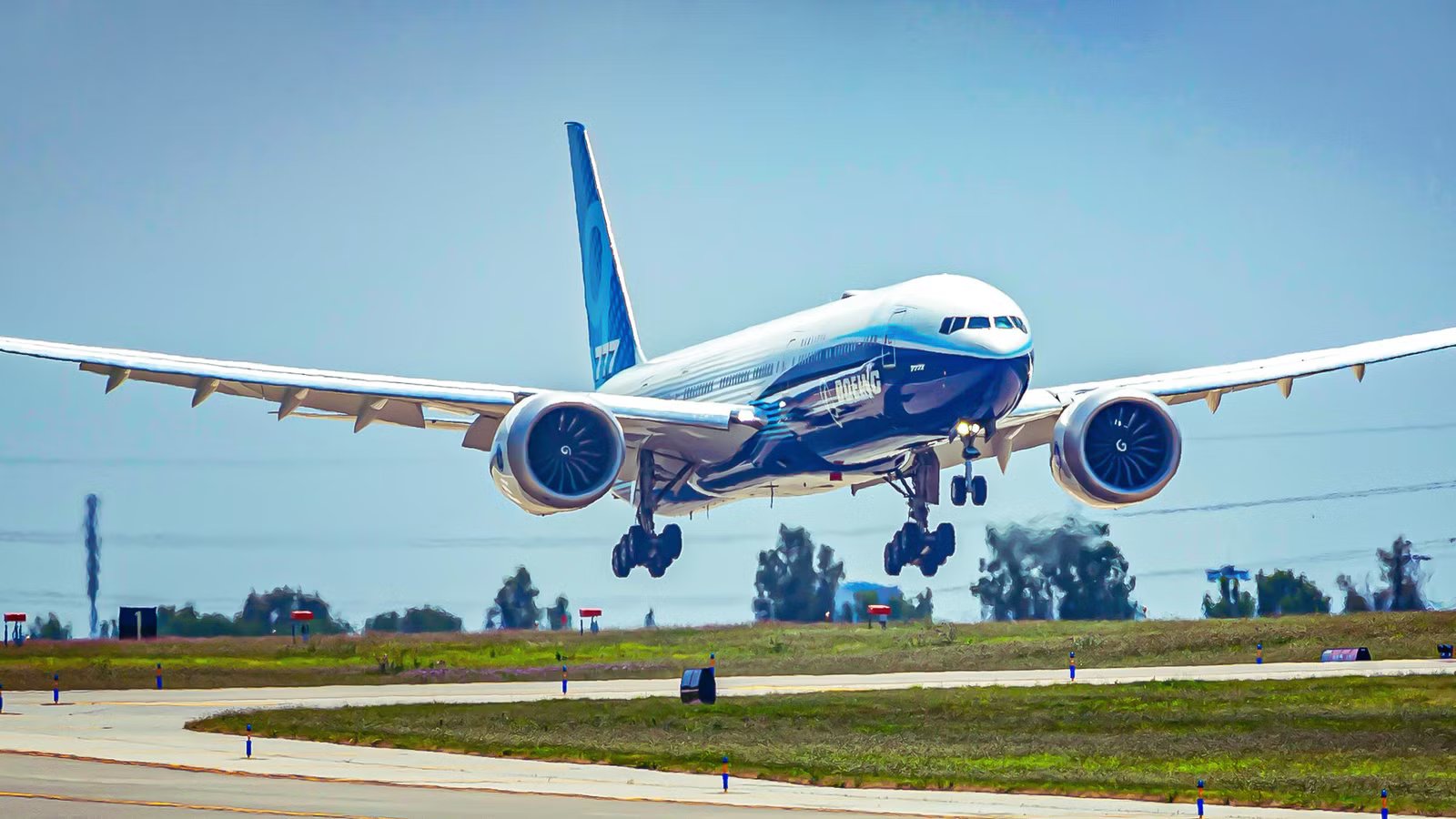
The Boeing 787 , which was the first airliner to have an airframe primarily made from composite materials, has been in service since 2011. As such, it may puzzle readers to learn that the much newer Boeing 777X, which is due to be introduced next year, has an aluminum fuselage and composite wings. Composite materials for this application are made from carbon-fiber-reinforced polymers, and have been successful due to their high strength-to-weight ratio and rigidity.
Let’s take a look at this choice of materials by  Boeing, the 777X’s manufacturer, and investigate the reasons behind it according to Boeing’s representatives. It is also worth considering the 777X’s unique wing design and some of the differences between aluminum and composite materials.
Timing And Cost-Effectiveness Drove The Decision

During media briefings prior to the Paris Air Show in 2013, Leeham News and Analysis spoke to Scott Fancher, the Vice President and General Manager of Aircraft Development at Boeing. As the Boeing 777X was only unveiled in November of that year, the question of why Boeing elected not to go with an all-new fuselage was quite relevant at the time, particularly as the comparison point of the 787 was only introduced two years prior. Fancher began to answer with the following:
“Our job is to harvest the investments in technology we’ve made over the last 10 years and translate those into value for our customers and value for Boeing.”
He went on to say that the 787 required a new fuselage cross-section compared with the 767, so Boeing had to create all-new tooling anyway, and making the leap to a composite fuselage was convenient as a result. In the case of the 777-9, the first 777X variant to be designed, the fuselage cross-section remained unchanged from the 777-300ER, so the decision was made to use the modern technology the 787 uses, while retaining a metal fuselage.
According to Fancher, using an aluminum fuselage was largely a matter of cost-effectiveness, as was the decision to re-engine the 737. However, the completion of the 787 did allow the manufacturer to apply the same modern design principles to the 777X, making it cutting-edge, even without so many composite materials being used:
“It’s really about harvesting those technology investments [from the 787]. The time it would take to do a new small airplane in the single aisle market vs the time it would take to bring to market that is very competitive against our adversary, it’s a very cost-effective decision to do a derivative.”
The Early 2010s Were An Era Of Technological Milestones

Further putting the 777X’s design into context, the 787 was a big deal for Boeing, as there were several technological advancements that came with it. For Boeing’s customer airlines, the advancements in fuel efficiency were a particular selling point. Hybrid Laminar Flow Control, for instance, may have been able to boost fuel efficiency by up to 8% alone, but combined with wing design and engine advancements, the 787 boasted a potential 20% increase in fuel efficiency over the 767.
For Boeing, developing the 777X to utilize the same advancements was an opportunistic move, as it increased the market attractiveness of the plane. Fancher also mentioned this in the interview with Leeham:
“We’ve made huge investments in technology. It was a long, hard road. But the investments paid off. We need to continue to harvest those investments and apply them going forward in the most cost effective way we can. Going forward, offering derivative airplanes that are able to offer 20% more fuel efficiency to the market place by harvesting the technology investments we’ve made today, that sounds like a great business plan to me and that’s why we’re doing derivatives. It’s about value to the market place in the most cost effective way.”
Another factor driving efficiency in the air is the weight of the plane, and between 2010 and 2013, the weight of the 777X was reduced by 1,000 pounds, showing continuous improvement in ongoing optimization efforts. That said, given the time that has elapsed since its unveiling, the new technology may not end up being so new by the time the 777X finally reaches airlines and commercial use.

Why The Boeing 777X Will Evolve Long-Haul Flying
The aircraft features many new innovations from the older generation 777s.
Boeing Revamped Its Processes With The 777X

According to Elizabeth Lund, VP and GM of the 777 program, who also spoke to Leeham, the continued work on the 777X has allowed Boeing to heavily invest in the aircraft. She explained that the company intends for it to be the next flagship airliner for long-haul travel:
“We invest for three primary reasons. One is to reduce the cost of the airplane. Two is to meet the needs of our customers. We spend a lot of time with our customers understanding the market, doing technology development so that we understand the future market needs. The third area is to do some investment where it makes sense is that if there are technologies or applications that we can implement early to prove out for the Triple 7X as we continue to move into that.”
The ethos of practicality shown by the decision not to go with a composite fuselage for the 777X has been echoed in the manufacturing, supply chain, and future maintenance procedures. According to Jason Clark, Director of Manufacturing, the changes to these processes will increase the ability of the manufacturer to produce the number of planes that the market demands. He states that:
“Going to moving line and Lean reduced parts shortages by 57% on 777 line. Our quality continues to improve year end and year out. It gets down to improved productivity. If we are going to have the rate flexibility that the market demands of us, we were going to have to look at the production system differently.”
World events in recent years have put pressure on the aviation industry, such as the Ukraine War and disruptions to shipping corridors to Europe. As a result, supply line shortages of parts and materials mean that manufacturers are under pressure to be as self-sufficient as possible. This contributed to the delays in the release of the 777X, and according to Clark, the entire supply chain and production system must be considered in order to gain a competitive advantage.
How Do Aluminum And Composite Materials Compare?

According to FlightGlobal, Boeing began the first assembly of a 777X (-9) fuselage in March 2018. This took place at Boeing’s Assembly Center in Everett, Washington. At the time of the Leeham interviews, it was undecided whether the fuselage would be made of traditional metal alloys used for the purpose or whether there would be experimentation with new alloys. As far as is known, however, Boeing went with traditional aluminum alloys.
According to a now-archived Reuters article about the composite wings of the 777X, the manufacture of carbon-fiber composites is less forgiving than traditional aluminum for the purposes of creating them. However, when successfully formed and assembled, composite wings have some benefits compared to metal, as they have a better high-strength-to-weight ratio, good stiffness, and resistance to corrosion. Carbon-fiber composites are also less prone to fatigue compared to metals.
Generally, carbon-fiber composites are more expensive to produce due to the complex manufacturing processes involved, including stages of layering and curing. The initial cost of manufacture can be high, but the longevity and performance benefits can offset this over time. Another downside is that the material is challenging to repair if damaged. Cracks can also propagate quickly, multiplying a repair workload if not addressed in time.

Why Did Boeing Build The 777X With The Longest Wings Ever On A Twinjet?
Find out the story behind the 777X’s amazing curved wings and folding wingtips.
Why The 777X’s Wings Are Unique

The use of composite material is not the only selling point the 777X’s wings have, as the aircraft has a massive wingspan of 235 feet and five inches. This wingspan helps a great deal in increasing efficiency on long-haul flights, but their unique feature of folding tips is a first for commercial jetliners. When unfolded, the 777X’s wingspan is 11% larger than the folded wingspan of 212 feet.
As reported by Composites Portal, the plane’s Chief Project Engineer, Terry Beezhold, believes that the wings may revolutionize the commercial airliner design field. This is because they will allow the plane to enjoy the fuel-efficiency increases of larger wings, while still utilizing the airport gates and hangars the original 777 could, without the need for new airport infrastructure. He explains that:
“This airplane actually will be the most efficient twin-jet ever developed in commercial history. For that reason, we developed the folding wingtip, so that in flight we can enjoy this very long, efficient span, but it will be able to operate at any airport, any gate, that today’s 777 can service.”
The strength of composite materials is one of the factors that allowed such a long wing to be designed, thanks to its strength-to-weight ratio. However, according to federal documents, US regulators had to craft guidelines from scratch, as commercial aircraft design standards did not envision a foldable wingspan. These guidelines were approved in May 2018, which may have been another factor in the 777X’s long certification process.
Boeing Believes That Technology Will Make A Difference

Boeing aims to take commercial aircraft design to the next level with the 777X, and there are also more subtle features that enhance the cabin features and navigation functions of the plane. According to Lund:
“There are many more investments you can’t see. You can’t see the things that have been done. In the last couple of years we’ve added international connectivity to the airplane. We’ve added the antennas and capabilities so the flying public can stay connected over the oceans all the time and not just over land. We’ve improved our navigation links, which allows real-time changes to be uploaded to the airplane to change flight plans through the system instead of verbal conversations as it has been done through the years.”
Clearly, executives believe that the innovative and modern features, together with the increased efficiency of the 777X, will more than offset any downsides due to using a metal fuselage. As the decision will also have cost-saving benefits on the back end, the decision may prove to be a sensible one.