dailynewsnblog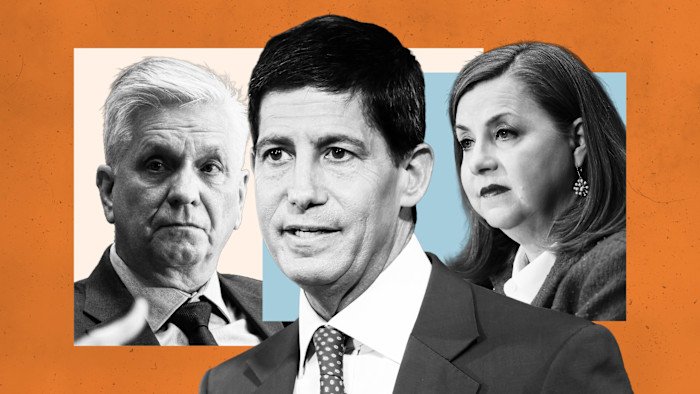
Kevin Warsh, the presumptive next chair of the Federal Reserve, has over the past year consistently said that interest rates in the US are too high.
Markets have taken this as a sign that cuts are coming soon. Investors are currently pricing in just under two rate cuts this year, which would take the benchmark rate to 3-3.25 per cent by the end of 2026.
But recent data suggests that the US economy is still robust, labour markets are resilient and inflation is decelerating only slowly. The US strikes against Iran will amplify inflation fears. That suggests that the main reason cuts are still forecast is because of expectations that Warsh will lean dovish.
The Fed chair cannot set the rate path alone and needs consensus of a majority on the Federal Open Market Committee. Though outright dissents are rare, strong pushback against a cut from a majority of voting members at a monetary policy meeting would be very likely to dissuade Warsh from forcing the issue. The following comments from FOMC members were taken before the US military strikes in Iran starting on Saturday.
The Fed board doves
Apart from Stephen Miran, who will step down to make way for Warsh, the two most dovish Fed voters are board members Christopher Waller and Michelle Bowman.
But in recent statements, both have hinted that they are becoming more data-dependent in their approach to rate-setting and do not necessarily support imminent further easing.
Waller, who along with Miran voted to cut rates in January, said last week that the January labour market data “came in substantially stronger than I [ . . . ] expected” and that it could push him towards supporting “a pause at our upcoming meeting” if confirmed by the February numbers.
But he reiterated that the labour market remained the main driver of his policy views and that he doesn’t put much stock in tariff risks to inflation.
Days after the January rate-setting meeting, Bowman framed the vote as a choice “between [delivering three cuts] by the April meeting, or moving [ . . . ] at a more measured pace.” Her vote to hold rates was ultimately determined by increasing “signs of stabilisation” in the labour market as well as “somewhat elevated” inflation.
Bowman also said that “the statistical noise introduced by the government shutdown” reduced the “meaningful signal” in the data and that her vote at future meetings will be determined by what the data shows.
Like Waller, Bowman seems to be moving away from a fixed dovish narrative, suggesting that the two FOMC uber-doves will support rate cuts in the near future only if the data justifies such a move.
The other permanent voters
Other Fed board members’ perspectives on further easing range from ambivalence to firm opposition.
Philip Jefferson is closest to backing another cut. In February, he said that he saw “risks on both sides” of the dual mandate. However, he put more emphasis on the labour market, stating that although he expects “the unemployment rate to hold approximately steady [ . . . ] in this less dynamic labor market, the downside risks [ . . . ] remain”.
Jefferson was marginally less concerned with inflation. He said that “some upside risks remain, but I expect the disinflationary process to resume this year [and] projected strong productivity growth may [help bring] inflation down”.
Michael Barr and Lisa Cook, by contrast, have both talked up the risk of above-target inflation more than the prospect of rising unemployment.
Barr said that he “see[s] the risk of persistent inflation above our 2 per cent target as significant” but the labour market is in “delicate balance”, leading him to the conclusion that “it will likely be appropriate to hold rates steady for some time”.
Cook’s interpretation is even more hawkish than Barr’s. In early February, she said that “inflation appears to have stalled stubbornly above our 2 per cent goal” while “the labour market appears to have stabilised”. She therefore sees risks to the Fed’s dual mandate as “tilted toward higher inflation”, putting her on course to support an extended rate hold.
Cook’s hawkish read extends to poor household sentiment data, which she believes is driven by recent experience of high inflation and fears of AI unemployment, among other factors. “Low sentiment [ . . . ] do[es] not, in my view, reveal a signal about increased slack that we can tackle with our typical demand-side monetary policy,” she said.
In sum, Jefferson seems likely to back further cuts if the labour market data weakens, even if inflation falls only very slowly. But Barr would probably need to see inflation indices falling faster in the absence of pronounced labour market weakness, while Cook would need to see falling inflation and a weakening labour market to back lower rates.
The regional Fed presidents
Cleveland Fed president Beth Hammack, usually one of the most hawkish members of the FOMC, said in a recent speech that she was definitely more worried about “too high” inflation than about the labour market, which is “stabilising”.
Hammack also believes that the fed funds rate is hovering around neutral and that “the risks of a higher or lower path [are] about balanced”.
Hammack’s assessment of the US economy and of the policy stance is similar to Lorie Logan’s, the Dallas Fed president who is also a voter this year. Logan said in February that she also believed the fed funds rate is in the neutral range and is “cautiously optimistic” that at the current rate inflation will return to 2 per cent without the labour market falling out of balance. That would mean “no further rate cuts are needed to achieve our dual mandate goals”.
Logan has sounded even more sceptical than Hammack that further rate cuts could be warranted. “I am not yet fully confident inflation is heading all the way back to 2 per cent,” she said, adding that there have been few signs of easing in recent months and that fiscal policy is set to support the economy. Like Cook, she pointed out that economic activity was firm and “rebounded strongly” last year.
While the other two regional Fed voters have not given public remarks recently, Logan and Hammack’s analyses of the US economy are both very hawkish. If Warsh does lean dovish in his first few months at the central bank’s helm, support from his colleagues seems likely to be lukewarm at best — and limited at that. The median FOMC voter is yet to be persuaded that there is a decisive case for more cuts.