dailynewsnblog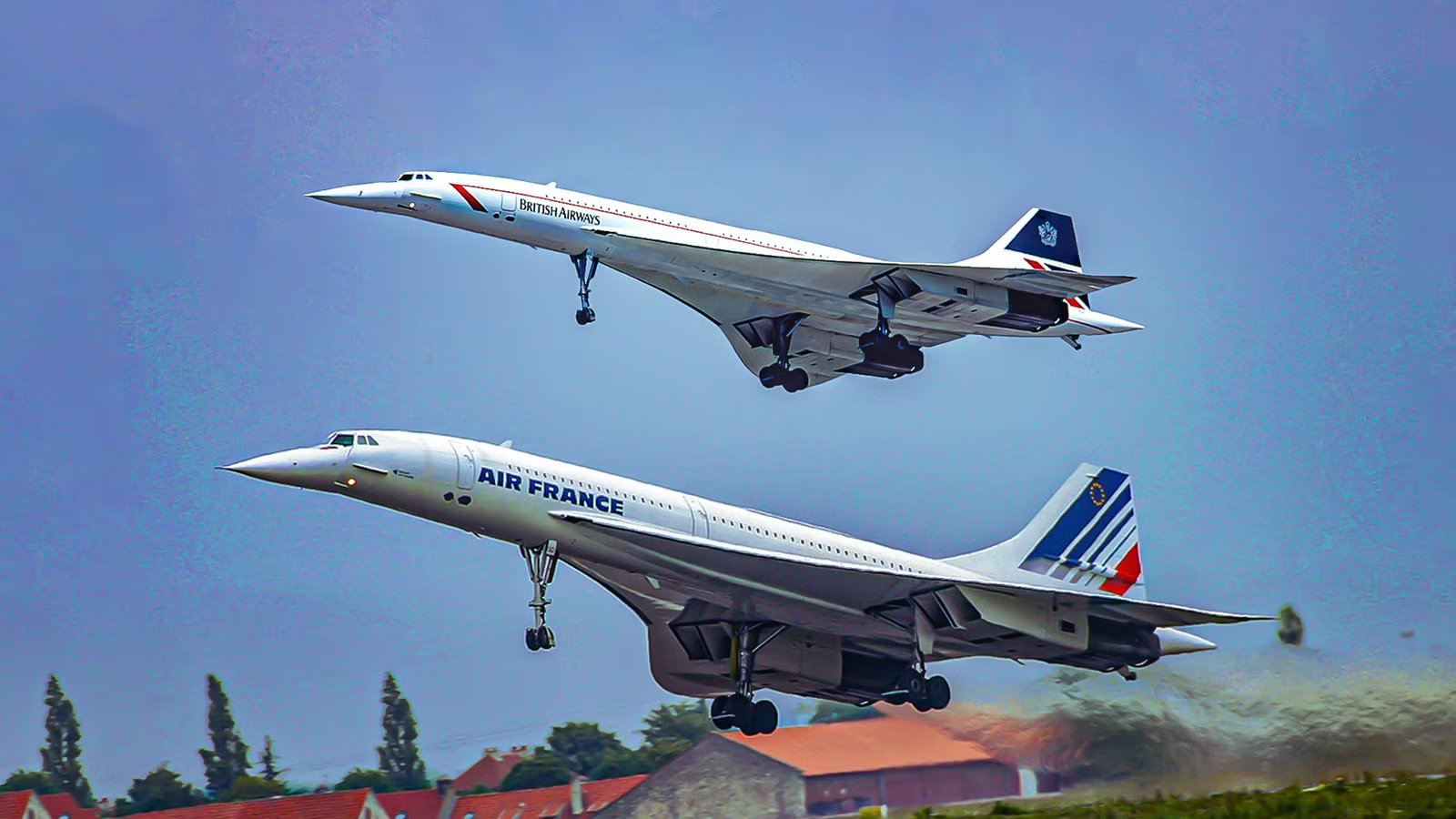
Both  British Airways and
  Air France operated seven Concordes, one more than each of them had actually ordered, and one fewer than what was theoretically available. It has now been 50 years since Concorde entered service, and while its core route was Paris/London to New York, that wasn’t the case on its inaugural revenue-generating flights. The first British flight flew to Bahrain, while the French flight flew to Rio de Janeiro via Senegal.
It can be argued that the Concorde project should not be viewed as a typical commercial aircraft project judged by its ability to be profitable (like the A380). Instead, it should be seen as a geopolitical European project that allowed European states to work together, overcome age-old rivalries, form Airbus, and more. Here is what to know about why British Airways and Air France had seven Concordes, not six or eight, and which other airlines placed orders for them.
Why British Airways & Air France Had Seven

Unlike most Western commercial aviation projects, Concorde was a prestige national program built by the UK and France. In 1963, the national British carrier, BOAC (later British Airways), placed an order for six aircraft and confirmed its order for five in 1972. At the same time, France’s national carrier ordered six in 1963, confirming four in 1972.
In the end, all other orders for Concorde were cancelled, but production of the aircraft continued anyway. A total of 20 Concorde airframes were built; these included two prototypes and two pre-production models, with a run of 16 production aircraft. With no external buyers, this left only 12 actually contracted for by British Airways and Air France (six each). This left four Concordes built with no buyers as “white tails.” Two of these were delivered to British Airways and Air France, bringing their total to seven.
The remaining two Concordes (aircraft 205 and 206) were not put into long-term airline service and were instead used mostly for spare parts, limited flying, and development use. Even with state subsidization, the route economics just didn’t justify eight aircraft for each airline. Concorde became essentially limited to a single twin or parallel route; that of London to New York, and Paris to New York. Other routes, like those to Washington-Dulles, Barbados, and charter destinations, were secondary or temporary.
Essentially Gifted Aircraft

The enormous development and production costs of the Concorde program made it impossible to operate profitably. The aircraft was incredibly expensive to operate and maintain; when coupled with its outsized capital expense, there was no plausible way for airlines to recoup the costs. It was possible to generate enough revenue to offset the operational expenses, but not the capital expenses. With seven aircraft in service, BA and Air France could sustain an operational fleet of five aircraft, with one or two in maintenance.
The capital expenses were paid for by the national governments. The aircraft were famously sold to British Airways for £1 each in 1984 as part of the airline’s privatization restructuring. Something similar happened in France with Air France paying one Franc. The only realistic way another airline could acquire Concordes was if their national governments likewise subsidized them. This almost happened in Iran (more on that below).
Another potential source of sales could have been a private jet, but there doesn’t seem to have ever been any serious development here, at least none that reached an advanced negotiation stage and was publicly known. Again, the aircraft would have been enormously expensive, much more expensive than today’s business jets.

What Was The Longest Concorde Flight?
It only took four hours and ten minutes for the supersonic airliner to cross the pond.
Which Airlines Placed Orders For Concorde?

A number of airlines around the world placed nonbinding orders for Concorde, but the crash of the Soviet Tu-144, regulations, environmental costs, noise pollution, and the burgeoning cost of purchasing the aircraft led export customers to cancel. The airlines that ordered Concorde include Pan Am, Continental, TWA, American Airlines, MEA/Air Liban, Qantas, Air India, Japan Airlines, Sabena, Eastern Airlines, United Airlines, Braniff, Lufthansa, Air Canada, CAAC, and Iran Air.
Pan Am had options for six and later eight Concordes, but canceled them in 1973. Continental placed orders for three, TWA for six, American Airlines for six, Eastern Airlines for six, United for six, and Braniff for three. In all, US-based airlines had options for 38 Concordes. At the time, Lebanon was one of the best-performing countries in the Middle East, and its Middle East/Air Liban placed orders for two aircraft, which it later increased to four.
|
Airlines that placed nonbinding orders for Concorde (per Concorde Heritage) |
|||
|---|---|---|---|
|
Air France |
6 (7 delivered) |
British Airways |
6 (7 delivered) |
|
Pan Am |
8 |
Continental |
3 |
|
TWA |
6 |
American Airlines |
6 |
|
MEA/Air Liban |
4 |
Qantas |
4 |
|
Air India |
2 |
Japan Airlines |
2 |
|
Sabena |
3 |
Eastern Airlines |
6 |
|
United Airlines |
6 |
Braniff |
3 |
|
Lufthansa |
3 |
Air Canada |
4 |
|
CAAC |
3 |
Iran Air |
3 |
Qantas was the only airline from the Southern Hemisphere to have orders; it had options for four aircraft, although technically it never officially canceled the order. The other European carriers to place nonbinding orders included Belgium’s Sabena for three and Germany’s Lufthansa for three. At the time, the market forecast was for 350 Concordes, although all the nonbinding orders listed above only add up to 78.
Iran Air’s Very Close Order

Given that most orders for the supersonic aircraft were economic ones placed by airlines planning to make a profit, this was a death sentence once it was clear the aircraft would not make economic sense. This is where Iran gets interesting. It was the most serious prospective customer planning to order the aircraft as a prestige symbol. At the time, the Shah of Iran saw it as a useful national symbol for a modernizing Iran. He envisioned using it on routes like Tehran to London and Tehran to New York.
Concorde Heritage writes, “The first Concorde was due to be delivered to Iran at the end of 1976, with the second in early 1977 and the option for the third would have been delivered in 1978. One of the production planes which had been earmarked for Iran Air was 216 (which later became G-BOAF), and this was later handed over to British Airways for £1.”
So Iran came perhaps the closest to being an export customer for Concorde, and an aircraft was even built for it. Concorde Heritage also notes, “Iran Air was more a symbol of national identity, and the Concorde’s were most certainly toys for the Shah rather than aircraft for his people.” The decisive moment came in 1979 as the Iranian Revolution overthrew the Shah, with the orders being canceled in 1980.

A Timeline Of Concorde’s Development & Entry Into Service
The supersonic airliner entered service 49 years ago today.
A Europe Struggling To Compete

While much is said of the United States and the Soviet Union competing during the Cold War for technological superiority, less is said of European states. After WWII, former global powers like the United Kingdom and France were diminished, but diminished is not gone or unimportant. In the 1960s, aerospace was a marker of technological supremacy, a proxy for national power, and an important part of defense-industrial capability.
Both Britain and France feared being permanently overtaken by the United States and its large aerospace companies like Boeing, Douglas, and Lockheed. At the same time, European aviation risked fragmentation and decline; over time, Europeans would learn to pool their resources into other advanced airplanes like the Airbus A350, but that was in the future. Concorde became a symbol of national resolve and a test if Europe could still compete in high-risk mega projects.
The 1962 Anglo-French Concorde Treaty should be seen in the context of this Cold War strategic-industrial perspective. Concordes’ development is better understood from the perspective of a military aircraft (one that happened to carry paying passengers). Military aircraft are not built because they make economic sense, but because governments feel like they need them. Had Concorde been a commercial free-market program, it would have been canceled.
How Concorde Succeeded

If one looks at Concorde through a typical market-driven lens, then it failed. But there are other ways to see it. For many enthusiasts, it’s the engineering marvel that counts. From the point of view of British and French strategic thinking, there is also a logic to calling it a success with a clue in the name “Concorde”. Going back to the military comparison, these don’t need to make money in a normal commercial sense, but they do serve various national strategic interests.
The program helped build cooperative structures, political trust, and industrial coordination between Britain and France, two countries that had been rivals for their entire existence. It helped prove that cross-border industrial integration could work and that Britain and France really could put their heads together and deliver in spite of enormous challenges. European countries individually could not compete with the US in building commercial aircraft, but they could collectively.
Concorde laid the foundation for Airbus, today the world’s biggest airplane maker. Later, Sud Aviation would develop into Aérospatiale, while British Aircraft Corporation would merge into British Aerospace before becoming BAE Systems. Aérospatiale became a core founding Airbus company, although BAC didn’t. Since Concorde, most aircraft in Europe are multinational projects, including the Eurofighter Typhoon and the upcoming GCAP/Tempest.