dailynewsnblog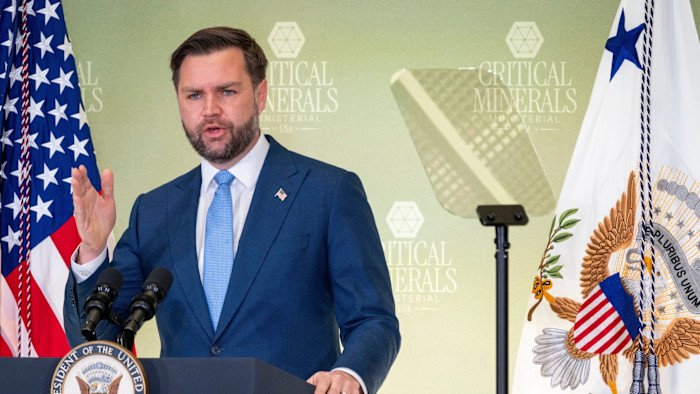
Unlock the White House Watch newsletter for free
Your guide to what Trump’s second term means for Washington, business and the world
Donald Trump’s administration has launched an effort to form a trade zone for critical minerals with allies including Japan and the EU, as it battles to break China’s control of the sector.
Vice-president JD Vance on Wednesday said the US would seek to use tariffs to create a price floor for critical minerals and to expand production and investment across the new zone.
“We want to eliminate that problem of people flooding into our markets with cheap critical minerals to undercut our domestic manufacturers,” said Vance, speaking at a state department gathering of ministers from 55 countries.
“We know that as soon as they’ve undercut our domestic makers . . . they leave the market . . . then jack up the price to a completely unfair level,” he added, an apparent reference to China. “We’re going to fix that problem together.”
The efforts mark a rare instance of global trade co-operation from the Trump administration, as it works to reduce reliance in the US, and the west more broadly, on China for a wide range of critical minerals from rare earths to the battery metal lithium.
Washington also announced on Wednesday that it had reached a minerals deal with Mexico as it works to seal a trilateral deal with Japan and the EU that could later include other nations.
China last year demonstrated its willingness to weaponise its dominance over many metals by restricting buyers’ access to them in the US, Europe and elsewhere. That triggered a new urgency in the west to reduce reliance on Beijing and build out alternative supply chains.
US policymakers, who say China poses the single biggest strategic threat to Washington, have long warned of the dangers posed by Beijing’s control over critical swaths of the international minerals supply chain.
On Wednesday, the US, EU and Japan published a joint statement pledging to “explore a plurilateral trade initiative with like-minded partners on trade in critical minerals”.
The initiative “could include” co-ordinated trade policy mechanisms, such as border-adjusted price floors, price gap subsidies or agreements to buy each others’ minerals at agreed prices, the text said.
EU diplomats see critical minerals as a rare area of potential collaboration with the US in what has otherwise become a strained transatlantic relationship.
Both EU and Japanese officials have advocated to protect supply chains from being undercut by China in ways that go beyond price floors, such as contracts for difference, in which governments guarantee a price but can request rebates if they rise above the threshold.
As part of the US and Mexico’s separate “critical minerals action plan”, the nations agreed to develop preferential trade through price floors and to prioritise financing on specific mining and processing projects.
In January, Trump directed US trade officials to negotiate agreements that would address the “threat” posed to national security by China’s dominance over many critical minerals supply chains and the US’s heavy reliance on imports.
Earlier this week, the US unveiled plans for a $12bn minerals stockpile that domestic manufacturers such as carmakers would be able to tap in times of crisis.
Separately, the Pentagon penned a $125mn deal to buy 400 tonnes of indium over three years from two companies, AIM Products LLC and Indium Corporation, for its national defence stockpile. Both companies have facilities in Asia, North America and elsewhere.
Additional reporting by Abigail Hauslohner