dailynewsnblog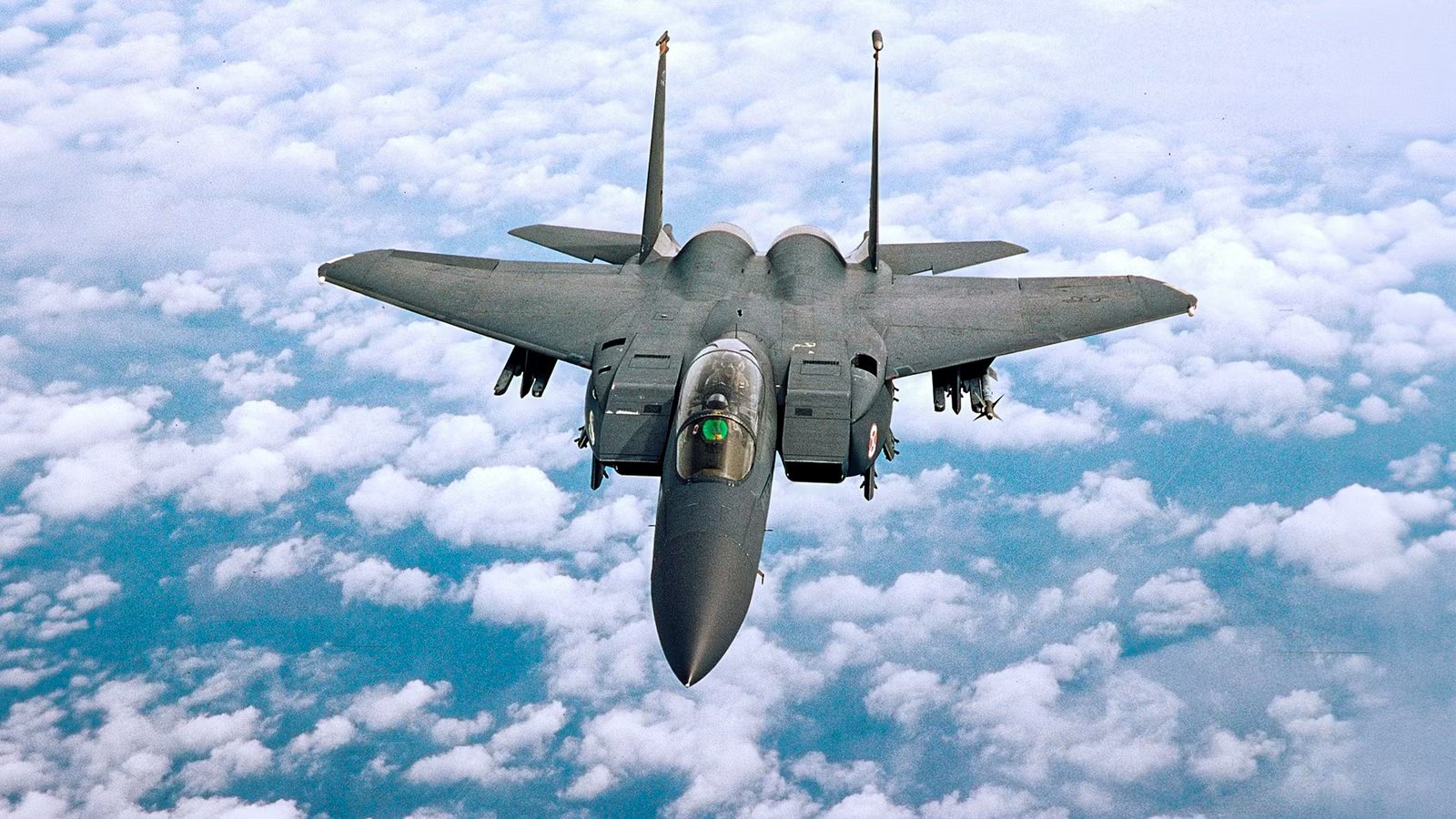
The  Boeing F-15 Eagle Is an icon of American airpower and one of the few aircraft to have flown in combat that can boast a perfect record of never being shot down by an enemy in an air-to-air dog fight. The incredibly powerful twin-engine supersonic fighter remains the fastest jet in the US Air Force, and the hardest-hitting fighter with the biggest payload.
This unparalleled performance and unrivaled battlefield record have earned it the moniker of ‘America’s Sweetheart.’ The jet is so beloved and capable even to this day that the US Air Force is currently buying the F-15EX Eagle II, a modernized version that will likely serve well into the 2040s.
Untouchable: The F-15

Developed in the 1970s, it was designed to be the ultimate air-to-air fighter. Its success in both the US and Israeli air forces cemented its reputation as a dominant force. Since entering service in 1976, the F-15 has never been shot down by enemy aircraft in air-to-air combat, racking up 104 aerial combat victories across eras. In the 1991 Operation Desert Storm alone, the F-15C accounted for 36 of the 39 US Air Force aerial victories.
The F-15’s first-ever air-to-air kill was recorded by Israeli pilot Moshe Melnik in 1979 against a Syrian MiG-21. The Israeli Air Force (IAF) was actually the first to take the Eagle into battle and has claimed the vast majority of the F-15’s aerial victories flying its F-15A/C ‘Baz’ and F-15I ‘Ra’am.’ During the 1982 Lebanon War, in a massive air battle over the Bekaa Valley, Israeli F-16s and F-15s destroyed over 80 Syrian aircraft without a single loss.
The Royal Saudi Air Force (RSAF) has also relied heavily on the F-15C and the F-15SA (Saudi Advanced) models extensively for regional defense. Again in 1991, a Saudi pilot, Captain Ayehed Salah al-Shamrani, downed two Iraqi Mirage F1s in a single engagement. Recently, Saudi F-15s have been the primary tool for intercepting Houthi drones and missiles over Yemen, showcasing the aircraft’s ability to pivot from traditional dogfighting to modern counter-UAV operations.
The Cold War Superfighter

When the F-15 debuted, it was a quantum leap over its predecessors. It was the first US fighter where the thrust of the engines exceeded the weight of the plane, allowing it to accelerate even while climbing vertically. While the F-15 has many specialized versions, its legacy is composed of four distinct generations of aircraft that saw heavy operational use: the F-15A/B, F-15C/D, F-15E, and F-15EX.
A large wing area relative to the aircraft’s weight enables the F-15 to turn tightly at up to nine G’s without losing airspeed. The airframe weight consists of approximately 37.3% aluminum and 25.8% titanium, with selective use of composites like boron-epoxy for the thin vertical stabilizers and rudders. The F-15A and its two-seat counterpart, the F-15B, are powered by two Pratt & Whitney F100-PW-100 afterburning turbofans, each producing nearly 24,000 pounds of thrust.
Entering service in 1979, the F-15C became the definitive version of the Eagle and is still flown by the Air National Guard today. While it looks nearly identical to the ‘A’ model, it featured significantly upgraded internal electronics and increased fuel capacity. The ‘C’ model also introduced the capability to carry Conformal Fuel Tanks (CFTs)—aerodynamic tanks that hug the side of the fuselage to extend range without sacrificing much speed.
Evolution Of A Predator

In the late 1980s, the Eagle underwent a massive transformation. The F-15E Strike Eagle was designed to retain its air-to-air dominance while becoming one of the most lethal deep-strike bombers in history. The back-seater acts as a Weapon Systems Officer (WSO) to manage the complex radar and targeting systems during ground attacks. It is capable of carrying almost every air-to-ground weapon in the USAF inventory.
|
Specification |
McDonnell Douglas (Boeing) F-15 |
|---|---|
|
Powerplant |
Two Pratt & Whitney F100-PW-100, 220 or 229 turbofan engines with afterburners |
|
Thrust |
(C/D models) 23,450 pounds each engine |
|
Speed |
1,875 mph (Mach 2 class) |
|
Ceiling |
65,000 feet (19,812 meters) |
|
Range |
3,450 miles (3,000 nautical miles) ferry range with conformal fuel tanks and three external fuel tanks |
|
Wingspan |
42.8 feet (13 meters) |
|
Length |
63.8 feet (19.44 meters) |
|
Weight |
31,700 pounds |
|
Maximum takeoff weight |
(C/D models) 68,000 pounds (30,844 kilograms) |
The F-15EX is the newest version currently being delivered to the USAF. While the airframe looks like a Strike Eagle, the electronics are entirely 21st-century. It features a digital fly-by-wire flight control system, the world’s fastest mission computer, and a massive digital cockpit display. It is designed to carry a much heavier missile load than its predecessors, acting as a ‘missile truck’ to support stealth fighters like the fifth-generation F-22 Raptor and F-35 Lightning II stealth fighters.

This Is The United States Air Force’s Fastest Jet
The US Air Force has an incredible arsenal of aircraft, but which one is really the fastest?
The Eagle’s Might

While stealth technology is revolutionary, it is also expensive and maintenance-heavy. The F-15 is the workhorse that doesn’t quit. The Eagle’s reputation for being over-engineered in the best way possible was cemented in 1983. During a training exercise, an Israeli F-15D collided with another jet, completely shearing off its right wing.
Against all laws of aerodynamics, the pilot managed to land the plane at twice the normal landing speed. When the engineers at McDonnell Douglas saw the photos, they were stunned; the plane stayed in the air due to the lift generated by its massive fuselage and the sheer power of its engines. During the Gulf War, F-15s proved their resilience again as they frequently returned to base after taking hits from missiles that blew out large chunks of the tail or engine bay but still flew home.
The F-15’s airframe is a masterclass in Cold War over-engineering, designed at a time when the US was terrified of a Soviet MiG-25 superfighter. Most planes rely entirely on their wings for lift. The F-15, however, features a wide, flat, and cavernous fuselage (the main body) that actually acts as a third wing. This lifting body design provides roughly 25% of the aircraft’s total lift.

Which Countries Has The US Banned From Buying The F-15?
The US has always been selective where it sells its F-15s, being more restrictive than its F-16 exports.

Unlike modern stealth jets that use high percentages of carbon fiber and composites, the F-15 is a heavy-duty metal ‘beast.’ Approximately 26% of the F-15’s structure is titanium, used specifically in high-stress areas like the wing spars and engine structures. The wings and tail surfaces use an aluminum honeycomb core bonded to the outer skin. This makes the surfaces incredibly stiff and resistant to the vibration and stress of Mach 2.5, 9-G turns, as well as incoming fire.
Another major survivability factor is that the F-15’s two Pratt & Whitney F100 engines are spaced far apart. If one engine suffers a catastrophic failure or takes combat damage, the physical distance prevents the fire or debris from automatically taking out the second engine, allowing the pilot to limp home on one motor.

How Many F-15 Eagles Are Still In Service?
An overview of the F-15 Eagles still in-service
The Definitive Strike Fighter

The F-15A was the original single-seat version that entered service in the mid-1970s. It was designed with a singular, focused philosophy: ‘Not a pound for air-to-ground.’ This mantra meant every ounce of the aircraft was dedicated to winning dogfights. All of that changed when the USAF needed a replacement for the F-111 Aardvark. Engineers took the two-seat F-15D and redesigned 60% of the airframe to make it even tougher.
The result was the F-15E, leveraging the Eagle’s immense payload and extreme performance to craft the ultimate strike fighter. The F-15E is easily identifiable due to its dark ‘gunship gray’ paint for low-level, night-time ground attack. It became the backbone of US power projection in Iraq and Afghanistan, capable of loitering over a battlefield for hours and delivering a massive variety of GPS and laser-guided bombs.
The payload and speed limitations of the Lockheed Martin F-22 and F-35 stealth fighters, as well as the 5th-Gen fighter’s high price tags, have secured the F-15 a place in the Air Force of the Future. The F-15EX Eagle II is just starting to ramp up in production to support the ‘high-low’ fleet mix, where the ‘exquisite’ stealth fighters are the tip of the spear, and the latest iteration of the Eagle acts as a ‘missile truck.’
The F-15EX, unburdened by stealth geometry, can carry up to 29,500 lbs of ordnance, including up to 12 air-to-air missiles. The Eagle II swoops in to hit targets painted by the 5th-Gens, allowing the F-22 or F-35 to maintain its stealth by never opening its weapons bays or activating its own radar. This tactic makes the 5th-Gens a quarterback behind enemy lines, dismantling enemy air defenses and destroying targets in the air, land, or sea alike with complete impunity.