dailynewsnblog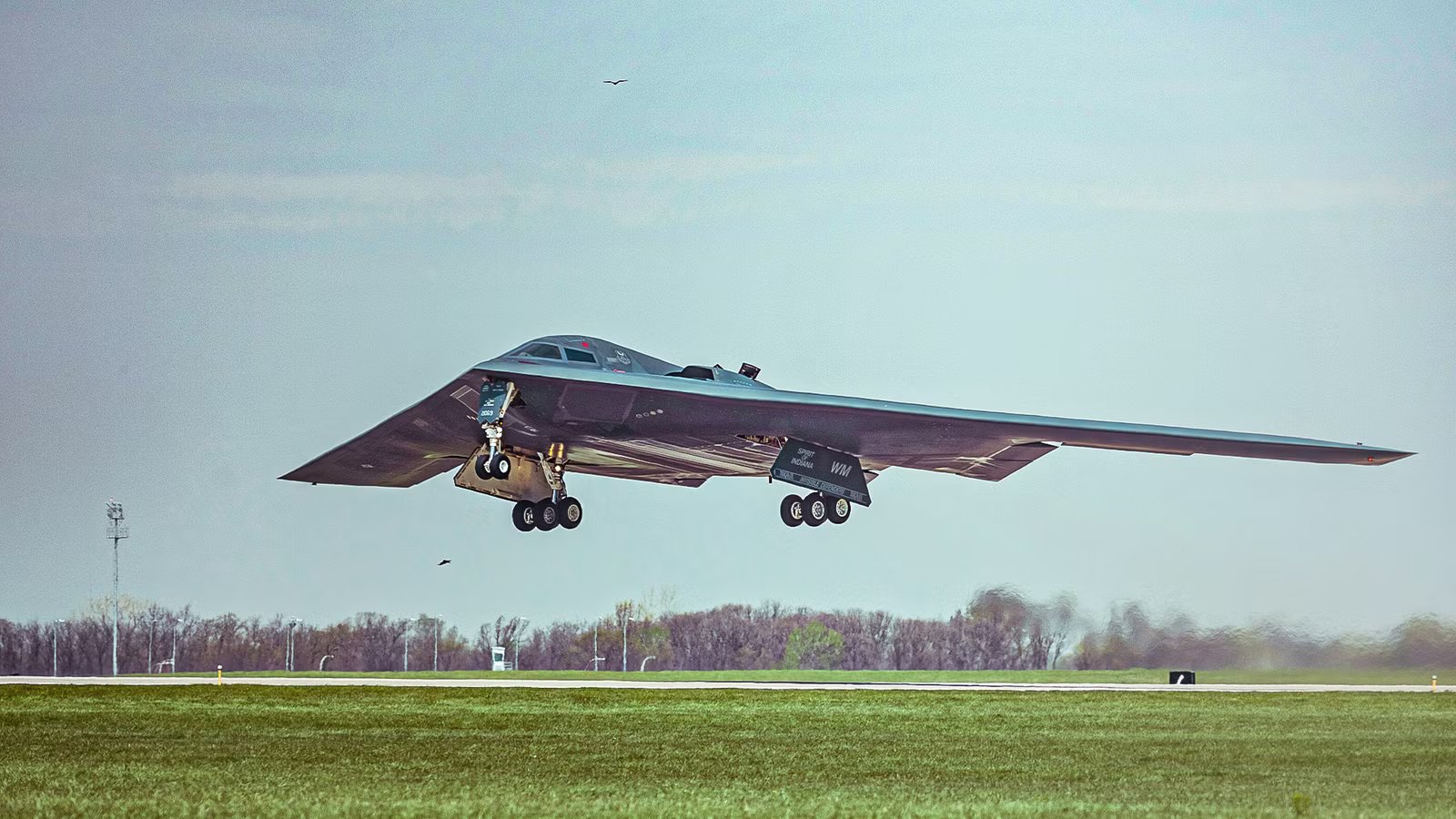
It is relatively easy and defensible to say that the United States has the most powerful stealth aircraft. Many articles about stealth aircraft focus on radar cross-section (RCS), which is where the Russian Sukhoi Su-57 does fairly well, but RCS is just one (important) aspect of stealth. Modern fighter jets and bombers are nodes in a much more complicated web of systems that also helps them remain stealthy. Here, the Su-57 falls hard.
It is important to keep in mind that stealth does not mean invisible or invulnerable. All aircraft can be seen and targeted. What stealth aims to do is delay detection and confuse the radar. The radar may be able to see the aircraft, but its location is fuzzy, having been lost in the noise being generated. It also matters where the aircraft is being observed from; just because an aircraft may have a low RCS in the front, that doesn’t mean it has a low RCS from the side or the rear.
US Has Only The Most Stealth Bombers

The Northrop B-2 Spirit is the world’s first and only stealthy strategic bomber and the only strategic bomber able to operate in contested airspace today. All the world’s other strategic bombers, the B-52, B-1B, Tu-22M3, Tu-95MS, Tu-160, and H-6, are unable to operate in contested airspace and all function mostly as missile trucks delivering their munitions from outside contested airspace.
Ironically, this de facto means the B-2 Spirit is the only “strategic bomber” able to drop bombs in the real world. The others now rely on missiles to provide the range to keep the bombers out of harm’s way, although the development of long-range glide bombs may mean bombers can carry those. In Ukraine, Russia’s strategic bombers have been kept far behind the lines, firing missiles from afar, while the B-2 flew directly over its Iranian nuclear facility targets in 2025, dropping its GBU-57 MOBs.
The Northrop Grumman B-21 Raider is the next-generation update on the B-2 Spirit, and at least two flying examples are now in service with the US Air Force for testing and training. These aircraft come with all-aspect stealth to penetrate and survive the most contested space. It restores much of the eroded advantage the B-2 had when it entered service in the 1990s. China is developing its stealthy Xi’an H-20 bomber, but progress is unclear. Russia claims to be developing a next-generation stealth bomber, although this is questionable given that it has fallen back on putting its old prestige Tu-160 back into production.
F-22 & F-35 Are The Best Stealth Fighters

Even though the F-22 Raptor is 20 years old, it is still considered the gold standard as an air dominance fighter, rivaled only by the F-35. The F-35 is considered the world’s most advanced fighter jet, although it is designed to carry out a greater range of missions than the one-trick pony F-22. The United States Air Force is the only operator of the F-22 Raptor, and it is investing in extensive upgrades to keep them at the cutting edge into the 2040s.
The F-35 is designed as a strike fighter. It excels at penetrating enemy air defenses and disabling or destroying them, allowing fourth-generation fighter jets to exploit the gap. The jet not only enjoys a “god’s-eye-view” of the battlespace, but it can also pass that situational awareness onto fourth-generation fighter jets. As discussed below, this helps fourth-generation aircraft become more “stealthy.”
|
US stealthy/low observable aircraft |
|
|---|---|
|
Fighter jets |
F-22, F-35, (F-47, F/A-XX in development) |
|
Bombers |
B-2 (B-21 in testing) |
|
Spy aircraft |
RQ-170, RQ-180 (widely rumored), SR-72 (black box project in development) |
As the F-35 is exported to US allies, it is not a jet that only the US enjoys. But the United States (used by the Air Force, Marines, and Navy) has the majority of the F-35s produced. US F-35s are also kept at the cutting edge. For example, Avionics International reported that since mid-2025, US F-35s have been delivered without radars, while export F-35s are being delivered with radars. This is because export F-35s are equipped with the existing Northrop Grumman AN/APG-81, but the US is waiting for the much more powerful next-generation AN/APG-85 radar.

Which Country Has The Most Superior Military Aircraft In The World?
In a world where air power means everything, one country reigns supreme. See the cutting-edge technology and strategic advantages that set it apart.
Spy Stealth Aircraft

Another category of stealth aircraft is spy planes or reconnaissance aircraft. After Northrop built the B-2 Spirit, it went on to produce stealthy flying wing reconnaissance drones for the US Air Force. Perhaps the most famous is the unmanned RQ-170 Sentinel, of which up to 30 are believed to have been built. The type was first introduced in 2007. The US has been exceptionally mute about this aircraft, and there is only one publicly available USAF image of it, although it has been seen flying from bases and in satellite imagery.
Most recently, the RQ-170 was observed taking part in the operation to capture Venezuela’s Maduro in 2026. The USAF description of the aircraft is very brief and says, “The RQ-170 is flown by Air Combat Command’s 432nd Wing at Creech Air Force Base, Nevada and the 30th Reconnaissance Squadron at Tonopah Test Range, Nevada.” Even more secretive is the unmanned Northrop Grumman RQ-180 that is believed to exist, but has not been acknowledged by the USAF. It is thought to have entered service in 2015 and be a massive aircraft.
The US Navy built the Northrop Grumman X-47B, but then canceled the program. It is also known that Lockheed Martin is developing the unmanned hypersonic SR-72 Son of Blackbird, although the program has gone dark. Other countries, notably China, are also designing stealthily large reconnaissance drones, but it’s the US that enjoys decades of inertia and expertise.
Lowest Radar Cross-Sections

Radar cross-sections found online are useful, but also misleading and problematic at the same time. One issue is that RCS is classified, so these are little more than educated guesses. Another issue is that they are only for the front sections; in the real world, the aircraft will be observed from more angles than just its front section. The values for the other sections of the aircraft may be radically different.
Commonly cited values for fifth-generation fighter jets (e.g., by GlobalSecurity.org) are 0.0001 m² for the F-22 Raptor and 0.0015–0.005 m² for the F-35 Lightning II. These are equivalent to a small marble or bumblebee for the Raptor and a golf ball or small plate for the Lightning II. The Chinese Chengdu J-20 is estimated to be 0.05 m² and as much as 0.08–0.3 m² in some estimates. The Russian Su-57 is mediocre at 0.1–1.0 m².
Complementing RCS is radar-absorbent material (aka ‘paint’). These are classified. Then there’s reducing infrared (IR) signatures and masking the engine; these measures are not measured in the aircraft’s RCS. It is worth noting that the F-22 and F-35 are built with their optimized engines and nozzles for IR reduction. However, China is only now believed to have recently started integrating its new engines into the J-20, while Russia has only begun testing with the Su-57’s optimized engines.

Eight 4.5-Generation Fighter Jets Produced Worldwide
A selection of the some of the most advanced fighter jets in the world.
Stealth As Action

It’s a common misconception that stealth aircraft meekly hide. They don’t. They actively fight the radars using electronic warfare and a range of deception tactics. For example, the F-35 and B-21 are built around using their radars as jammers for electronic attack. They don’t just deflect radar signatures; they actively cancel or broadcast inverted radar returns. This can also be done by other aircraft like the Navy’s EA-18G Growlers.
The biggest difference between the old Gripen C and the new Gripen E is its greatly increased sensors and battlespace awareness. It comes with three types of signal generators: Digital Radio Frequency Memory, Doppler, and Noise. They can obscure the aircraft’s presence or confuse enemy aircraft about its location. Modern jets are designed to broadcast signals that the enemy radars interpret as other enemy targets.
These electronic decoys can blink in and out of existence, further confusing radars. The radars may know an aircraft is there, but not know which one in the noisy picture it is, and be unable to fix a proper firing solution. Being able to see an aircraft is not the same as being able to see it well enough to target. Noise generators pump noise into the picture while virtual decoys and jamming confuse the picture further. Again, this is where the F-35 excels.
Network With Other Sensors

Russia’s Su-30 Flanker series famously has a powerful PESA radar. While some fans may boast about the range of these radars, they also effectively function like flashlights in the night. They may be able to find what they are looking for, but everyone can see the beam. Modern Western jets use passive sensing and hide emissions. They prioritize EMCOM (emission control) and use IRST/DAS/EOS for detection without emitting.
They are also able to network with an ecosystem of assets like other aircraft, satellites, and ground stations. This helps them detect targets and observe the battlespace without turning the flashlight on or emitting. Modern stealth aircraft are designed around a full kill chain, not a single sensor. This is why comparisons of the Su-57 vs Eurofighter, focusing on detection ranges and RCS, are so misleading.
The Eurofighter is plugged into a much more powerful ecosystem than Russia can generate for the Su-57. A Eurofighter flying with the F-35 also benefits from electronic warfare, increased situational awareness, and more. The power of stealth is a concoction of passive stealth (e.g., RCS), emissions control, electronic warfare, passive detection, and networked stealth. These are areas where the United States continues to dominate.