dailynewsnblog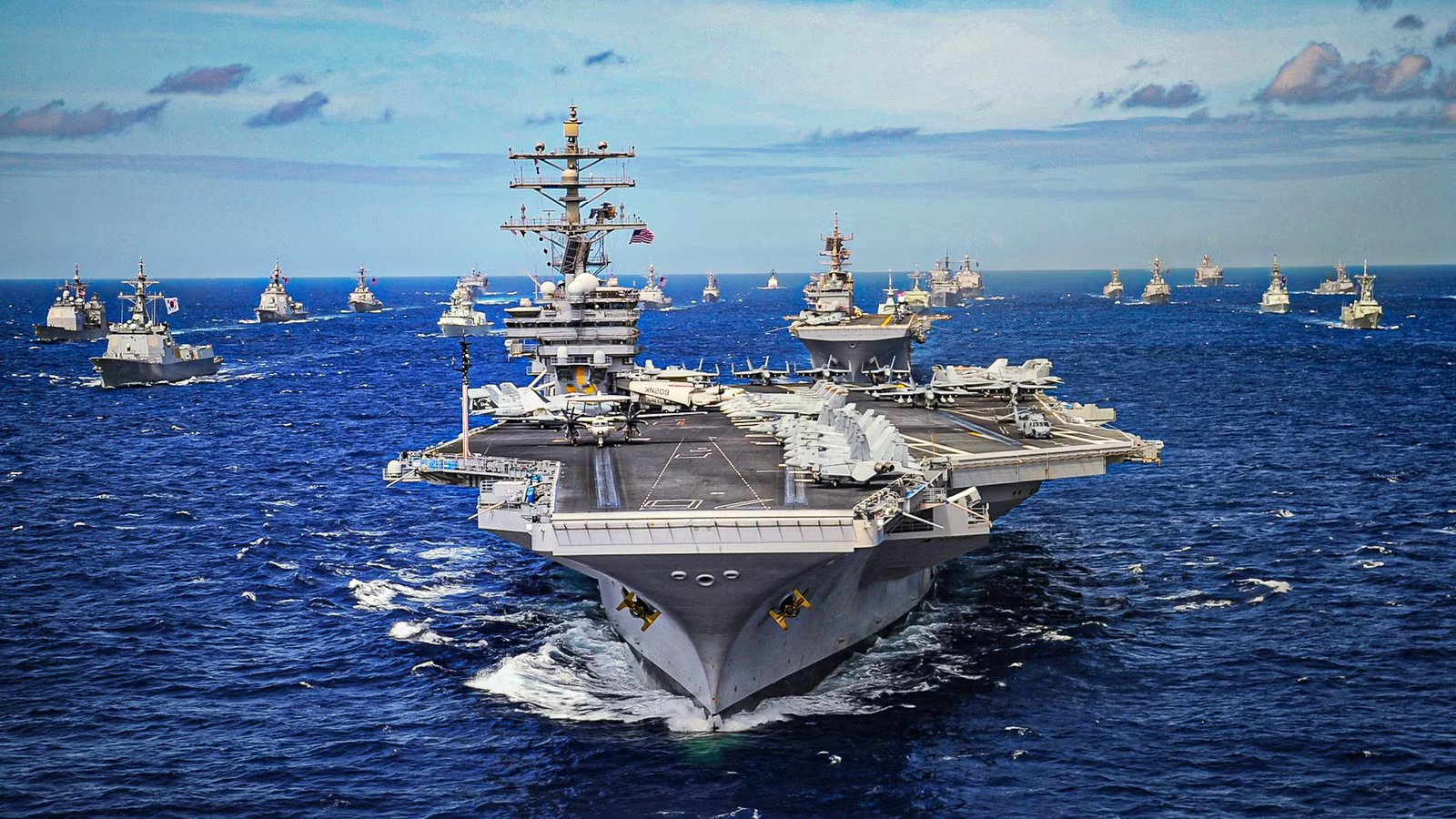
As of 2026, the United States Navy operates 11 active nuclear-powered supercarriers, more than all other nations combined. While the US remains the undisputed leader, other nations are expanding their capabilities. France is the only other country with a nuclear-powered carrier, but the People’s Liberation Army Navy of China now has three conventional ships, powered by diesel. The Indian Navy has two supercarriers, like the US and China.
Of these, one was originally bought from Russia and the other was made domestically. Light carriers with ski jumps or helicopter carriers with Vertical/Short Take-Off and Landing jets have become more powerful than ever, thanks to the Lockheed Martin F-35B stealth ‘jump jet.’ The United Kingdom’s Royal Navy has two Queen Elizabeth-class ships, and Italy also has two ships in a similar class to the UK, which now carry these fifth-generation jets.
The US has been developing and operating carriers for 100 years, which has sustained a level of expertise in complex carrier aviation that emerging powers are still struggling to replicate, and even close allies can’t come close to. However, in the 21st century, massive supercarriers are increasingly seen as strategic liabilities, as much as they are valued as capital ships, under the threat of new weapons like drones and advanced hypersonic missiles.
The US Navy By The Numbers: Quality & Quantity

The US Navy fleet is backed by unmatched technological sophistication, decades of operational experience, and a massive support ecosystem of strike groups and global logistics. Each US supercarrier displaces over 100,000 tonnes and can carry 75+ aircraft, including fighter jets, electronic warfare planes, and helicopters. The total tonnage of the US Navy is over 8.2 million tons, which far exceeds China’s 3.1 million tons.
A single Ford-class carrier can launch up to 160 combat sorties per day, delivering more firepower in 24 hours than many entire national air forces can manage in a week. All 11 US carriers are nuclear-powered, providing essentially unlimited range and the ability to operate at high speeds (over 30 knots) for decades without refueling. The US Nimitz-class is beginning to age, so the USS Nimitz is scheduled for decommissioning in May 2026 to be replaced one-for-one by the Gerald R. Ford-class.
Smaller, more versatile vessels allow middle-tier powers to project significant air power without the $13 billion price tag of a supercarrier. The US Navy also operates nine amphibious assault ships of the Wasp and America classes. The America-class is often called a ‘Lightning Carrier’ because it can carry up to 20 F-35Bs, rivaling the strike power of other nations’ full-sized carriers.
The Big Deck Advantage

While ‘the boat,’ as American sailors jokingly refer to supercarriers, will always have a greater capacity to support our operations than amphibious helicopter carriers and light carriers, these ships offer a number of their own strengths. Referred to in the US Navy as ‘big decks,’ the complement of aircraft aboard these ships that uses VSTOL has become a more capable force than ever before, with the advanced technology of the F-35B.
The United States and its allies are the primary operators of aircraft carriers around the world, and the majority of its light carriers have either been retrofitted to support the F-35B or are being made specifically with the purpose of deploying it to sea. These jets have a limited range by comparison to their counterparts aboard a supercarrier, the F-35C, and the smaller aircraft carriers can only carry a fraction of the total airframes by comparison; however, they require far less investment to construct and operate.
|
Rank |
Country |
Number of Aircraft Carriers |
Description |
|---|---|---|---|
|
1 |
United States |
11 |
All nuclear-powered at 100,000+ tons each. |
|
2 |
China |
3 |
Rapidly expanding with future electromagnetic catapults. |
|
3 |
United Kingdom |
2 |
Optimized for F-35B Lightning II. |
|
3 |
Italy |
2 |
Light carriers using STOVL aircraft. |
|
3 |
India |
2 |
Includes India’s first indigenously built carrier. |
|
4 |
France |
1 |
The only non-US nuclear-powered carrier is currently in service. |
|
4 |
Russia |
1 |
Admiral Kuznetsov has faced frequent operational issues. |
|
4 |
Spain |
1 |
A versatile vessel with a ski-jump acting as a light carrier. |
The table above shows a comparison between world naval aviation powers, and illustrates the gap between the biggest navies and the similarity of the other forces around the globe. Third place and fourth place both have a three-way tie between multiple navies with just one or two carriers. Fleet statistics are supported by the World Database of Modern Military Warships.
VSTOL-optimized carriers do not require expensive and maintenance-heavy steam or electromagnetic catapults or arresting wires. These ships require significantly fewer personnel to operate the flight deck since they lack complex launch and recovery machinery. Because many allies use the same F-35B, they can land and refuel on each other’s ships, creating a massive, distributed coalition fleet, which has already been demonstrated in joint operations in the Pacific between the UK, Japan, and the US.

F-35B, MV-22B Osprey & CH-53E Super Stallion: The USS America’s Flight Operations In The Philippine Sea
The USS America sets sail to the Philippine Sea, supporting freedom of the seas and displaying the awesome air power of the US Navy big decks.
Naval Aviation: The Pointy End Of The Spear

Unsurprisingly, the Carrier Air Wing aboard a US Navy Nimitz or Ford-class supercarrier is more than just a specialized task force. The Air Wing aboard a single carrier is larger than many of the air forces of nations around the world. Each of these colossal warships contains its own fully functional air force and airfield that can be moved anywhere in the world over the high seas.
The Carrier Air Wing has full mission depth that is uncompromising and capable of accomplishing virtually any assignment that a land-based squadron of the United States Air Force could achieve. It is true that most of the aircraft designed for operations from a ship have engineering compromises that make them lower-performing than their land-based counterparts. However, the value of having their home field be parked off the coast of the target more than makes up for this trade-off.
The performance gap between land-based and shipborne platforms is also narrowing, largely thanks to the fifth-generation F-35 family of stealth fighters and its three variants, which are becoming the standardized platform for both the US and its allies. The Boeing F/A-18 Super Hornet introduced a host of automation and new technology that not only made landing and taking off from the ship more efficient and safer but also improved mission effectiveness.

The World’s Most Superior Carrier-Based Aircraft
Engineering excellence and modern technology meld in the world’s best fighters found on the decks of aircraft carriers around the world.
The Hummer: Eye In The Sky

Nicknamed the ‘Hummer,’ one overlooked yet very important aircraft in the Carrier Air Wing is the turboprop Airborne Early Warning platform known as the Grumman E-2 Hawkeye. The latest iteration, the E-2D, can take off and become a flying radar post with advanced capabilities that rival those of the extremely cost-prohibitive  Boeing E-7 Wedgetail next-gen AWACS. The US Navy’s VAW squadrons that fly the new E-2D and older E-2C make a critical contribution to the carrier air wing.
Each plane can track hundreds of targets from over 300 miles away, coordinating the entire battle by supporting air, sea, and even land units of the carrier strike group and other joint forces. Before the F-35 was introduced, the E-2D was the most expensive platform ever deployed on a ship and was actually funded by the Navy’s air and surface communities because its incredibly powerful radar increases the combat effectiveness of the entire fleet.
A Joint Forces Coalition Fleet can rely on the American E-2, but light carriers or helicopter carriers operating independently cannot benefit from its radar. Sailing independently means either solely using ship-based radar or relying on land-based assets to enhance their coverage. Some smaller carriers have AEW platforms with helicopters, but these have significantly shorter range, lower altitude ceilings, and much shorter on-station time, leaving the fleet more vulnerable to long-range missile attacks.
The E-2D Hawkeye is actually so impressive and so much less expensive than the E-7 that it has become popular with US partner air forces. The USAF is even considering purchasing a batch as a stopgap while the E-3 Sentry is retired, but it will not be able to acquire the E-7 immediately due to budget constraints.

5 Fast Facts On The US Navy’s Airborne Command & Control Squadrons
The carrier air wing embarked on US Navy aircraft carriers uses a highly specialized surveillance plane to dominate battlespace and project power from
The Rising Contender To America’s Navy

The Chinese Navy is increasingly moving away from a coastal defense force to a deep-water, global naval branch, also known as a ‘blue water Navy.’ Chinese carriers are increasingly deploying further into the Western Pacific and near Japan to signal an ability to contest American access. This aims to keep US carriers at a distance through Anti-Access/Area Denial strategies.
The primary focus of this expansion is on the three aircraft carriers that represent iterative improvements, but the most recently commissioned is the Fujian (Type 003). The Pentagon reports that China plans to build a total of nine aircraft carriers by 2035. A fourth carrier (Type 004), suspected of being nuclear-powered, is currently under construction in Dalian. The Chinese Navy is expected to begin regular carrier rotations through the Indian Ocean to secure trade routes and challenge regional powers like India.
Although these ships do not equal America’s nuclear-powered aircraft carriers, they are expected to gain the Shenyang J-35 stealth fighter in the near future, which would make their air wing much more threatening than ever before. As of February 2026, the Fujian has successfully begun launching and recovering combat aircraft using its electromagnetic catapults. This technology allows it to launch heavier, more capable jets like the KJ-600 airborne early warning plane and the J-35 stealth fighter.