dailynewsnblog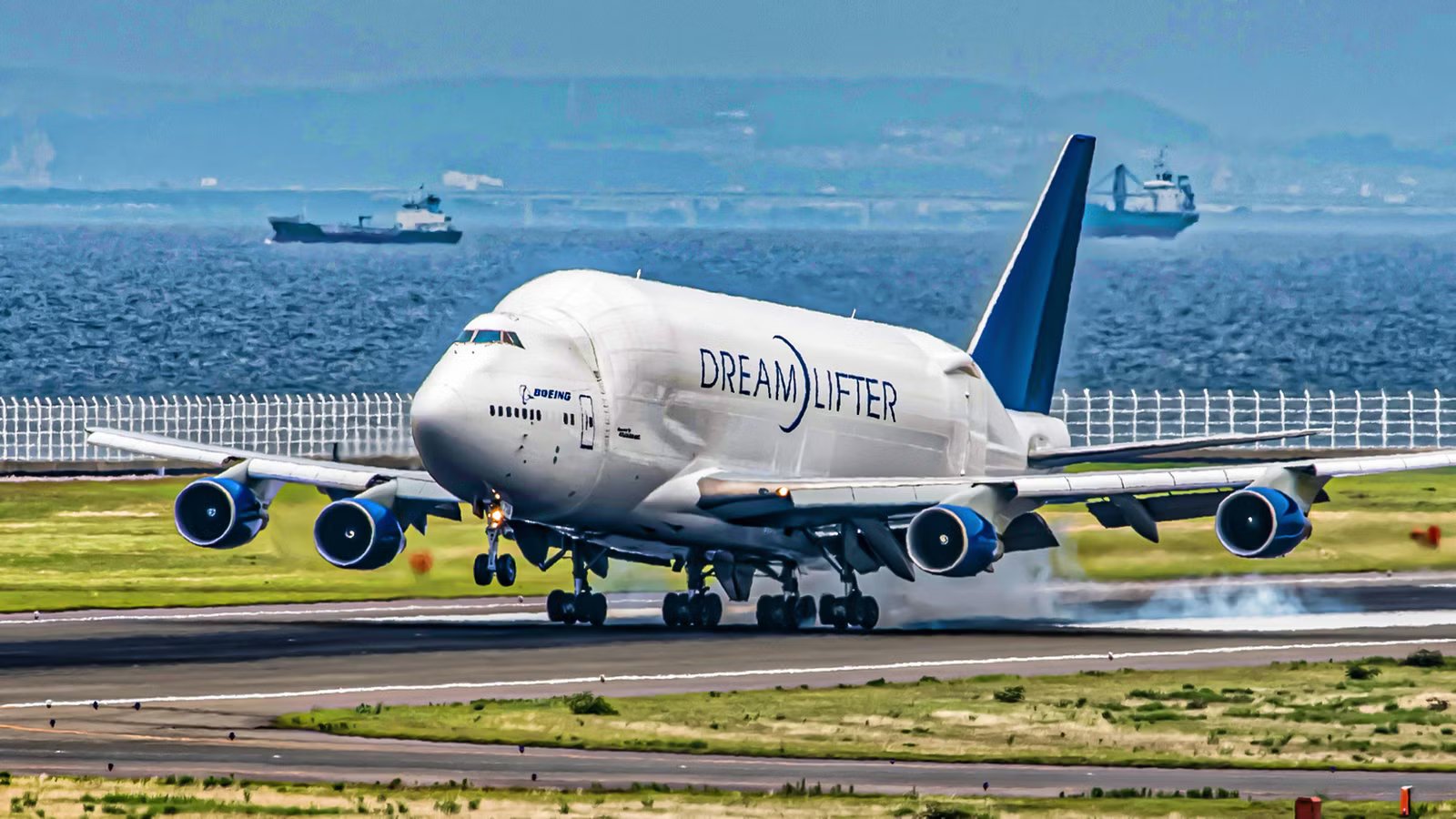
The  Boeing Dreamlifter is one of those aircraft that looks like it belongs in a science fiction movie, and, for years, it quietly did a very unglamorous but mission-critical job. The aircraft had the task of hauling huge Boeing 787 components across oceans on tight production schedules. Officially known as the Boeing 747-400 Large Cargo Freighter (LCF), the Boeing 747 Dreamlifter is a heavily modified 747 airframe that features an outsized, swing-tilt fuselage designed to swallow cargo that will not fit anywhere else. The jet can carry full sections of a widebody jet, not pallets of boxes.
Only four such Dreamlifters were ever built, which makes their movements usually consequential. When any one of them is in maintenance, delayed by weather, or repositioned to cover another aircraft, it can ripple through Boeing’s logistics network. While their original purpose was to keep the global Boeing 787 supply chain moving between major supplier hubs and final-assembly sites, their day-to-day flying today reflects a mix of production needs, inventory balancing, and occasional special missions. We will map where Dreamlifters most commonly show up, why those routes make sense, and what their patterns actually reveal about the current rhythm of Boeing’s widebody ecosystem. Unlike Airbus, which elected to put together next-generation outsized transport, Boeing has elected to continue relying on its older-generation fleet of outsized transports.
A Brief Overview Of The Boeing Dreamlifter

The Boeing Dreamlifter, a project which was originally conceived as the 747-400 Large Cargo Freighter (LCF), is a heavily modified 747-400 built to move outsized 787 Dreamliner parts quickly between global supplier sites and the manufacturer’s assembly plants. Boeing has an incredibly diverse US factory footprint, but there are some significant limitations to this kind of system that pose operational challenges. When there are large pieces that need to be moved from place to place, a manufacturer like Boeing will have to look into new kinds of solutions.
The aircraft itself is very unique. It is instantly recognizable thanks to its dramatically enlarged fuselage, giving it a bulged upper body far wider than that of a standard Boeing 747. Boeing created the type in the mid-2000s because it believed that it would significantly replace slower ocean shipping and help keep the 787 Dreamliner program’s far-flung supply chain intact. Even more challenging is making sure that the production schedule (the extensive subject of analyst scrutiny) remains on-track.
Only four Dreamlifters were converted, all from used Boeing 747-400 passenger airframes. Their key feature is a swing-tail design, with the entire rear fuselage pivoting open to allow oversized sections, such as complete fuselage barrels or wings. This allowed for specialized equipment of all kinds to be comfortably loaded. While it is not capable of carrying the heaviest payloads compared to some dedicated cargo jets, the Dreamlifter is optimized for volume, not raw weight, making it perfect for large, lightweight aircraft structures. Operated for Boeing by Atlas Air, the Dreamlifter remains a niche but vital asset, linking production nodes and enabling rapid repositioning of major components when manufacturing plans happen to shift.
Anchorage Is A Key Transfer Point

It is now time to begin digging deeper into the schedules of how Boeing actually uses this specific aircraft. Across flight histories for its four-aircraft fleet, it appears that Ted Stevens International Airport (ANC) in Anchorage shows up as the Dreamlifter network’s pivot point for Pacific flying. Multiple airframes run the same ladder, including services from Charleston International Airport (CHS) to Anchorage Airport, before heading on to Nagoya Airport (NGO) and back again.
Airframe N747BC, for example, operates flights from CHS-ANC, which are around 7-8 hours in length, and then ANC-NGO, which are roughly 6-7 hours in length, before retracing the entire route. N249BA does the same pairing, and another airframe even links Everette Paine Field (PAE) directly to NGO when the flow needs to bypass Charleston International. The routing makes a lot of operational sense for the carrier. Anchorage breaks the transpacific mission into manageable stages, provides robust cargo handling and diversion options, and lets Boeing or the aircraft’s operator, Atlas Air, keep schedules resilient even when winds, payload, or crew duty times get very tight.
You can thus see that flexibility in the data, ultimately including an ANC diversion recorded on one of the ANC-NGO routes. The result is thus a system that behaves less like four unique aircraft and more like a single four-unit pipeline. When parts need to move between Japan’s Boeing 787 supply base and major US production notes, the Dreamlifters slot into a repeatable rhythm that can be sped up, slowed down, or resequenced depending on demand. It is a hub-and-spoke model built around reliability and not glamour.

All The Boeing 747 Freighter Variants: The Ultimate Guide
The Boeing 747 has been a crucial part of global cargo transport for decades.
Charleston Is Also A Major Network Link

If Anchorage is the network’s long-haul connecting point, Charleston (CHS) is the day-to-day center of Boeing’s Dreamlifter operations. In flight logs analyzed by Simple Flying using data from FlightRadar24, CHS repeatedly appears as the collection and distribution point where oversized sections arrive, get staged, and then are pushed onward as production needs change. The most obvious examples include tight, high-frequency shuttles between Charleston and Wichita Airport (IAB).
Airframe N747BC has been observed flying routes to Charleston in just 2-2.5 hours, and airframe N249BA repeats that same loop multiple times across late February and early March. That kind of cadence looks less like occasional heavy airlift and more like scheduled line-haul trucking with a swing-tail Boeing 747. One can also see that CHS is a connector between domestic nodes and international legs, with aircraft coming into CHS from Anchorage late in the day, then repositioning to IAB the next morning, effectively handing off cargo flows from the Pacific to the US interior.
Everett appears as another frequent network spoke, with one airframe running CHS-PAE routes and then PAE-IAB, suggesting that the fleet is used to balance parts between sites rather than serving a single fixed route. The key takeaway is that these jets are employed for tempo and flexibility, ultimately keeping the outsized supply chain moving in hours, not weeks. This is true even when the plan may change overnight.
Long-Haul Flights To Europe

What jumps out immediately from extensive analysis of Boeing Dreamlifter schedules is the recurring Charleston-Taranto (TAR) route pairing, an intercontinental hop of around 9-11 hours in each direction. N718BA operates between CHS and Taranto and in the reverse direction multiple times within the span of any individual week. Airframe N249BA shows similar TAR-CHS routes followed immediately by domestic and Pacific repositioning.
This provides a strong clue that Dreamlifters are not only using a single Japan to US pipeline but that they are also dispatched to Europe when a specific stream of oversized components needs to be accelerated or carefully re-timed. Just as important, not every airframe in the sample is doing TAR work at the same moment. Instead, the fleet appears interchangeable, with one jet on the Italy shuttle while another focuses on NGO through ANC, and a third bounces between CHS, PAE, and IAB to keep US flows synchronized.
With only four kinds of jets in active service, that kind of modularity really matters as Boeing and Atlas can swap which tail numbers cover which routes without rewriting the entire operational network. In practice, the Dreamlifter system behaves like a small, high-priority logistics task force, constantly re-allocating capacity across Italy, Japan, and US nodes in order to match whatever the factory needs next. The route map looks repetitive, but it is engineered for overall recovery.

The Aircraft Replacing The Boeing 777-200
A closer look at why the 787-9 is such a compelling replacement for the 777-200, unlike the 777X.
What Does The Future Hold For The Program?

Equipped with just four airframes and a job tailored to the Boeing 787’s global supply chain, the Dreamlifter’s future is less about growth and more about how long Boeing will need the aircraft for. In the near term, the jet stays relevant as long as major Boeing 787 structures are built far from final assembly lines and Boeing wants the option to correct schedule slips quickly by flying and not shipping.
Over time, however, the fleet’s age and uniqueness become the constraint, as maintenance intensity rises and parts support gets significantly harder, and there is no off-the-shelf replacement with the same swing-tail, volume-oriented capabilities. If Boeing continues simplifying its production logistics with more local sourcing and fewer last-minute transfers, the Dreamlifter could gradually shift its role.
The jet may eventually be used for more occasional, surge-style missions rather than constant shuttling. The most plausible endgame is a phased drawdown tied to Boeing 787 rate decisions and supply-chain redesign efforts, with the aircraft retained as strategic insurance until the economics can no longer justify it.
What Is Our Bottom Line?

The Boeing Dreamlifter is an incredibly unique, one-of-a-kind product, one that offers exceptional transport capabilities to one specific operator. Boeing needs an aircraft capable of transporting large, oversized aircraft components between its many hubs, something that has historically been a challenge for the manufacturer.
Shipping by land or sea can be both slow and expensive, especially if done on a one-off contractual basis. This has encouraged the manufacturer to operate in an incredibly unique way. Boeing’s operations of the type highlight exactly what it is designed to be used for, as it is consistently ferried between different facilities.
The aircraft appears to be limited only in some capacity by its range. This makes it an incredibly unique jet, especially as pretty much anything else ever built on a Boeing 747 airframe has never been limited by range. The aircraft will undoubtedly remain in service until the manufacturer no longer has a use for it.