dailynewsnblog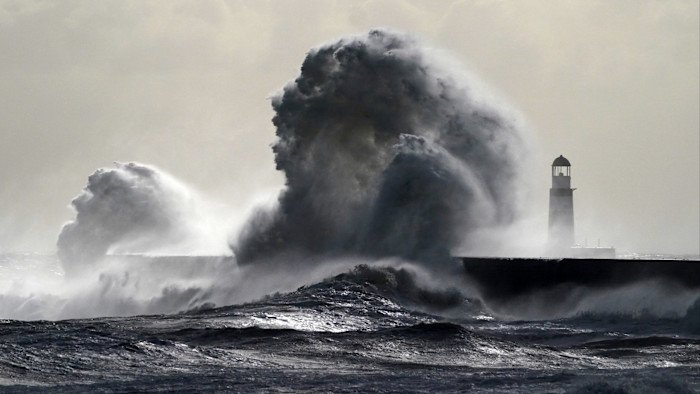
Stay informed with free updates
Simply sign up to the Global Economy myFT Digest — delivered directly to your inbox.
The writer, an FT contributing editor, is a former chief economist at the Bank of England
What happens when two waves collide, disorder meets disorder, uncertainty touches uncertainty? This question has long occupied oceanographers and complexity scientists. But it is now occupying economists and finance professionals too, as they assess the effects of two waves, of unknown size and velocity, simultaneously crashing over them.
The first wave is geopolitical — the rupture in the global rules-based order. Or, more accurately, the transition from order to disorder in everything from global trade to global security. Without those rules the world’s laws of motion are more quantum than Newtonian, intrinsically and radically uncertain.
That uncertainty is a plague on all our houses. For businesses, it means a costly rewiring of global trading and financial systems; for governments, a rethinking of defence spending and a refashioning of security alliances; for citizens, threats to their public goods including the independence of central banks, courts and parliaments. Each carries an economic and fiscal cost that, given low growth and high public debt, we can ill-afford.
This uncertainty is also recontouring financial markets as investors seek sanctuary. Tellingly, they are doing so not by moves into “safe” government assets but into precious metals — prices have doubled over the past two years at the same time as those of many longer-maturity government securities have fallen. Geopolitical risk means it is in gold, not government, we now trust.
Yet this tells only half the story. The fattening of the lower tail due to heightened geopolitical threat has coincided with a fattening of the upper tail due to a rising wave of technological opportunity. This has been powered by the potential of AI and the prospect of quantum computing.
This technology wave has already generated a feeding frenzy of investment into risky assets, both real (about $1tn has poured into AI infrastructure each year over the past two years) and financial (the prices of some technology stocks more than doubled over the same period).
That has in turn driven a mini-boom in growth in the US, the centre of AI invention, which has averaged around 3 per cent recently, bucking global trends. Moreover, buoyant demand has occurred despite weakening employment prospects, implying US growth has been underpinned by productivity gains. This may be the first harvest of the fourth industrial revolution.
The turbulence generated by these twin waves gives the outward appearance of chaos. But today’s state is better described as “kurtotic” — a statistical term for distributions with fat upper and lower tails — than chaotic. The twin waves mean the world increasingly resembles a barbell, with greater weight at its extremities, rather than a bell curve. This has important implications for economies and financial markets.
Even small differences in the balance of weight can generate very different outcomes. We see that in wide growth disparities between countries — compare the tech-centred US and tech-peripheral western Europe. And we see it too in growth disparities within countries — the K-shaped pattern of recent US growth reflects the contrasting economic fortunes of the tech-exposed rich and the tariff-exposed poor households.
Barbell behaviour is clearly visible in financial markets as well. The combined effects of the twin waves have been to cause high, rising and volatile prices at either end of the risk spectrum: in ultra-safe precious metals but also in ultra-speculative crypto and technology stocks. These are the gold and fool’s gold of today’s barbell portfolios.
Even small shifts in the probabilities of either tail can unbalance the barbell and cause outsized responses: “excess sensitivity” in asset prices in response to small shifts in sentiment. The sharp fall in the prices of both precious metals and technology stock so far this year, in the face of little news about fundamentals, is evidence of that fragility.
Finally, if these geopolitical and technological waves collide, should we expect chaos or calm? Oceanographers and complexity scientists have long wrestled with this question. The short answer is: it depends. If a rapidly retreating wave coincides with a forceful incoming one, the effect is to neutralise their collective force, not compound it. Disorder meeting disorder then generates calm and resilience.
That was the story of last year, whose economic and financial resilience surprised many. The shock and awe of geopolitical risk and tariffs in the first quarter caused a rapid retreat in risk appetite and growth forecasts. But these forces were then neutralised by the incoming AI wave, leaving asset prices and growth prospects higher overall. In 2025, the barbell balanced. A kurtotic world was self-stabilising and resilient.
Alas, that happy coincidence cannot be guaranteed in future. If two waves collide at their crests, their forces are compounded. This is a recipe for chaos not calm, fragility not resilience. It is an oceanographer’s perfect storm. Were an extreme risk to materialise — such as war, real or trade-related — that swept innovation off course, geopolitical and technological systems would become coupled. A kurtotic world could quickly turn chaotic. Economies and financial markets would then join oceanographers in being all at sea.