dailynewsnblog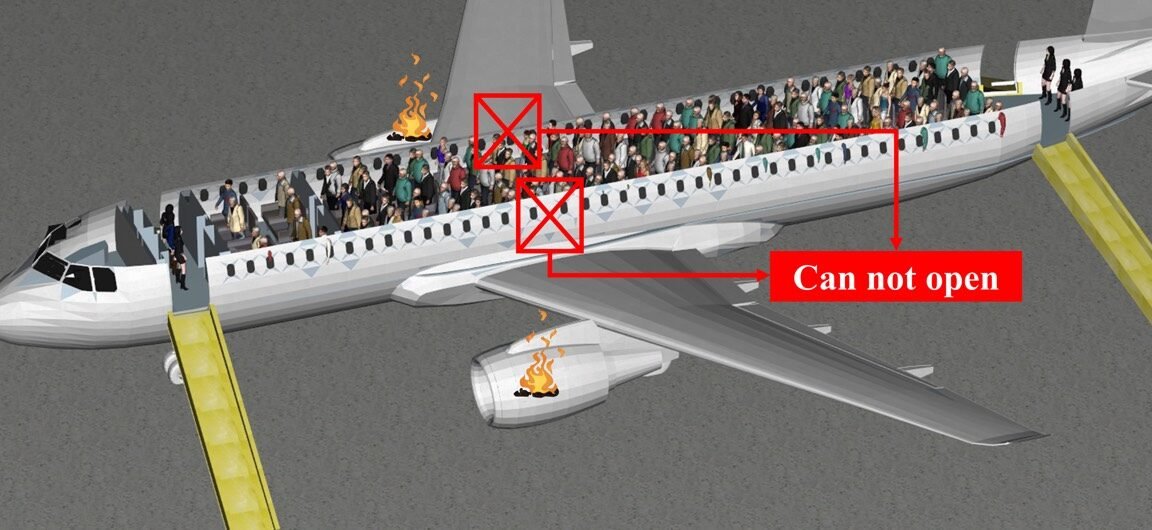
“While a dual-engine fire scenario is statistically rare, it falls under the broader category of dual-engine failures and critical emergencies in aviation. History has shown that dual-engine failures and emergencies, such as the famous ‘Miracle on the Hudson’ involving Captain Sullenberger, can happen and lead to severe consequences,” said co-author Chenyang (Luca) Zhang of the University of Calgary in Canada. “Our study focuses on these low-probability but high-impact events to ensure the highest safety standards.”
Zhang et al. created two passenger categories: elderly adults age 60 and older and those younger than 60 years. They modeled three different ratios of those two categories—youth-dominated, evenly balanced, and elderly dominated evacuation scenarios—to capture more realistic travel dynamics and exclude edge cases (e.g., all non-elderly or all-elderly scenarios). For each of those, the model looked at three distinct seating patterns: one where elderly passengers are evenly distributed in areas near the exits; one where the elderly were concentrated in the middle of the cabin, away from the exits; and one where elderly passengers were randomly distributed throughout the cabin.
None of the tested conditions resulted in evacuation times within the FAA-mandated 90 seconds. The shortest evacuation time—20 percent elderly passengers evenly distributed near the exits—was 141 seconds. The longest—involving 80 percent elderly passengers and the same near-exit seating distribution—was 218.5 seconds.
Zhang et al. acknowledge that their study has some limitations. For instance, not all elderly passengers are the same, and their models did not incorporate the need for crew assistance for decreased mobility or similar issues. And because they focused on just the dual-engine fire scenario, their findings might not be generalizable to other evacuation scenarios.
The authors suggest future simulations could be more accurate with the addition of empirical data from real aircraft environments under controlled conditions. Future research should also test the effectiveness of different behavioral interventions, such as providing extra safety briefings tailored to elderly passengers. Airbus and other aircraft manufacturers might also consider redesigning cabins with designated seating areas for elderly passengers, giving them easier access to exits, better visibility, wider aisles, or perhaps armrests to assist with mobility.
AIP Advances, 2026. DOI: 10.1063/5.0310405 (About DOIs).