dailynewsnblog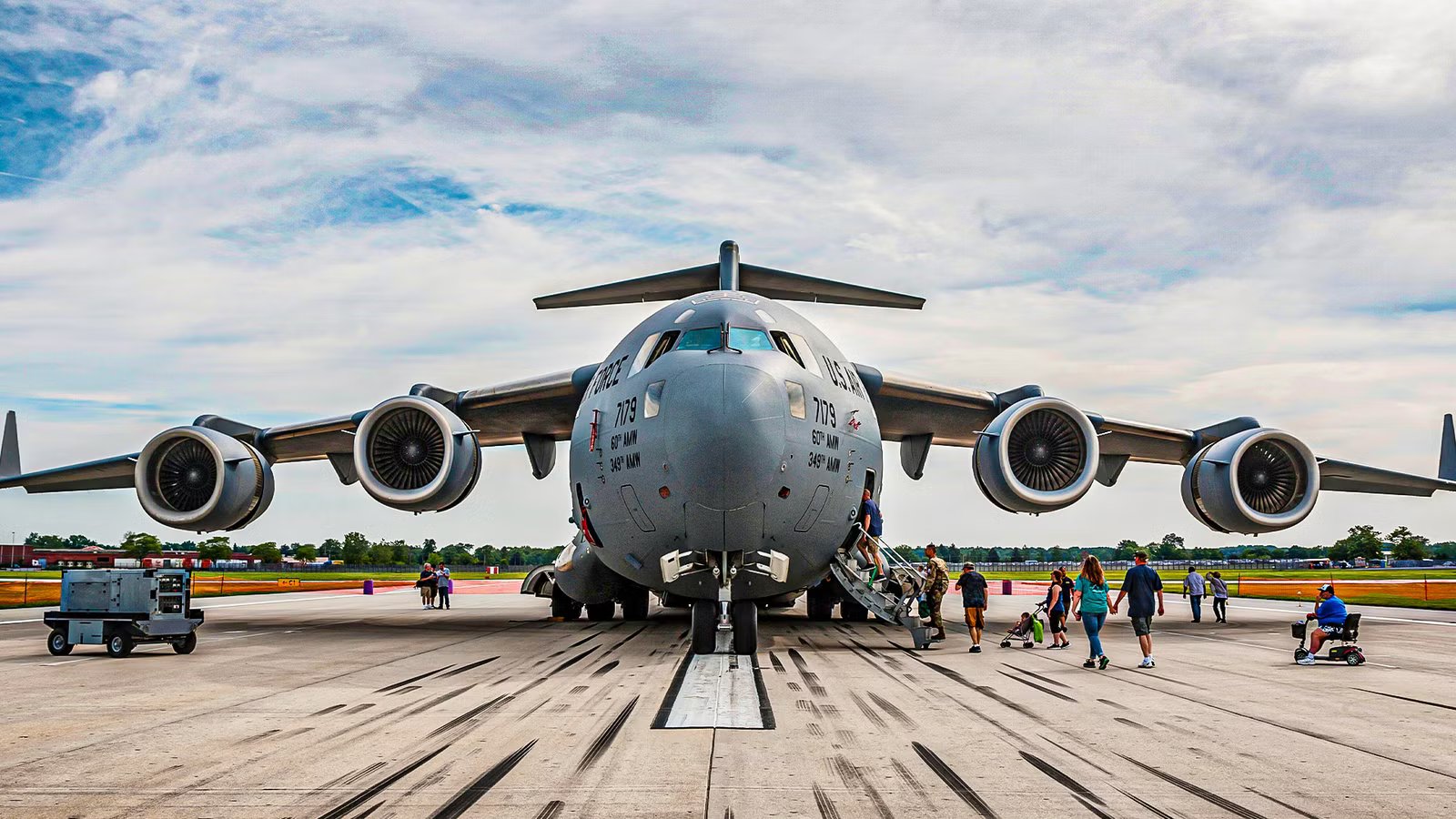
Unlike the finished cabins of airliners, a military transport interior is a blank canvas of exposed tubing, wiring, and air-conditioning ducts. Specifically, flying in a C-17 Globemaster III is a stark contrast to commercial air travel, characterized by a cavernous interior, significant noise levels, and non-traditional seating. Often described as a workhorse, the passenger experience of crossing the ocean prioritizes utility over comfort.
Despite its size, the United States Air Force C-17 is known for relatively smooth flight and rocket ship takeoffs when lightly loaded. The interior is extremely loud. Crew members typically hand out foam earplugs upon boarding, and passengers often wear noise-canceling headphones to cope with the engine and wind noise. Preparing for a flight on the C-17 is more like going on a mission than riding public transportation.
Air Force Express: All Go, No ‘Show’

It is true that the McDonnell Douglas (now Boeing) C-17 Globemaster III shares the same engines as a Boeing 757 airliner; however, that is the only thing it has in common. Those engines are maxed out for higher performance through a variety of modifications that make them capable of extremely impressive tactical maneuvers. In order to empower the C-17 to achieve the highest capability on the battlefield, there is no room left for luxuries in the back of the jet.
Most passengers sit in fold-up seats along the sides of the aircraft with their backs against the wall. These seats can feel unusual during takeoff and landing. There are very few windows, typically restricted to small portholes at the front and back of the cargo area. Instead of a pressurized jet bridge, passengers often exit via a metal ladder or the large rear cargo ramp directly onto the airfield.
For larger troop movements, additional rows of palletized, forward-facing seats can be installed in the center of the cargo hold. On long flights with light cargo loads, passengers sometimes stretch out on the floor. While some units once allowed hammocks to be hung from the internal structure, many have since banned them. Large pallets of cargo, vehicles, or even tanks often occupy the center of the cabin, sometimes blocking the passengers’ view on the opposite side.
The cabin temperature can be inconsistent. It is often cold in the rear but warmer in the middle. To stay comfortable, passengers are frequently advised to pack warm clothes or bring a sleeping bag. There is usually only one private bathroom at the front of the aircraft. In-flight service generally consists of a pre-purchased sack lunch or ‘boxed nasty’ rather than airline meals.
Routine Ops On Uncle Sam’s Airways

A routine transoceanic or transcontinental flight on a C-17 is a rugged, self-sufficient experience where passengers are responsible for their own comfort. Unlike commercial travel, there are no flight attendants, in-flight entertainment, or meal services. Unlike on a 757, the roaring Pratt & Whitney F117 engines make conversation nearly impossible without shouting. Noise-canceling headphones or high-grade earplugs are considered essential for the 8–12 hour duration.
Once at cruising altitude and the seatbelt sign is off, it is standard practice for passengers to leave their sidewall seats and sleep on the cargo floor. Because the metal floor is hard and cold, most regular flyers bring thin inflatable camping mats or yoga pads. The C-17, at least, has a full-sized airline-style lavatory at the front, which is a major upgrade over the chemical toilets found on older transport planes like the C-130.
Some C-17s have a limited number of 110V outlets located mid-cabin. Bringing a power strip is a common pro tip for sharing power with other passengers. Passengers must bring all their own food and drinks. While some crews may allow the use of a small microwave, most advise bringing cold snacks. Large Igloo water dispensers are typically available, but troops and other passengers must bring their own refillable bottles.
C-17 Customers: Every Service Branch And Then Some

On routine long-haul missions, a C-17 is configured for high passenger capacity, using palletized seat rows in the center of the cargo bay. The passengers are typically military members, their families, or government contractors moving between major global air bases like Yokota in Japan or Ramstein in Germany.
Entire units of up to 130 personnel fly this way during rotations to or from deployments overseas. Palletized seating is used when they aren’t carrying heavy equipment that would otherwise occupy the floor. Family dependents accompanying active duty service members moving to a new long-term assignment are on these passenger-heavy flights.
The C-17 is the primary vehicle for moving heavy mechanized firepower of the Army and Marines, including M1 Abrams tanks, M2 Bradley fighting vehicles, and Strykers. It also performs large-scale airdrops of Army paratroopers, such as the 173rd Airborne Brigade. The US Navy relies on C-17s for troop transport and specialized missions as well. So does NASA and even the McMurdo research Station in Antarctica.
A C-17 always accompanies the President on long-distance trips to transport the Presidential Limousine, Marine One helicopters, and security detachments. There are eight other nations that operate the C-17 for a wide variety of other missions as well.
On some occasions, off-duty military members or retirees can ride along in an empty seat, so long as the cargo is not classified, through what is known as Space-A travel. On a low cargo flight, the Air Force may release dozens of seats for Space-A travelers if the mission’s primary requirements are met. Even on these flights, the aircraft will often carry at least one baggage pallet.

How Military Cargo Planes Avoid Threat Zones During Deployments
The tactics of frontline delivery.
Air Mobility Command: US Airlift Hubs

The busiest hubs for C-17 high-capacity passenger missions are the primary Air Mobility Command bases that serve as strategic gateways to Europe, the Pacific, and the Middle East. On the West Coast is Travis Air Force Base, known as the gateway to the Pacific for handling thousands of flights a year outbound from California. Joint Base Charleston in South Carolina is a major East Coast hub that supports both troop movements and humanitarian aid.
Dover Air Force Base in Delaware, closer to Washington DC, is a major support hub for the US Armed Forces as well as presidential mission activities like Charleston. Joint Base McGuire-Dix Lakehurst in New Jersey is a similar site that serves as a jumping-off point for missions to Europe and the Middle East. Finally, we have Joint Base Lewis-McChord in Washington State, which is a major center for flights crossing the Northern Pacific and heading to the Arctic.
The air bases most frequently on itineraries overseas include Ramstein Air Base in Germany, which is the single largest US military installation on international soil. There is also Joint Base Pearl Harbor Hickam in Hawaii and Yokota Air Base in Japan, which is one of the most important hubs in the Pacific Theater. Additionally, Al Udeid Air Base in Qatar handles high volumes of troops and cargo, serving as the Central Command hub for US forces in the Middle East.

Why This NATO Air Base Is Considered Europe’s Most Strategic
The strongest link in NATO’s chain of air stations.

In extreme emergency situations like the August 2021 evacuation from Kabul, the C-17 shifts from its standard seating to a method called floor loading. On August 15, 2021, a single C-17 (call sign Reach 871) set an all-time record by evacuating 823 passengers in one flight. This practice involves removing all traditional seat pallets to create an open floor space where passengers sit shoulder-to-shoulder.
The record load included 640 adults and 183 children, many of whom sat on their parents’ laps. The aircraft was not originally intended to carry this many people. However, as panicked evacuees pulled themselves onto the half-open cargo ramp, the crew made the tactical decision to depart rather than force them off. For the record-breaking Kabul flight, pilots opted for a lighter fuel load to stay within maximum takeoff weight limits.
Flying with over 800 passengers presents massive technical challenges. Loadmasters must meticulously calculate the center of gravity to ensure the plane remains flyable. The primary risk in these overloaded scenarios is injury from severe turbulence or hard landings. To secure such a large, unrestrained group, loadmasters used standard cargo tie-down straps run across the floor over passengers’ legs to act as a collective seatbelt.

How Many Drones Does The US Department Of Defense Operate?
The rapidly growing fleet of unmanned aircraft.
Getting Down To Business: Tactical Arrival On A C-17

When a C-17 is reconfigured from strategic cargo and passenger hauling to a tactical delivery mission set, the internal layout as well as the flight profile significantly change. While standard passenger flights use comfortable palletized seating, in many tactical scenarios, only the 54 permanent sidewall seats are used. This keeps the entire center floor clear for a roll-on/roll-off (RO-RO) flow of troops or small tactical vehicles that need to exit instantly upon landing. Troops in bulky body armor with weapons and ‘rucks’ take up much more space than ordinary travelers as well, reducing the shoulder room in the cargo.
For airdrop-capable missions, the plane is configured for 102 combat-equipped paratroopers. This requires specific hardware, like static lines and anchor cables, to be deployed along the ceiling of the cargo hold. Unlike commercial jets, the C-17’s landing gear and high-wing design allow it to land on unpaved surfaces like dirt, sand, or gravel airstrips commonly found at forward operating bases.
The C-17 can execute a maximum-rate descent using its unique in-flight thrust reversers and speed brakes. This allows the aircraft to drop from high altitudes to the runway very quickly, at rates sometimes exceeding 15,000 to 20,000 feet per minute, minimizing the time spent in the danger zone of anti-aircraft fire. The aircraft uses a propulsive lift system where engine exhaust is directed onto large, multi-slotted flaps. This allows it to fly steep approaches at very low speeds and land on runways as short as 3,500 feet (1,064 meters) and as narrow as 90 feet.